%20(3000%20x%20800%20px).avif)
LinkedIn now has 250 news editors recruited from Bloomberg, the Wall Street Journal, and Reuters. It operates a global editorial infrastructure that selects which practitioners appear alongside major news stories. Companies are using LinkedIn as a breaking news distribution layer instead of issuing press releases. Reporters are using LinkedIn to identify thought leaders to feature in their stories.
LinkedIn has become, by any reasonable definition, a media company with a social network attached to it rather than the other way around.
The Old Model No Longer Applies
Content marketing and public relations have always operated as separate disciplines because they were separate activities. Content was publishing. PR was pitching. The teams were different, the skills were different, and the KPIs were different.
On LinkedIn, those two functions have converged into a single activity because the content executives publish is what LinkedIn's editorial team evaluates for selection.
The post is the pitch. The body of work is the credential. The editorial placement is the earned media outcome.
Most comms leaders haven't reorganized around this. They're still running infrastructure designed for a media environment that no longer reflects how editorial selection, journalist sourcing, or buyer influence actually work on the platform where all three now happen.
What a LinkedIn-First Comms Leader Actually Looks Like
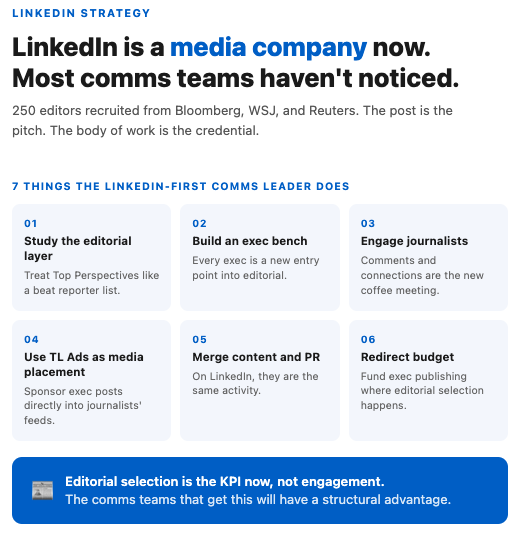
If you run a communications team and want to operate effectively on the platform where editorial selection, journalist sourcing, and buyer influence happen, here are the seven things that define the role.
1. You study LinkedIn's editorial layer like you used to study beat reporters.
Look at Top Perspectives for your industry. Note the topics, the angles, and who gets selected. Pay attention to which formats get picked up and which points of view get amplified versus ignored. Use that as the basis for your executive publishing cadence not your existing content calendar. The comms leaders who treat LinkedIn's editorial infrastructure with the same rigor they once applied to media lists will outperform the ones who treat it as a social channel.
2. You build a bench of executives, not just your CEO.
Each executive or subject matter expert publishing credibly on the platform is an additional entry point into LinkedIn's editorial layer, journalist sourcing, and audience reach. Your CFO has a perspective on capital allocation that matters to a different audience than your CTO's perspective on infrastructure. Your VP of People has credibility on workforce topics that your CEO does not. The comms leader in the LinkedIn era thinks in terms of a roster because each person publishing credibly represents an additional point of entry into the editorial system.
3. You treat executive engagement as relationship building with the media.
Have your executives send connection requests to journalists, podcast hosts, and LinkedIn's editorial staff. When these people are connected to your executives, content appears in their feed organically. Every post functions as a passive pitch without requiring outreach. Commenting on posts from journalists, editors, and industry voices builds name recognition with the people who control editorial selection and press coverage. This is the LinkedIn equivalent of the coffee meeting, the conference handshake, the "just wanted to put this on your radar" email and it needs to happen continuously, not just when there's something to promote.
4. You use Thought Leader Ads as a precision media placement tool.
When an executive publishes something with news value, sponsor it as a Thought Leader Ad targeted to journalists and editors in your vertical. It appears as organic content in their feed rather than a press release in their inbox. This is one of the most underused capabilities in B2B communications. You can put an executive's point of view directly in front of the people who write about your industry, in a format that looks and feels like something they discovered on their own. Most comms teams haven't connected these dots yet which means the ones that do will have a structural advantage for as long as that gap exists.
5. You merge content and PR into one function.
LinkedIn has made content marketing and PR the same activity. The content executives publish is what LinkedIn's editorial team evaluates for selection, there is no separate pitching step. If your content and comms teams operate separately, they are fragmenting a single workflow. The brief that informs an executive's LinkedIn post is the same brief that should inform your media strategy, because the post is the media strategy.
6. You redirect the budget toward executive publishing.
Press release distribution, media database subscriptions, and trade pub sponsorships should be evaluated against the cost of funding an executive publishing program on the platform where editorial selection actually happens. This doesn't mean those legacy channels are worthless. It means the ROI comparison has shifted and most comms budgets haven't shifted with it. The comms leader in the LinkedIn era knows where the returns have moved and reallocates accordingly.
7. You measure what actually matters now.
Track editorial selection as a KPI, not just engagement. Measure whether executives are being pulled into Top Perspectives, LinkedIn News features, and editorial roundups, that is the earned media outcome on this platform. Impressions and likes are secondary indicators, not the thing itself. And when editorial placement happens, repurpose it. Share it, reference it in future content, use it in sales materials. Each placement increases the likelihood of the next one, and the comms leader in the LinkedIn era builds a system around capturing and compounding those placements rather than treating them as isolated wins.
What It Looks Like When You Get This Right
The companies that understand what LinkedIn has become treat executive content as core infrastructure. When a major story breaks, LinkedIn's editorial team already knows who their executives are. Journalists find them on the platform and reach out directly. Target buyers encounter their thinking repeatedly before a sales conversation ever happens. And when there's something to announce, they have a real choice: go through traditional media, or post directly to an audience and an editorial infrastructure that will distribute it at platform scale.
The proof is already there. Duolingo shared an all-hands email directly to LinkedIn announcing their transition to AI-first. The Verge, Business Insider, and Tech Times all covered it afterward. Tinder's CEO announced a leadership change on her personal LinkedIn rather than through a press release and about an hour later, the incoming CEO responded publicly in the comments. Nasdaq President Tal Cohen announced the exchange's plans to move to 24-hour trading with no press release, no embargo, and no advance briefing. Nearly 60 media outlets covered the story. Bloomberg, Fast Company, and Reuters all cited his LinkedIn post as the primary source.
In each case, LinkedIn's editorial infrastructure was the route through which the story entered the broader media cycle. These are comms operations that recognized where editorial distribution has moved and built their process around it.
The question is whether yours will.

Copyright 2025 © Influent Social LLC & Vanta Five, Inc.