















Turn LinkedIn thought leadership
into measurable growth
and proprietary engagement intelligence to build authority and connect it to business results.
Trusted by 100+ B2B Brands



OUR SYSTEM
How we build and run your LinkedIn thought-leadership program
We help you decide which executives should participate, what they should become known for, and whom they need to reach. We develop their content, distribute it organically and through Thought Leader Ads, and identify which people and companies engage. Then we work with your teams to act on that response.
Case Studies
What it looks like in practice
Case study · Sohva

Navi Singh
CEO & Founder, Sohva
670K+ impressions. 2.8× the audience.
How TikTok Shop operator Navi Singh's LinkedIn content helped buyers arrive already familiar with Sohva's approach.
Read the studyCase study · 2X

Lisa Cole
Chief Market Officer, 2X
6.4× the qualified ICP engagement and 15.3× the impressions with 61% less content
A head-to-head comparison on Lisa Cole's profile: our 18 posts vs. her team's 46, with 6.4× the qualified ICP engagement events and 16.8× the saves.
Read the studyCase study · Incrementum Digital

Liran Hirschkorn
CEO, Incrementum Digital
3.8M impressions and 1,250+ ICP engagements in 12 months
How we turned CEO Liran Hirschkorn's LinkedIn into Incrementum's #1 growth channel: 1.41M members reached and 20K+ new followers.
Read the studyTestimonials
Trusted by category leaders
and industry innovators

"Because of Influent, our founder now has 27K followers, gets tons of ICP engagement, and drives new leads every week."
Kate Bray
VP of Marketing, Incrementum Digital

"Honestly, I was skeptical going in. A few months later prospects are quoting my posts back to me on sales calls. That's never happened before."
Andrew Hamada
CEO, Reason Automation

"In my 35 years in this space, I have never worked with an agency that was able to understand our industry so deeply and so quickly."
Frank Papayianis
CEO, Atlantis UGC

"I'd show up to conferences and people I'd never met would walk over to talk about a post of mine. That just didn't happen before Influent."
Jill Clifford
President, FreightPlus

"3.1 million impressions in 90 days. The build-in-public playbook Influent ran for me reset what I thought was possible on LinkedIn."
John Ghiorso
Founder, VantaFive

"I went from 5K to over 40K followers in a year with Influent. They built me into one of the most recognized voices in the no-code space."
Matt Graham
CEO, Rapid Dev
The next step
Ready to lead your category on LinkedIn?
Limited partnerships available each quarter.

What we believe
The three forces reshaping B2B marketing and comms
by Garret Caudle, Founder of Influent
We started Influent because the same pattern kept showing up across the B2B companies we worked with. Paid pipeline was getting more expensive and less qualified. Outbound was decaying in real time. And the one channel quietly outperforming everything, executive presence on LinkedIn, was being run as a side project with no system behind it.
Three forces are reshaping how B2B marketing works.
1.Buyers form their opinions of you on LinkedIn.
By the time someone fills out a form, six to ten people inside that account have already formed opinions about your company by reading your executives' content. The sales motion you can see is downstream of the buying behavior you can't.
2.A real voice is now the scarcest asset in B2B.
AI has driven the cost of competent content to zero. Every feed is flooded with synthetic posts that sound like everyone. Authority compounds for the few who sound like themselves and collapses for everyone else.
3.Performance and brand have collapsed into one approach.
The wall between long-cycle reputation and short-cycle pipeline has dissolved. Executive content does both at once. The leaders winning the next decade are the ones running brand and demand as one compounding system.
We built Influent for the companies that already see this clearly, and want a partner who can operate at the depth those three forces demand.
Our blog
Read more about
what we believe
October 8, 2026 · 11 min read
How does LinkedIn content influence AEO and GEO?
LinkedIn posts and articles can become sources for AI-generated answers. That makes them relevant to answer engine optimization (AEO) and generative engine optimization (GEO), which focus on helping buyers find your expertise through answer-based systems. Publish clear, evidence-backed explanations of buyer decisions, then measure whether AI tools cite them and describe your business accurately.
A prospective customer asks an AI tool how to evaluate a problem your company solves. The answer explains the trade-offs, suggests a few approaches, and cites someone who has written clearly about the decision.
That person could be your CEO. It could be the practitioner on your team who knows where implementations fail. It could also be a competitor whose explanation is easier to find.
This is an additional job for executive thought leadership: helping shape the advice buyers receive before they speak to you.
LinkedIn’s [2026 guide to AI search visibility](https://business.linkedin.com/advertise/resources/unlocking-ai-visibility) brings together platform data and research from Profound, Meltwater, and Semrush. Its most useful implication for B2B leaders is that public expertise can keep working beyond the feed. An article or post can become source material for an answer delivered somewhere else, to someone who never followed its author.
That changes what deserves space in your content program. Specific explanations, useful decision criteria, and experience your team can substantiate become more valuable. A busy publishing calendar, on its own, gives buyers very little to work with.
## How can LinkedIn content appear in AI-generated answers?
Most executive content programs are built around an understandable sequence: publish, reach the right people, earn engagement, and start conversations. AI search adds another possible route. A buyer asks a question; a system retrieves sources; the response borrows an explanation or recommendation from those sources.
The buyer may receive your idea without visiting your profile. They may remember the distinction you made without remembering where it came from. They may also click through to inspect the person behind it. Each is a different outcome, and only the last necessarily produces an observable visit.
In its March 2026 research, [Profound ranked LinkedIn first for citations across a defined basket of professional queries tested on six AI-search platforms](https://www.tryprofound.com/blog/linkedin-is-the-most-cited-domain-for-professional-queries-in-ai-search). That finding covered 1.4 million citations. The professional-query analysis used synthetic prompts; a separate part of the study examined real ChatGPT queries between November 15, 2025, and February 15, 2026.
The opportunity is specific: useful professional advice can travel through these answers. The questions your buyers ask should guide where you investigate first.
For a marketing leader, the practical question is straightforward: when someone asks for advice about the problem you solve, have your people published anything worth using in the answer?
## Whose expertise should your company put forward?
The guide cites a striking finding from Meltwater: **75% of LinkedIn citations in its analysis came from individual-member content, compared with 25% from Company Pages.** The underlying study analyzed 9.5 million AI citations across six platforms. This is a split within LinkedIn citations, not a claim that individuals receive 75% of all AI citations.
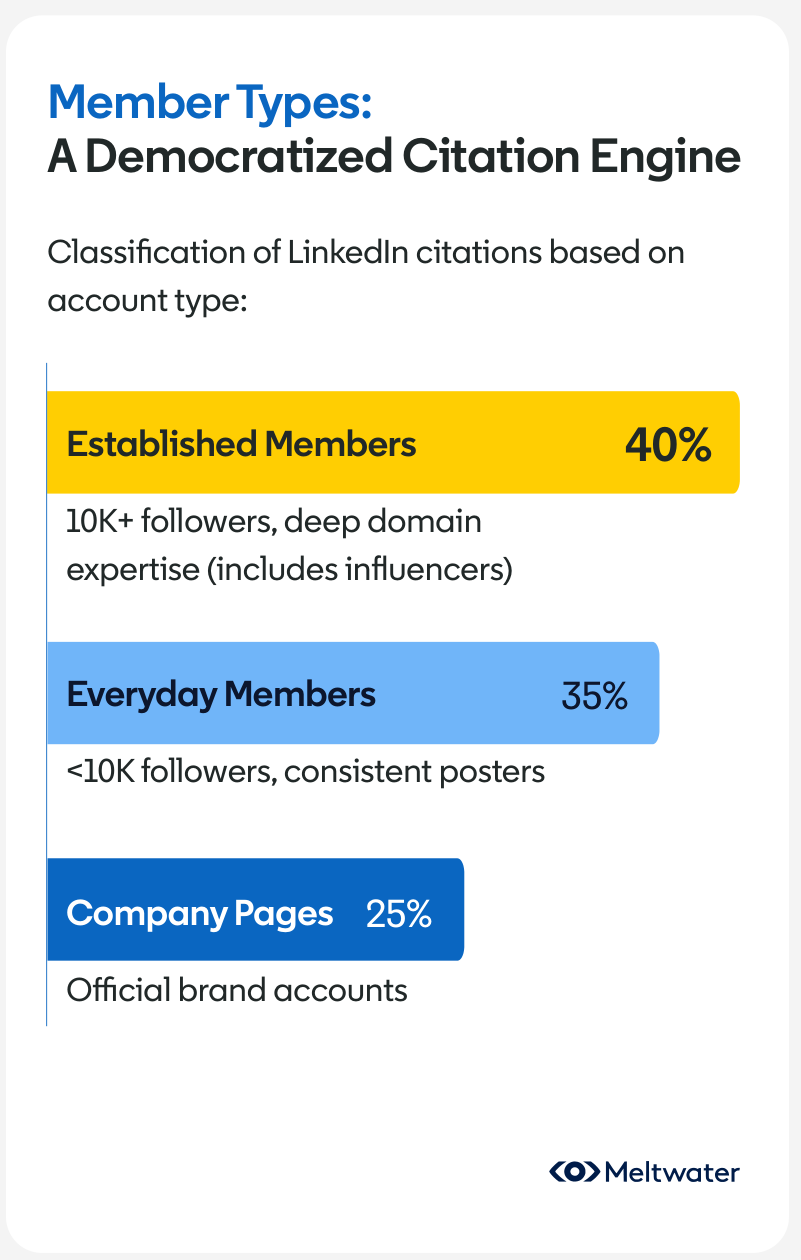
*Individual-member content accounts for 75% of the LinkedIn citations shown here. Source: LinkedIn, *Unlocking AI Search Visibility*, p. 9, citing Meltwater (2026). [Read the underlying study.](https://www.meltwater.com/en/blog/linkedin-ai-visibility-study)*
For communications teams, that expands the brief beyond keeping the CEO visible. The person with the most useful answer might lead customer success, run implementation, or spend every week untangling a specific operational problem.
Choose contributors by the questions they can answer with authority:
- **The executive** can explain the business decision: why it matters, what the company believes, and where leaders misjudge the trade-off.
- **The practitioner** can explain the work: prerequisites, failure modes, and the difference between a promising demo and a successful deployment.
- **The customer-facing expert** can explain what buyers repeatedly misunderstand and what changes once a product is in use.
- **The Company Page** can maintain a clear account of the business, its offering, and the evidence it is authorized to share.
Give these people a common subject and room to contribute different knowledge. Five employees publishing the same approved paragraph add little for a reader. Five useful explanations can answer five different objections.
Company Pages still deserve attention. Semrush’s separate January to February 2026 study found that the member-versus-company mix varied by platform, with Company Pages representing 59% of LinkedIn citations on Perplexity. The lesson is to support the people and maintain the company presence, then inspect what happens in your own category. [Source: Semrush.](https://www.semrush.com/blog/linkedin-ai-visibility-study/)
## Publish the decisions buyers need help making
“We need more thought leadership” is too loose a brief to produce useful material. Start with a decision the buyer is struggling to make.
Consider a hypothetical software company selling to revenue teams. “The future of revenue operations” leaves the writer with almost unlimited room for generalities. “When should a revenue team fix its CRM before buying another forecasting tool?” demands a position. It forces the author to name symptoms, explain sequencing, and acknowledge when a new tool will not solve the underlying problem.
The second subject gives the executive something to argue and the buyer something to use.
Build the brief around the author’s recommendation, the evidence behind it, and the conditions that would change it. An approved customer example or a documented implementation lesson gives the argument something concrete to stand on.
This produces a more useful kind of differentiation. A company can claim to be customer-centric in almost any category. An executive explaining exactly which customers should delay a purchase is taking a position a buyer can evaluate.
It also makes interviews more productive. Ask what buyers get wrong, which questions change the recommendation, and what happened the last time the conventional approach failed. Follow up until the answer contains enough detail to survive outside the conversation.
The raw material is often already inside the business. The editorial work is to identify it, verify what can be shared, and make the reasoning clear.
## What makes content easier to retrieve and quote?
Good structure helps a reader locate the answer. It also makes an individual section intelligible when it is retrieved or quoted apart from the rest of the article.
On page 20, LinkedIn reproduces Meltwater’s analysis of the **24 most-cited LinkedIn articles**: all used lists, 92% used clear section headings, and 67% included hard numbers or data.
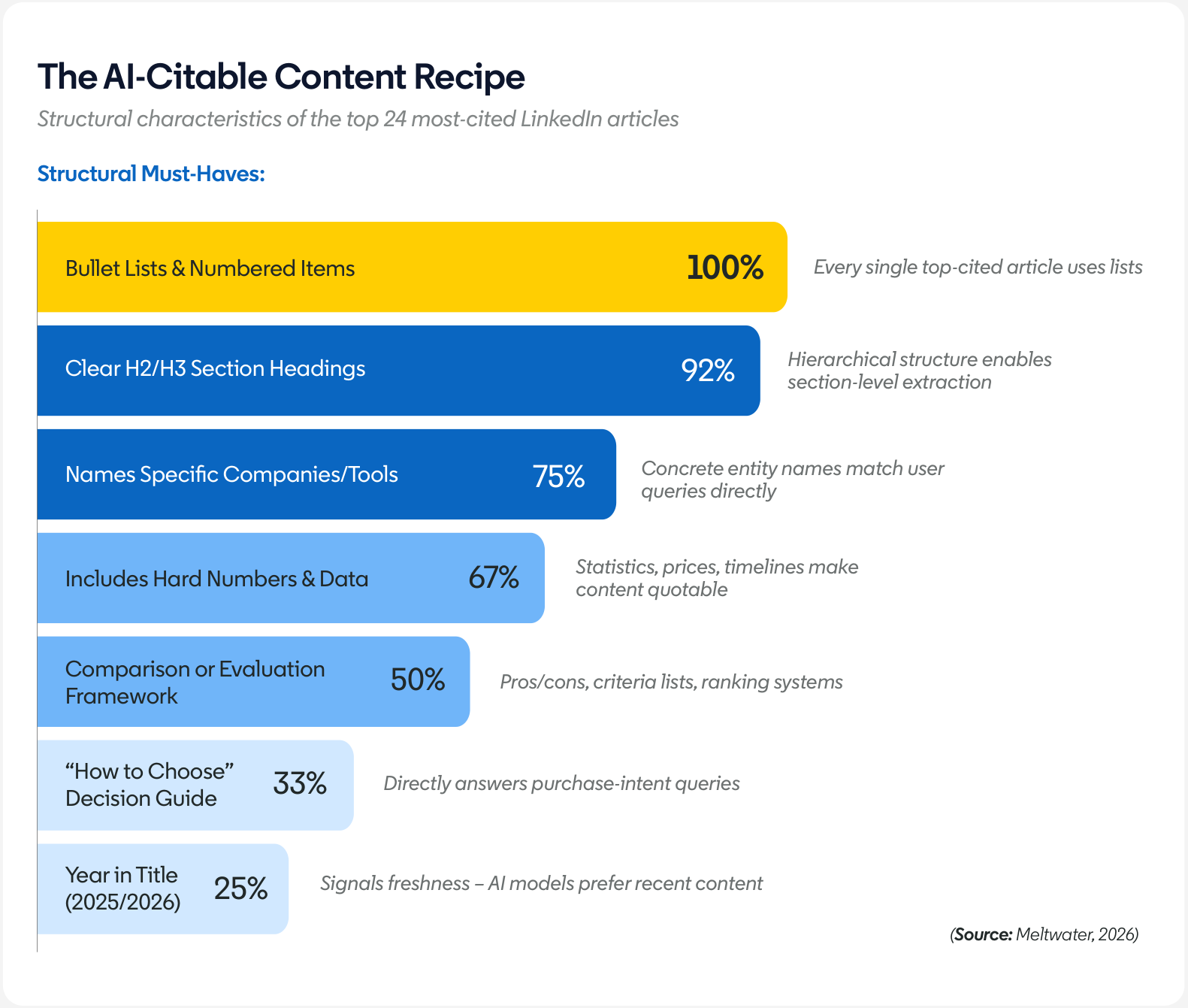
*A small, selected sample of highly cited articles, not an experiment proving that formatting causes citations. Source: LinkedIn, *Unlocking AI Search Visibility*, p. 20, citing Meltwater (2026).*
The productive response is better editing. Use a heading that names the question, answer it directly, and then show the reasoning. Keep a statistic’s population and time period close to the number. Explain what a comparison measures. Name the situation in which a recommendation applies.
For example, “Implementation takes six weeks” is easy to repeat and easy to misunderstand. An explanation that identifies the project scope, data-readiness requirements, and work excluded from that estimate is much more useful.
Assume a reader may encounter that paragraph without the introduction. Keep the scope and conditions inside the explanation so the useful advice can travel with its context.
Structure cannot supply an original insight. It can stop a valuable one from getting lost in an opening anecdote, vague terminology, or a paragraph that tries to make four arguments at once.
## Should you publish articles, posts, or both?
LinkedIn’s guide reports an internal split of roughly **60% of LinkedIn content citations going to articles and 40% to posts**. Both formats deserve an editorial role.
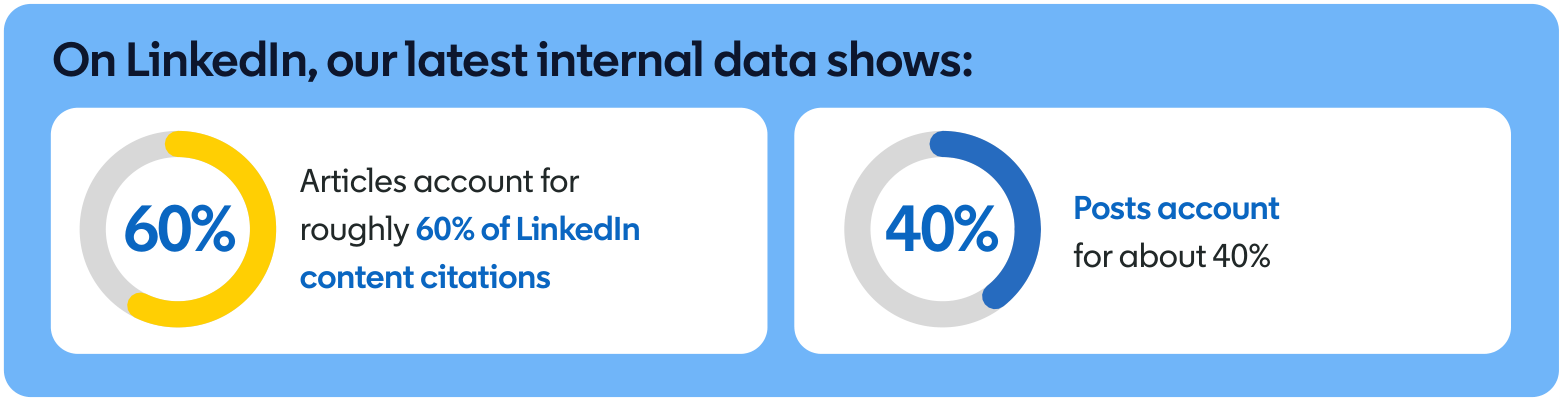
*Both formats appear in LinkedIn’s reported citation mix. Source: LinkedIn internal data, reproduced in *Unlocking AI Search Visibility*, p. 18. The guide does not disclose this figure’s sample size or time window.*
Use an article when an idea requires context, a comparison, or a sequence of decisions. Give the reader the complete argument: the problem, the recommendation, the evidence, and the exceptions.
Use a post when one observation can stand on its own. A post might explain a warning sign, challenge a common assumption, or show what changed the executive’s mind. It can point to a longer piece while still rewarding someone who never clicks.
Returning to the hypothetical forecasting example, one article could explain when to repair CRM data before replacing a tool. Supporting posts could cover:
- A diagnostic question that reveals whether forecast inputs are trustworthy.
- A trade-off between implementation speed and data cleanup.
- An objection a finance leader might reasonably raise.
- A situation in which replacing the tool really is the better choice.
Each adds a reason to reconsider the problem. Repeating the article’s introduction four times would waste that opportunity.
Original contributions also stand out in the cited material. Semrush found that approximately 95% of cited LinkedIn posts across its three studied tools were original posts, with reshares making up about 5%. Give the executive a real contribution to make, rather than asking them to circulate the company’s announcement. [Source: Semrush, January to February 2026 analysis.](https://www.semrush.com/blog/linkedin-ai-visibility-study/)
The website should carry the relevant commercial detail and proof; the executive’s article should offer a complete professional perspective. Keep descriptions consistent across both. Buyers who follow the citation should recognize the same business and find evidence that supports the argument.
## How do you measure whether it’s working?
A citation is useful evidence of visibility. Its value depends on the question, the claim it supports, and whether the buyer learns something accurate about your business.
An executive can be cited for a generic industry definition without bringing the company into a relevant buying decision. A brand can be mentioned frequently and described incorrectly. Neither problem is visible in a total citation count.
Build a small, repeatable set of buyer questions using sales conversations, customer interviews, and the objections your team hears repeatedly. Include category questions, comparisons, implementation concerns, and situations in which your offering is a poor fit. Record which prompts are branded; asking an AI system about your company by name measures something different from seeing whether it brings you up unprompted.
Then review three kinds of evidence:
### 1. The right people are responding
Look at who engages with the content and what they say. A detailed question from a relevant buyer can inform the next article. Reach and reactions help explain distribution, but neither establishes that an AI system has cited the work.
### 2. Your expertise is appearing accurately
Record the exact answer, cited URL, platform, prompt, and date. Separate a brand mention from a linked citation. Note whether your source provides the central recommendation, supporting evidence, or a passing reference. Inspect the description itself: does it preserve the recommendation and its limits?
Keep the tracked question set reasonably stable so comparisons mean something. If you expand it, show the original group separately. Repeated observations are more informative than a screenshot of one favorable answer.
### 3. Visibility is connecting to commercial behavior
Track identifiable referral visits, relevant inquiries, and opportunities where the content enters a sales conversation. Ask prospects how they researched the problem. Record those answers separately from what analytics can directly observe.
If citations rise while relevant conversations do not, examine which questions are producing the visibility and what readers encounter next. You may be reaching a broad research audience, answering the wrong question, or sending interested buyers to a page that does not support the argument.
LinkedIn recommends allowing at least 30 days before evaluating AI-visibility impact and continuing to measure beyond that point. Use monthly reviews to compare patterns across questions, authors, and formats. [Source: LinkedIn guide, pp. 27-34.](https://business.linkedin.com/advertise/resources/unlocking-ai-visibility)
## Start with one question your team can answer better
You do not need to turn every executive into a full-time publisher to test this.
Choose one commercially important question, one executive with a defensible view, and one practitioner who can supply detail. Establish what AI answers currently say about the topic. Interview the contributors, verify the evidence, and publish a complete article with a few distinct supporting posts.
Give one editor responsibility for the argument and the sources. Involve the person who owns search measurement and the people who hear buyer objections. Keep review focused on factual accuracy, disclosure, and genuine disagreement rather than sanding the writing into a committee-approved generality.
Plan to maintain what you publish. The guide’s Meltwater chart shows that 48% of cited content was less than three months old. Review a useful existing article when the advice, evidence, or market changes. An updated explanation of a consequential decision can contribute more than another post introducing the same broad theme.
At Influent, we see this as a reason to take the substance of executive thought leadership more seriously. Buyers need informed judgment. Publishing that judgment clearly gives it more opportunities to be discovered, discussed, and used.
Your executive’s most valuable contribution may be the explanation a prospective customer needed before they knew which company to call.
## What should your executives be known for?
Build your LinkedIn thought leadership around the questions your buyers need answered and the expertise your team can genuinely contribute.
## Sources and research notes
This article is Influent’s interpretation of LinkedIn’s [*Unlocking AI Search Visibility: The B2B Marketer’s Guide to LinkedIn*](https://business.linkedin.com/advertise/resources/unlocking-ai-visibility) (2026), especially pages 9, 18, 20, and 27-34. The report combines LinkedIn internal observations and external studies; it is not a single controlled experiment. Chart excerpts retain their original labels and attribution.
- [Profound, March 9, 2026:](https://www.tryprofound.com/blog/linkedin-is-the-most-cited-domain-for-professional-queries-in-ai-search) professional-query citation analysis across six platforms, with separate methodology for real ChatGPT usage.
- [Meltwater, May 12, 2026:](https://www.meltwater.com/en/blog/linkedin-ai-visibility-study) 9.5 million citations across six platforms; member/company mix and a 24-article structural analysis.
- [Semrush, March 10, 2026:](https://www.semrush.com/blog/linkedin-ai-visibility-study/) 325,000 unique prompts and 89,000 unique cited LinkedIn URLs across three tools, studied in January to February 2026.
The studies use different prompt sets, dates, and definitions. Their percentages should not be combined into a single benchmark. The publishing and measurement recommendations above are editorial judgments; they do not guarantee rankings, citations, or revenue.
Garret Caudle
Founder, Influent
September 24, 2026 · 8 min read
Best LinkedIn and thought leadership agencies
for cybersecurity in 2026
Security buyers are skeptical, technical, and allergic to fear-based marketing. Here are the agencies worth considering for cybersecurity thought leadership and LinkedIn in 2026, and how to test them.
Cybersecurity is one of the hardest categories to do thought leadership in. Every vendor claims to stop breaches, every feed is full of the same threat statistics, and the buyers, CISOs, security architects, and SOC leaders, can spot a writer who has never run an incident review.
That is why the agency choice matters more here than in most industries. This guide covers what separates good cybersecurity thought leadership from noise, the agencies worth considering, and the questions that expose weak partners fast.
Influent publishes this guide and is included in the list. Each entry notes who it fits and where another agency is the better choice.
## Thought leadership agency or LinkedIn agency?
In cybersecurity the two overlap heavily. Thought leadership is the ideas: points of view on threats, architecture, regulation, and the category. LinkedIn is where most security executives actually read those ideas. A strong partner does both: it builds the point of view with your executives and then gets it in front of the right security leaders.
## What makes cybersecurity different
- **Technical credibility is checked instantly.** A vague post about zero trust or AI threats loses the practitioner audience in one line.
- **Fear does not work anymore.** Security leaders are numb to breach statistics. Useful opinions, clear frameworks, and honest tradeoffs earn attention.
- **The buying committee is split.** The CISO, security engineers, IT, risk, and finance all weigh in. One CEO voice cannot cover them all; a CTO or head of research often carries the technical audience.
- **Trust is the product.** Buyers are handing you access to their environment. Executive visibility is often the first trust signal they see.
- **Sensitive topics need review.** Posts about incidents, customers, or vulnerabilities need a clear approval process.
## The short list
| If you need... | Look at |
|---|---|
| Executive LinkedIn tied to target accounts and pipeline | Influent |
| Full-funnel cybersecurity marketing (SEO, paid, LinkedIn) | Wadi Digital, MV3 Marketing |
| Cybersecurity brand, messaging, and demand programs | The Rubicon Agency, Ah-Ha Marketing |
| Technical cybersecurity content written by practitioners | HackerContent |
| Enterprise-scale security content and SEO | 97th Floor |
## 1. Influent
**Best for: Security vendors that want executive thought leadership to reach named CISOs and security leaders and show up in pipeline.**
[Influent](/) works only on LinkedIn and runs executive programs for B2B technology companies, including security vendors. The model assigns executives to parts of the buying committee (the CEO for the market narrative, a CTO or research lead for practitioners), produces content from interviews and product sources, distributes the strongest posts to target accounts with Thought Leader Ads, and identifies which buyers engaged using its own software, Fluentcy.
Influent is a poor fit if you want SEO, paid search, and web work from one vendor, or if you only need one executive posting occasionally.
## 2. Wadi Digital
**Best for: Cybersecurity vendors that want SEO, paid search, LinkedIn, and influencer marketing from one specialist.**
[Wadi Digital](https://wadidigital.com/cyber-marketing/) says it has run SEO, paid search, LinkedIn, and influencer marketing for more than 40 cybersecurity vendors. It is a strong option when LinkedIn is one channel inside a wider demand program. Ask how executive thought leadership is produced and whether target-account engagement is reported at the individual level.
## 3. MV3 Marketing
**Best for: Security companies that want a cybersecurity-focused marketing agency across channels.**
[MV3 Marketing](https://www.mv3marketing.com/industries/cybersecurity/) positions itself as a cybersecurity marketing agency. It suits vendors that want broad marketing support from a team that knows the category. Ask how much of the work is executive-led content on personal profiles versus company-level campaigns.
## 4. The Rubicon Agency
**Best for: Security vendors that need positioning, messaging, and demand programs.**
[The Rubicon Agency](https://therubiconagency.com/cybersecurity-marketing-agency/) offers cybersecurity marketing as a specialty. It is a logical choice when the underlying problem is messaging and category positioning. If your priority is an ongoing executive LinkedIn program, confirm who writes and how posts get distributed.
## 5. Ah-Ha Marketing
**Best for: Cybersecurity companies that need complex products explained simply.**
Ah-Ha Marketing describes itself as a B2B marketing agency for cybersecurity companies focused on cutting through complexity with simple, compelling messaging. That fits vendors whose main challenge is clarity. Ask how that messaging carries into executive voices on LinkedIn.
## 6. HackerContent
**Best for: Vendors that need deeply technical content for practitioners.**
[HackerContent](https://hackercontent.com/) focuses on cybersecurity content. It is useful when your content must hold up with engineers and researchers. Pair it with a distribution plan, since technical depth alone does not guarantee the right people see it.
## 7. 97th Floor
**Best for: Enterprise security companies investing heavily in content and organic search.**
[97th Floor](https://97thfloor.com/industries/cybersecurity/) offers enterprise cybersecurity marketing. It fits companies where search and content scale matter most. Executive LinkedIn is usually a separate conversation.
## Questions to ask any cybersecurity agency
- Who writes the technical posts, and have they worked in or close to security?
- Show me a post you wrote for a CTO or research lead. Would a security engineer respect it?
- How do you avoid fear-based messaging and generic threat statistics?
- Can you show which CISOs and security leaders from our target accounts engaged?
- What is your approval process for posts touching incidents, customers, or vulnerabilities?
- Do you run Thought Leader Ads, and how do you pick which posts get budget?
## What it costs
Executive LinkedIn programs for security vendors typically run $5,000 to $12,000 a month for one or two executives, and more for multi-executive programs with paid distribution. Full-funnel marketing agencies price differently, often by channel. See [LinkedIn agency pricing](/blog/linkedin-agency-pricing) for detail.
**Part of the series:** this guide sits under [the best LinkedIn marketing agencies in 2026](/blog/best-linkedin-marketing-agencies). For industrial security, see [OT and industrial cybersecurity agencies](/blog/best-linkedin-thought-leadership-agencies-operational-technology).
Garret Caudle
Founder, Influent
September 24, 2026 · 7 min read
Best LinkedIn and thought leadership agencies
for fintech in 2026
Fintech sells trust to skeptical, regulated buyers. Here are the agencies worth considering for fintech thought leadership and LinkedIn in 2026, and how to tell which one fits.
Fintech companies sell trust. The buyer might be a bank, a credit union, a CFO, or a payments leader, and in every case they are asking the same question: can I trust this company with money, data, and regulators watching?
Executive thought leadership on LinkedIn is one of the fastest ways to answer that question before a sales call. This guide covers what makes fintech different, the agencies worth considering, and how to choose.
Influent publishes this guide and is included in the list. Each entry notes who it fits and where another agency is the better choice.
## Thought leadership agency or LinkedIn agency?
Thought leadership is the point of view: how your executives see payments, lending, compliance, or the future of banking. LinkedIn is where finance leaders read it. The best partners build the ideas with your executives and then make sure the right bank and finance decision-makers actually see them.
## What makes fintech different
- **Compliance review is part of the workflow.** Posts may need legal or compliance sign-off. An agency without a clear process will slow down or create risk.
- **Buyers are conservative.** Banks and finance teams reward depth and steadiness, not hype.
- **Two audiences at once.** Many fintechs sell to institutions while also courting investors and partners. Executives need clear lanes.
- **Small, named target markets.** A fintech selling to mid-size banks may have a few hundred real accounts. Paid distribution to that list beats broad reach.
## The short list
| If you need... | Look at |
|---|---|
| Executive LinkedIn tied to named financial institutions and pipeline | Influent |
| Fintech content systems and thought leadership | Content Rewired |
| Founder thought leadership from a financial-services veteran | Bill Rice Strategy Group |
| Fintech advertising, web, SEO, and campaigns | CSTMR |
| UK fintech digital marketing | Lever Digital |
## 1. Influent
**Best for: Fintechs selling to banks, lenders, or finance leaders that want executive content to reach named accounts and show up in pipeline.**
[Influent](/) works only on LinkedIn. It builds executive programs across the buying committee, produces content from executive interviews, distributes the best posts to target-account lists with Thought Leader Ads, and identifies which buyers engaged using its own software, Fluentcy. Approval workflows can include compliance review.
Influent is a poor fit if you need consumer fintech marketing, app-install campaigns, or website and SEO work.
## 2. Content Rewired
**Best for: Fintechs that want a content engine built around thought leadership.**
[Content Rewired](https://contentrewired.com/category/fintech-thought-leadership/) describes itself as a fintech content marketing agency that builds authority and demand through content systems. It fits companies that want a steady flow of fintech-literate content. Ask how executive posts are distributed and measured on LinkedIn.
## 3. Bill Rice Strategy Group
**Best for: Fintech founders who want senior, hands-on thought leadership and positioning.**
[Bill Rice Strategy Group](https://billricestrategy.com/fintech-marketing-agency) offers B2B content, founder thought leadership, and product positioning, drawing on 20 years inside financial services. It suits founders who value a seasoned individual advisor. Confirm capacity if you need several executives covered.
## 4. CSTMR
**Best for: Fintechs that need strategy, advertising, website, and SEO from one agency.**
CSTMR Fintech Marketing specializes in fintech and financial marketing across strategy, advertising, website design, SEO, and campaign management. It is a strong option for broad marketing needs. Executive thought leadership on LinkedIn would be one part of a larger scope.
## 5. Lever Digital
**Best for: UK fintechs that want digital marketing with a thought leadership angle.**
[Lever Digital](https://www.leverdigital.co.uk/) is a UK agency that publishes on fintech thought leadership and digital marketing. It fits UK-based fintechs wanting a local partner.
## Questions to ask any fintech agency
- How do you handle compliance and legal review without slowing publishing to a crawl?
- Who writes, and do they understand payments, lending, or banking infrastructure?
- Can you target named banks, credit unions, or finance teams with Thought Leader Ads?
- Can you show which decision-makers from our target accounts engaged?
- How do you separate investor-facing and buyer-facing messaging across executives?
## What it costs
Executive LinkedIn programs typically run $5,000 to $12,000 a month for one or two executives, plus media when paid distribution is included. Broader fintech marketing agencies usually price by channel and scope. See [LinkedIn agency pricing](/blog/linkedin-agency-pricing).
**Part of the series:** this guide sits under [the best LinkedIn marketing agencies in 2026](/blog/best-linkedin-marketing-agencies).
Garret Caudle
Founder, Influent
September 24, 2026 · 7 min read
Best LinkedIn and thought leadership agencies
for manufacturing in 2026
Manufacturing buyers research suppliers on LinkedIn long before they talk to sales. Here are the agencies worth considering for manufacturing thought leadership and LinkedIn in 2026.
Manufacturing is one of the most under-served industries on LinkedIn, which makes it one of the biggest opportunities. Plant managers, engineers, procurement leads, and operations executives are all there, and very few suppliers are showing up with anything useful.
The companies that win are the ones whose leaders explain how things actually get made: tradeoffs in materials, lessons from the floor, what changes in reshoring or automation mean for buyers.
Influent publishes this guide and is included in the list. Each entry notes who it fits and where another agency is the better choice.
## Thought leadership agency or LinkedIn agency?
Thought leadership is the expertise: your leaders' view on quality, capacity, automation, and supply risk. LinkedIn is where engineering and procurement buyers increasingly research suppliers. A good partner turns that expertise into content and makes sure named target accounts actually see it.
## What makes manufacturing different
- **Expertise lives with engineers, not marketers.** The best content comes from interviewing the people who run the plant or design the product.
- **Long, relationship-driven cycles.** Contracts can take a year or more. Measure target-account reach and engagement early, pipeline later.
- **Small, specific audiences.** A component maker may sell to a few hundred OEMs. Paid distribution to that list beats chasing followers.
- **Low competition.** Most manufacturers barely post, so consistent, credible executives stand out quickly.
## The short list
| If you need... | Look at |
|---|---|
| Executive LinkedIn tied to named OEMs, distributors, and pipeline | Influent |
| Thought-leadership marketing built for manufacturers | RH Blake |
| Specialist marketing for advanced and industrial manufacturers | Fifth Ring |
| LinkedIn as part of manufacturing digital marketing | Ballantine Digital |
| Executive branding, outreach, and ads combined | Moriah |
| Industrial B2B marketing and content | Altitude Marketing, Exponential B2B |
## 1. Influent
**Best for: Manufacturers that want executives to reach named buyers and show up in pipeline.**
[Influent](/) works only on LinkedIn. It interviews executives and engineers, turns that expertise into content, distributes the strongest posts to target-account lists with Thought Leader Ads, and identifies which buyers engaged with its own software, Fluentcy.
Influent is a poor fit if you need trade show, website, or catalog marketing, or if your buyers are not on LinkedIn.
## 2. RH Blake
**Best for: Manufacturers that want thought leadership at the core of their marketing.**
[RH Blake](https://rhblake.com/b2b-manufacturing-thought-leadership-marketing-agency/) positions itself as a B2B manufacturing thought-leadership marketing agency for manufacturers and their suppliers. It is a natural fit when differentiation through expertise is the main goal. Ask how content is distributed on LinkedIn and how engagement is reported.
## 3. Fifth Ring
**Best for: Advanced and industrial manufacturers needing a specialist full-service agency.**
[Fifth Ring](https://www.fifthring.com/manufacturing-marketing-agency) is a specialist marketing agency for manufacturers of equipment, materials, components, and machinery. It fits companies wanting broad industrial marketing. Executive LinkedIn would be one component.
## 4. Ballantine Digital
**Best for: Manufacturers adding LinkedIn to a digital marketing mix.**
[Ballantine Digital](https://ballantinedigital.com/services/linkedin-marketing/) uses LinkedIn as part of marketing services for B2B manufacturing and industrial businesses. Good for company-level LinkedIn and lead generation. Ask about executive-profile content specifically.
## 5. Moriah
**Best for: Established manufacturers comfortable combining executive branding with outbound.**
[Moriah](https://www.moriah.ai/solutions/linkedin-lead-generation-for-manufacturers) runs executive personal branding, targeted outreach, and LinkedIn Ads together for established manufacturers. Review the outreach approach carefully, since volume affects executive reputation.
## 6. Altitude Marketing and Exponential B2B
**Best for: Industrial companies wanting B2B marketing strategy and content.**
[Altitude Marketing](https://altitudemarketing.com/) and [Exponential B2B](https://exponentialb2b.com/b2b-marketing-manufacturing-companies/) both publish guidance on B2B marketing for manufacturers. They suit companies wanting broader strategy support.
## Questions to ask any manufacturing agency
- How do you get content out of engineers and plant leaders who do not want to write?
- Show me a post a procurement or engineering buyer would find useful.
- Can you target named OEMs, distributors, or accounts with Thought Leader Ads?
- Can you show which buyers from our target accounts engaged?
- How do you measure progress during a 12-month sales cycle?
## What it costs
Executive LinkedIn programs typically run $5,000 to $12,000 a month for one or two executives, plus media for paid distribution. Full-service industrial agencies usually price by scope. See [LinkedIn agency pricing](/blog/linkedin-agency-pricing).
**Part of the series:** this guide sits under [the best LinkedIn marketing agencies in 2026](/blog/best-linkedin-marketing-agencies). Related: [supply chain and logistics](/blog/best-linkedin-thought-leadership-agencies-supply-chain-logistics) and [OT and industrial cybersecurity](/blog/best-linkedin-thought-leadership-agencies-operational-technology).
Garret Caudle
Founder, Influent
September 24, 2026 · 6 min read
Best LinkedIn and thought leadership agencies
for supply chain and logistics in 2026
Shippers, 3PLs, and supply chain tech companies all compete for the same operations leaders. Here are the agencies worth considering for supply chain thought leadership and LinkedIn in 2026.
Supply chain buyers live on LinkedIn. VPs of logistics, procurement leaders, and operations executives use it to follow disruptions, rates, regulation, and technology, and they notice which companies have something useful to say.
When disruption hits, the executives who explain what is happening and what to do next become the names buyers call. That is the opportunity for 3PLs, carriers, freight brokers, and supply chain software companies.
Influent publishes this guide and is included in the list. Each entry notes who it fits and where another agency is the better choice.
## Thought leadership agency or LinkedIn agency?
Thought leadership is the perspective: your leaders' read on capacity, tariffs, nearshoring, and technology. LinkedIn is where supply chain leaders consume it. The strongest partners turn that perspective into timely content and put it in front of named shippers and buyers.
## What makes supply chain different
- **Speed matters.** Disruptions, tariff changes, and rate swings move fast. Agencies need a process to publish within days, not weeks.
- **Operational credibility.** Buyers can tell who has actually run a warehouse or managed a lane.
- **Crowded with sameness.** Many logistics firms post the same service messages. Real opinions stand out.
- **Named accounts matter.** A 3PL or freight tech company often has a defined list of target shippers, ideal for paid distribution.
## The short list
| If you need... | Look at |
|---|---|
| Executive LinkedIn tied to named shippers and pipeline | Influent |
| Supply chain marketing consultancy focused on pipeline | Fuse |
| Logistics thought leadership and content | Virago |
| Global integrated marketing and PR for supply chain | TEAM LEWIS |
| Fractional marketing leadership for logistics tech | Winston Francois |
## 1. Influent
**Best for: 3PLs, freight tech, and supply chain software companies that want executives to reach named buyers.**
[Influent](/) works only on LinkedIn. It builds executive programs from interviews, publishes quickly on market events, distributes the strongest posts to target accounts with Thought Leader Ads, and identifies which buyers engaged using its own software, Fluentcy.
Influent is a poor fit if you need a full-service agency covering web, SEO, trade shows, and PR.
## 2. Fuse
**Best for: Supply chain companies that want a specialist consultancy focused on pipeline.**
[Fuse](https://fuseagency.com/) describes itself as a logistics and supply chain marketing consultancy and publishes guidance on building pipeline in the category. It fits companies wanting category-specialist strategy. Ask how executive LinkedIn fits into the program.
## 3. Virago
**Best for: Logistics companies wanting thought leadership and content as a core capability.**
[Virago](https://viragomarketing.com/capabilities/adaptive-content-thought-leadership/) offers thought leadership and content for logistics companies. Good for content depth. Confirm how posts reach target accounts on LinkedIn.
## 4. TEAM LEWIS
**Best for: Larger supply chain companies needing global PR and integrated marketing.**
[TEAM LEWIS](https://www.teamlewis.com/supply-chain-marketing-agency/) runs a global supply chain and logistics marketing practice. It suits enterprises wanting PR, media, and marketing across regions.
## 5. Winston Francois
**Best for: Logistics tech companies needing senior fractional marketing leadership.**
[Winston Francois](https://winstonfrancois.com/blog/fractional-cxo-for-logistics-supply-chain/) offers fractional CMO support for logistics and supply chain tech. Useful when you need strategy and leadership more than execution.
## Questions to ask any supply chain agency
- How fast can you publish when a disruption or tariff change hits?
- Who writes, and do they understand freight, warehousing, or supply chain software?
- Can you target named shippers or accounts with Thought Leader Ads?
- Can you show which buyers from our target accounts engaged?
## What it costs
Executive LinkedIn programs typically run $5,000 to $12,000 a month for one or two executives, plus media for paid distribution. See [LinkedIn agency pricing](/blog/linkedin-agency-pricing).
**Part of the series:** this guide sits under [the best LinkedIn marketing agencies in 2026](/blog/best-linkedin-marketing-agencies). Related: [manufacturing](/blog/best-linkedin-thought-leadership-agencies-manufacturing).
Garret Caudle
Founder, Influent
September 24, 2026 · 6 min read
Best LinkedIn and thought leadership agencies
for operational technology (OT) in 2026
OT and industrial cybersecurity buyers sit between IT, engineering, and the plant floor. Here are the agencies worth considering for OT thought leadership and LinkedIn in 2026.
Operational technology sits in an awkward spot for marketers. The buyer might be a CISO, a plant manager, a controls engineer, or an OT security lead, and they do not speak the same language. Content that works for IT security often falls flat with engineers who care about uptime and safety first.
That makes executive thought leadership especially valuable: a credible leader who can speak to both sides builds trust faster than any campaign.
Influent publishes this guide and is included in the list. Each entry notes who it fits and where another agency is the better choice.
## Thought leadership agency or LinkedIn agency?
Thought leadership is the point of view on OT risk, IT/OT convergence, regulation, and industrial resilience. LinkedIn is where OT security leaders, engineers, and industrial executives follow it. The right partner builds that view with your experts and gets it in front of named industrial accounts.
## What makes OT different
- **Two cultures in one buying committee.** IT security and plant engineering have different priorities. Content must respect both.
- **Safety and uptime come first.** Messaging that treats OT like IT loses engineers immediately.
- **Small, specialized community.** The OT security world is tight-knit. Credibility compounds, and so do mistakes.
- **Critical infrastructure sensitivity.** Posts about incidents or customers need careful review.
## The short list
| If you need... | Look at |
|---|---|
| Executive LinkedIn tied to named industrial accounts and pipeline | Influent |
| Critical infrastructure and OT marketing | OT Catalyst |
| Cybersecurity content for OT and the industrial sector | Content Workshop |
| Cybersecurity and B2B marketing for technical vendors | OTReniX |
| Deep tech and industrial technology marketing | based. |
## 1. Influent
**Best for: OT and industrial security vendors that want executives to reach named industrial accounts.**
[Influent](/) works only on LinkedIn. It pairs executives with the parts of the buying committee they understand (a CEO for industrial executives, a technical leader for engineers and OT security), distributes the strongest posts to target accounts with Thought Leader Ads, and identifies which buyers engaged using its own software, Fluentcy.
Influent is a poor fit if you need SEO, events, or analyst relations handled in one place.
## 2. OT Catalyst
**Best for: Companies selling into critical infrastructure.**
[OT Catalyst](https://www.otcatalyst.com/services/critical-infrastructure-marketing) offers critical infrastructure marketing. It fits vendors wanting a partner focused on that market. Ask how executive LinkedIn content is handled.
## 3. Content Workshop
**Best for: OT security companies needing credible technical content.**
[Content Workshop](https://contentworkshop.com/cybersecurity-marketing-for-operational-technology-and-the-industrial-sector/) publishes on cybersecurity marketing for OT and the industrial sector. A good option for content depth; pair it with a distribution plan.
## 4. OTReniX
**Best for: Technical vendors wanting a cybersecurity-focused B2B agency.**
[OTReniX](https://otrenix.com/cybersecurity-marketing-agency/) positions itself as a cybersecurity marketing agency for infosec vendors. Ask about OT-specific experience and executive-profile content.
## 5. based.
**Best for: Deep tech and industrial technology companies.**
[based.](https://www.based.marketing/industries/deep-tech-marketing-agency) markets deep tech and industrial technology companies. It fits vendors with complex products needing clear positioning.
## Questions to ask any OT agency
- Have your writers worked with controls engineers or OT security teams?
- How do you write for IT security and plant engineering in the same program?
- What is your review process for posts touching incidents or critical infrastructure?
- Can you target named industrial accounts with Thought Leader Ads and show who engaged?
## What it costs
Executive LinkedIn programs typically run $5,000 to $12,000 a month for one or two executives, plus media for paid distribution. See [LinkedIn agency pricing](/blog/linkedin-agency-pricing).
**Part of the series:** this guide sits under [the best LinkedIn marketing agencies in 2026](/blog/best-linkedin-marketing-agencies). Related: [cybersecurity](/blog/best-linkedin-thought-leadership-agencies-cybersecurity) and [manufacturing](/blog/best-linkedin-thought-leadership-agencies-manufacturing).
Garret Caudle
Founder, Influent
September 21, 2026 · 7 min read
LinkedIn executive content benchmarks:
2026 data from 21 real programs
Engagement rate, impressions per post, follower growth, and connection acceptance, measured across 21 client programs, 25 executive accounts, and 1,709 posts published in 2026.
Most LinkedIn benchmarks you find online are either platform-wide averages that include dormant accounts, or vendor marketing with no sample behind them. Neither helps you judge whether your own executive program is working.
These numbers come from programs we operate. The sample, the date windows, and the measurement caveats are all stated, including the four metrics where we could not produce a defensible aggregate and therefore publish nothing.
## The sample
The core historical sample is 21 external client programs, 25 executive accounts, and 1,709 posts published between January and August 2026. It covers currently active clients who published in that window. Internal company programs are excluded. Two benchmark families use separate samples, noted where they appear.
:::stats 21::Client programs | 25::Executive accounts | 1,709::Posts analyzed | Jan to Aug 2026::Publishing window
## Engagement rate
Pooled across all 1,709 posts, engagement rate was **0.74 percent**. Averaged at the account level it was **1.28 percent**, with a **median of 0.90 percent** and a typical account range of **0.70 to 1.63 percent**.
:::bars Engagement rate by measurement method (percent of impressions) | Pooled across all posts::74::0.74% | Median account::90::0.90% | Average account::128::1.28% | Top of typical range::163::1.63%
Engagement here means reactions plus comments plus shares, divided by impressions. Clicks were not available in the source data, and saves and sends are excluded, so these rates are conservative relative to LinkedIn's own in-product engagement figure. Boosted posts are included. These are account-level period rates, not the distribution of individual post rates, so a single viral post does not distort an account's number the way it would a per-post average.
The practical read: if your executives sit above roughly 0.9 percent, you are at or above the middle of a professionally operated sample. Below 0.7 percent, the problem is usually topic selection rather than posting frequency.
## Impressions per post
The historical sample averaged **7,940 impressions per published post**, including boosted distribution.
Because boosts inflate that figure, we also pulled a standardized organic-only benchmark: **5,684 median impressions per post**, with a typical range of **1,937 to 9,366**. That benchmark comes from 22 active executive accounts as of a September 2026 snapshot, where each executive's posts are averaged first and percentiles are then calculated across executives.
:::bars Organic impressions per post, executive accounts | Bottom of typical range::1937::1,937 | Median executive::5684::5,684 | Top of typical range::9366::9,366 | Average including boosts::7940::7,940
The five-times spread between the bottom and top of the typical range is the real finding. Two executives at the same company, posting the same number of times, routinely differ by that much. Reach on LinkedIn is a function of who engages early, not of cadence.
## Executive follower growth
Across 19 executives and 181 executive-months between May 2025 and September 2026, the median was **248 net new followers per month**, with a typical range of **152 to 361 per month**.
:::stats 248::Median net new followers per executive per month | 152 to 361::Typical monthly range | 181::Executive-months measured
This is absolute growth, not percentage growth, which matters when you compare an executive with 3,000 followers against one with 30,000. We do not have a defensible percentage benchmark, and company-page follower growth is not included here.
## Connection acceptance: engagement-informed outreach versus the rest
This is the number that most changes how a program should be run. Comparing 8 qualifying campaigns where outreach was informed by content engagement signals against 59 other campaigns, using campaign-lifetime results as of a September 2026 snapshot:
:::bars Median connection acceptance rate (percent) | Engagement-informed outreach::528::52.8% | Other campaigns::265::26.5%
Engagement-informed outreach saw **52.8 percent median connection acceptance**, against **26.5 percent** for other campaigns. Roughly two times. Typical ranges were **48.2 to 62.3 percent** versus **18.7 to 41.8 percent**, so the two distributions barely overlap.
The caveat matters: "engagement-informed" here is a proxy based on campaigns fed by our Fluentcy engagement data, not a verified account-by-account warm classification. The sample on the treated side is 8 campaigns. Treat the direction as solid and the exact multiple as indicative.
## What we could not measure, and are not going to invent
Four metrics people ask for regularly, where we do not yet have a number worth publishing:
| Metric | Why it is not here |
| --- | --- |
| Thought Leader Ads CTR, CPC, CPM | Only 7 settled campaigns, below our eight-campaign publication threshold, with measurement eligibility starting August 25, 2026. No matched comparison against standard ads exists yet. |
| Target-audience reach efficiency | Our paid measurement tracks impressions and ICP engagement lift, not deduplicated target-account members reached. Cost per ICP engagement is not a substitute for cost per member reached. |
| Time to results | No launch-to-outcome cohorts and no consistent definition of meaningful lift. Any "expect results in X weeks" figure would be speculative. |
| Non-follower distribution share | Analytics do not give a follower versus non-follower impression split. Even a high non-follower share would not prove an algorithmic shift without a comparable historical baseline. |
We would rather publish four honest gaps than four confident guesses. If you see a competitor quoting precise numbers on all of these, ask them for the sample size and the date window.
## How to use these benchmarks
1. Compare like with like. Measure your executives at the account level over a period, not post by post, or one strong post will make the program look better than it is.
2. Separate organic from boosted. A 7,940 average with amplification and a 5,684 organic median are different questions.
3. Judge reach spread, not just the average. If your best executive gets five times your weakest, the fix is topic and audience work on the weak account, not more posts.
4. Check outreach acceptance rates. If your connection acceptance sits near 26 percent, your outreach is not yet informed by who engages with your content.
**Related reading:** [what a LinkedIn agency costs in 2026](/blog/linkedin-agency-pricing), [how to measure category ownership](/blog/measure-category-ownership), and [the Thought Leader Ads playbook](/blog/thought-leader-ads-playbook).
Garret Caudle
Founder, Influent
September 21, 2026 · 7 min read
Best LinkedIn agencies for CPG
and trade marketing in 2026
CPG brands spend heavily to reach shoppers and almost nothing to reach the buyers who decide shelf space. Here is what a LinkedIn agency needs to run trade marketing, and how few can.
A category manager at a large grocery retailer decides whether your product gets shelf space. That person is on LinkedIn. So are the distributor reps, the brokers, and the food service operators who determine your distribution.
Almost no CPG brand markets to them. Trade spend goes to slotting fees, promotions, and shopper marketing, and the upper funnel that shapes how those buyers perceive the brand before the appointment is left empty.
That makes it the least competitive LinkedIn audience in any category we work in, and it also means most agencies have never run a program like it.
## Why most agencies cannot run CPG trade marketing
**They optimize for shopper reach.** CPG marketing agencies are built for consumers: retail media, social, influencer, in-store. LinkedIn sits outside that muscle.
**They target by job title alone.** Retail buying is a small, specific world. "Category manager" is a start, not an audience. Brokers, distributors, food service directors, and merchandising leads all matter and are titled inconsistently.
**They think in campaigns, not familiarity.** Trade audiences are measured in thousands of people, not millions. The objective is that a buyer already knows who you are before the appointment, which is a sustained presence, not a flight.
**They have no thought-leader motion.** Retail buyers respond to people with category knowledge. A brand page posting about product launches does not build that; a founder or category lead talking about velocity, margin, and consumer shifts does.
## What a CPG-ready LinkedIn agency needs
**Audience building beyond titles.** Named retailer accounts, distributor and broker organizations, food service groups, and the roles inside each. The list is small enough to be built by hand and should be.
**Thought Leader Ads capability.** With audiences this small, organic reach is unreliable. Amplifying an executive's post to a few thousand named people is the mechanism that makes trade marketing on LinkedIn work at all. The mechanics are in [the Thought Leader Ads playbook](/blog/thought-leader-ads-playbook).
**Content that speaks buyer economics.** Velocity data, margin structure, repeat rate, category growth, shelf productivity, and consumer trends the buyer is being measured on. Not brand storytelling.
**The right internal voices.** Founder, head of sales, and category insights lead usually outperform the brand page, because buyers want a person who understands their P&L.
**Retail calendar awareness.** Category reviews, line review windows, and trade show cycles should shape the content calendar. Presence needs to build in the weeks before a review, not during it.
## What to ask the agency
- Have you built an audience of retail buyers, brokers, or distributors before?
- How would you find and target category managers at our top 10 retailers?
- Do you run Thought Leader Ads, and what budget would you use against an audience of 3,000 people?
- Who at our company should be posting, and what would each person talk about?
- How would you time the program against our line review calendar?
- What would you report in month two, before any distribution change?
:::stats Hundreds::Buyers who actually decide shelf space | Line reviews::The calendar the program runs on | Upper funnel::Where LinkedIn changes the trade conversation
## What good looks like in the first six months
Months 1 to 2: audience list built, one or two internal voices publishing weekly, amplification live against named retail and distributor accounts. Months 3 to 4: measurable reach into target retailer accounts, named engagers from buying and merchandising teams, first inbound conversations from brokers. Months 5 to 6: buyers arriving at appointments already familiar with the brand, and sales able to name accounts where several people engaged.
Distribution wins take longer and depend on the product. LinkedIn changes the temperature of the room before the meeting; it does not replace the meeting.
## Budget
Trade audiences are small, so this is cheaper than most B2B programs. A serious program usually runs $6,000 to $15,000 a month in fees with $2,000 to $5,000 in media. Spending more against an audience of a few thousand people mostly buys frequency you do not need.
**Adjacent reading:** [CPG trade marketing on LinkedIn](/blog/cpg-trade-marketing-linkedin) and [how to choose a LinkedIn agency](/blog/how-to-choose-a-linkedin-agency).
**Part of the series:** this guide sits under [the best LinkedIn marketing agencies in 2026](/blog/best-linkedin-marketing-agencies), which compares the whole market by job.
Garret Caudle
Founder, Influent
September 20, 2026 · 8 min read
Best LinkedIn agencies for B2B SaaS
in 2026: how to pick one
B2B SaaS has long sales cycles, buying committees of six or more, and a product story most writers get wrong. Here is what a LinkedIn agency needs to handle SaaS, and how to test for it.
SaaS is the most competitive category on LinkedIn. Every competitor is posting, every founder has a ghostwriter, and the feed is saturated with the same four post formats. An agency that works for a services firm can fail badly here.
This is what actually separates agencies that perform in B2B SaaS.
## What makes SaaS different
**The buying committee is large.** Six to ten people typically touch an enterprise SaaS purchase: the economic buyer, the practitioner, security, finance, and often a skeptic in an adjacent team. One executive posting to one audience cannot cover that.
**The cycle is long.** Three to twelve months between first exposure and a signed contract means monthly lead counts are a misleading scorecard.
**Technical credibility is checkable.** Your buyers can tell when a post about infrastructure, data models, or security was written by someone who has never touched the product.
**Category language shifts fast.** A writer who was fluent in the category 18 months ago is probably describing a market that has moved.
## What a SaaS-ready LinkedIn agency needs
**Committee coverage across several executives.** A CEO addressing strategic shifts, a CTO or head of engineering writing for technical evaluators, and often a product or customer leader writing for practitioners. The approach is laid out in [the multi-executive LinkedIn strategy framework](/blog/multi-executive-linkedin-strategy).
**Writers who can interview engineers.** Ask how they source technical posts. The good answer involves product and engineering interviews, changelogs, support themes, and usage data, not just the CEO's weekly call.
**Paid amplification against a named account list.** SaaS has clean ICP definitions, so there is no excuse for spraying. Target accounts, target roles, and budget allocated to the posts that already attract the right people.
**Buyer-level engagement data that reaches the CRM.** In a six-month cycle, the value of LinkedIn shows up as account coverage and warm conversations long before it shows up as closed revenue. If the agency cannot name which people from target accounts engaged, you will not be able to defend the spend at renewal.
**Comfort with product-led motions.** For PLG products, the goal is often signups and champion recruitment rather than meetings, which changes both the content and the call to action.
## PLG versus enterprise: different agency profiles
| | Product-led SaaS | Enterprise SaaS |
| --- | --- | --- |
| Primary audience | Practitioners and champions | Committee, including economics and security |
| Who should post | Founders, product, power users | CEO, CTO, CFO, category leaders |
| Content center of gravity | Craft, tooling, workflow | Strategy, risk, cost of the status quo |
| Paid role | Broad relevance and volume | Named account penetration |
| Best measure | Signups and activation from engaged accounts | Target-account reach and pipeline influence |
An agency that only runs enterprise ABM will over-target a PLG product into a tiny audience. An agency that only runs creator-style content will produce a lot of engagement and no committee coverage.
:::stats 6 to 10::People in a typical SaaS buying committee | 2 to 4::Executives most programs need posting | 2 quarters::Before pipeline influence reads clearly
## What to ask on the call
- Which SaaS categories have you worked in, and at what ACV?
- How do you divide content across our buying committee?
- How would you produce a technical post without the CEO in the room?
- How do you handle a category where every competitor posts daily?
- What did you report to a SaaS client in month three, before pipeline existed?
- How does engagement data reach our CRM, and what do reps do with it?
## Pricing expectations for SaaS programs
Seed and Series A with one or two executives: $5,000 to $12,000 a month. Series B and C with three or four executives plus amplification: $12,000 to $30,000 plus $3,000 to $10,000 in media. Enterprise programs with employee advocacy and creator campaigns run higher. The breakdown by capability is in [LinkedIn agency pricing](/blog/linkedin-agency-pricing).
**Also in this category:** [Best LinkedIn marketing agencies](/blog/best-linkedin-marketing-agencies) and [best executive LinkedIn agencies](/blog/best-executive-linkedin-agencies).
Influent runs programs in this category, so treat this as a point of view from a competitor and apply the questions above to us too.
Garret Caudle
Founder, Influent
September 19, 2026 · 8 min read
What KPIs should a LinkedIn ads
agency actually report on?
Impressions, CTR, and cost per lead are the metrics agencies report because they are easy. Here are the numbers that tell you whether LinkedIn advertising is moving your buying committee.
Most LinkedIn ads reports open with impressions, click-through rate, and cost per lead. Those numbers are real, they are just answering a question B2B buyers did not ask: they measure whether the ad ran, not whether the people who decide deals noticed you.
Here is a reporting structure that survives a CFO conversation.
## Tier 1: did we reach the right people?
**Target-account reach.** What share of your named account list saw the campaign at all. This is the single most important number in account-based LinkedIn advertising and the one most reports omit.
**Audience composition of impressions.** The percentage of impressions delivered to in-profile roles at target accounts. Organic distribution typically puts 10 to 15 percent of impressions in front of the intended audience. Well-targeted paid amplification should push that to 85 to 90 percent. If your paid number is not dramatically better than your organic number, targeting is broken.
**Frequency per account.** Reach without repetition does not build familiarity. Track average impressions per target account per month, not just per person.
## Tier 2: did they engage?
**Target-market engagements.** Reactions, comments, shares, and clicks from people at target accounts, counted as people rather than events. A post with 25 interactions from buyers beats one with 2,000 from strangers.
**Cost per target-market engagement.** Total spend divided by identified engagements from target accounts. This replaces cost per click as your efficiency metric. In our programs, a $500 Thought Leader Ad budget on the right post has produced over 200 target-market engagements, which is a very different unit economics story than cost per click implies.
**Accounts with multiple engagers.** Two or more people from the same account engaging in a 30-day window is one of the earliest reliable buying signals on LinkedIn.
**Repeat engagers.** Individuals engaging with three or more posts. These are the people outbound should be contacting first.
## Tier 3: did it influence revenue?
**Pipeline influence rate.** The percentage of CRM opportunities containing at least one contact with a recorded LinkedIn interaction. One Influent client reached 38 percent verified pipeline influence in the first year.
**Engaged-account to opportunity rate.** Of the accounts that engaged this quarter, how many entered pipeline within two quarters.
**Sales-cycle and win-rate comparison.** Deals with LinkedIn-engaged contacts versus deals without. This is usually where the strongest number in the whole report lives.
**Self-reported attribution.** Add "how did you hear about us" to your forms and record it on discovery calls. Imperfect, and still the closest thing to truth for content that influences buyers who never click.
:::bars Where reporting attention belongs | Tier 1, reached the right people::30::30% | Tier 2, buyer engagement::35::35% | Tier 3, pipeline influence::30::30% | Vanity metrics::5::5%
## Metrics to stop paying attention to
- **Impressions on their own.** Volume without composition tells you nothing.
- **Click-through rate as a primary KPI.** Thought leadership frequently succeeds without a click. High CTR often just means the creative promised something transactional.
- **Cost per lead from lead-gen forms.** Cheap leads from non-target accounts make the report look good and the pipeline look worse.
- **Follower growth.** A vanity metric unless the new followers are your buyers.
- **Engagement rate.** A ratio that rewards small audiences and punishes reaching new people.
## What a good monthly report looks like
- Spend by campaign and by post.
- Target-account reach and coverage against the named list.
- Percentage of impressions delivered to target roles and accounts.
- Named people and companies from target accounts who engaged.
- Accounts with two or more engagers this month.
- Cost per target-market engagement, trended.
- Pipeline influence rate and its change.
- A plain-language read of what changed and what will change next month.
## Reporting cadence that works
Weekly for spend pacing and delivery checks. Monthly for engagement composition and named-account movement. Quarterly for pipeline influence, win rate, and sales-cycle comparison. Judging pipeline monthly in a six-month sales cycle produces bad decisions in both directions.
## One honest caveat
LinkedIn does not reveal everyone who saw a post. Many senior buyers read without ever reacting, and saves and some profile views stay anonymous. Buyer-level engagement data is directional evidence of visible attention, not a complete record. That is exactly why pipeline influence and self-reported attribution belong in the same report as engagement metrics.
**Adjacent reading:** [the Thought Leader Ads playbook](/blog/thought-leader-ads-playbook) and [how to measure category ownership](/blog/measure-category-ownership).
**Part of the series:** this guide sits under [the best LinkedIn marketing agencies in 2026](/blog/best-linkedin-marketing-agencies), which compares the whole market by job.
Garret Caudle
Founder, Influent
September 18, 2026 · 7 min read
LinkedIn agency vs in-house hire
vs freelancer: which one fits
The same LinkedIn program can cost $3,000 or $25,000 a month depending on how you staff it. Here is the real cost of each option, what breaks in each, and the switching points.
Three ways to staff a LinkedIn program, and the deciding factor is rarely budget. It is which capability you are missing and how much management attention you have to spare.
:::stats 2 to 4 weeks::Freelancer time to productive | 2 to 4 months::In-house time to productive | 3 to 6 weeks::Agency time to productive
## Side by side
| | Freelancer | In-house hire | Agency |
| --- | --- | --- | --- |
| True monthly cost | $1,500 to $5,000 | $8,000 to $14,000 loaded | $8,000 to $30,000 |
| Time to productive | 2 to 4 weeks | 2 to 4 months | 3 to 6 weeks |
| Strategy depth | Low | High over time | Medium to high |
| Paid amplification | Rare | Depends on hire | Usually included |
| Buyer-level measurement | No | Only if tooled | Sometimes |
| Management overhead | Medium | High | Low to medium |
| Continuity risk | High | Medium | Low |
The in-house number surprises people. A mid-level content lead at $95,000 to $120,000 base becomes $8,000 to $14,000 a month once you add payroll taxes, benefits, equipment, tools, and management time. That is before any ad spend or design support.
## Freelancer: best when the bottleneck is writing
A good freelance ghostwriter is the fastest way to make one executive consistent. They match voice well, they are cheap relative to output, and you can start next week.
What breaks: strategy stays with you, distribution does not exist, and measurement is whatever LinkedIn shows natively. If the freelancer gets a full-time offer or takes two weeks off, your program stops. Most freelance relationships also plateau at around six months, when the executive's obvious stories are used up and nobody is doing fresh market research.
## In-house: best when LinkedIn is a permanent function
An internal hire accumulates context nobody else can: product roadmap, customer conversations, sales objections, internal data. Over two years that compounds into content an outsider cannot write.
What breaks: one person rarely has all the skills. Strong writers are usually not strong paid-media operators, and neither profile typically builds CRM attribution. Internal hires also absorb unrelated marketing work within a quarter, which is how LinkedIn programs quietly die. If you go this route, write the job description around one primary skill and buy the rest.
## Agency: best when you need several capabilities at once
Agencies win when the program needs content, paid amplification, engagement identification, and sales handoff running together, and when you want that in weeks rather than quarters. You also get pattern recognition across many programs, which shortens the learning curve on topics and formats.
What breaks: agencies start further from your product and your customers. Onboarding quality decides whether that gap closes. Watch for the account handover after month two, when the senior person who sold you moves on and a junior manager takes over.
:::bars True monthly cost, top of each range | Freelancer::5000::$5k | In-house hire, loaded::14000::$14k | Agency program::30000::$30k
## The hybrid most mature programs end up with
One internal owner who holds strategy, executive relationships, and internal data, plus an external partner that handles production volume, paid amplification, and measurement infrastructure. The internal owner is the difference between an agency that guesses and an agency that is fed.
## Switching points
- **Freelancer to agency:** when posts are consistent but the wrong audience is engaging, or when a second and third executive join.
- **Agency to in-house:** when spend passes roughly $25,000 a month and the work has become predictable and repeatable.
- **In-house to agency:** when your one hire is covering strategy, writing, ads, and reporting, and doing none of them well.
- **Anything to nothing:** when no executive will spend 30 minutes a week on the program. No staffing model survives that.
## The one question that decides it
Ask which capability you are missing. If it is writing, hire a writer. If it is reaching and identifying buyers, hiring a better writer will not help, and that is the case where an agency earns its fee. Costs per capability are broken out in [LinkedIn agency pricing](/blog/linkedin-agency-pricing).
**Part of the series:** this guide sits under [the best LinkedIn marketing agencies in 2026](/blog/best-linkedin-marketing-agencies), which compares the whole market by job.
Garret Caudle
Founder, Influent
September 17, 2026 · 7 min read
How to choose a LinkedIn agency:
a 10-step evaluation checklist
Most LinkedIn agency decisions are made on vibes and portfolio screenshots. Here is a repeatable evaluation process, the questions that reveal real capability, and the red flags worth walking away from.
Buyers usually choose a LinkedIn agency by looking at the agency's own LinkedIn presence. It is an understandable shortcut and a poor predictor: being good at your own content and being good at running someone else's program are different skills.
Here is a process that holds up.
:::stats 10::Steps before you sign anything | 8::Capabilities worth scoring | 90 days::The review point to negotiate for
## Step 1. Write down the outcome, not the activity
"Twelve posts a month" is an activity. "Our target accounts recognize us before sales calls" and "sales can see which buyers engaged" are outcomes. Agencies will happily sell you activity. Only outcomes let you judge a proposal.
## Step 2. Decide which problem you are solving
- Nothing gets published: you need production.
- Content gets published and the wrong people see it: you need distribution.
- The right people see it and sales never hears about it: you need measurement and activation.
- Leaders disagree on what to say: you need strategy first.
Buying a writer for a distribution problem is the single most common expensive mistake in this category.
## Step 3. Score the eight capabilities
Content strategy, content production, employee advocacy, paid amplification, influencer work, outbound, buyer-level measurement, and sales activation. Mark which ones the agency operates itself, which it subcontracts, and which stay with you. The full definition of each is in [the eight capabilities a complete program needs](/blog/executive-linkedin-agency-capabilities).
## Step 4. Ask who actually writes
Ask for the writer's name, their other accounts, their background in your category, and whether you can speak to them before signing. Agencies that will not introduce the writer are selling you a process, and you will meet a junior one.
## Step 5. Ask where topics come from
A good answer includes the executive interview plus at least two other sources: what the target audience is arguing about, what competitors publish, what past engagement data says, and internal first-party data such as product usage or sales-call themes.
## Step 6. Demand a redacted monthly report
This is the highest-signal request in the whole process. You are looking for named accounts and roles, not impression charts. If the report cannot tell you which buyers engaged, the agency cannot tell you either.
## Step 7. Test the distribution answer
Ask how they decide which posts receive paid budget. A strong answer talks about the composition of organic engagement: a post with 25 interactions from target buyers deserves budget over one with 2,000 interactions from strangers. A weak answer talks about which posts performed best.
## Step 8. Trace the path from comment to CRM
Walk one hypothetical buyer through the system out loud. They comment. Then what? Who sees it, what record is it written to, who follows up, and with what message? Most agencies stop the story at "we report it."
## Step 9. Check references that look like you
Similar company size, similar deal size, similar sales cycle. Ask references what the first 90 days felt like, how many revision rounds each post took, and what the agency got wrong.
## Step 10. Structure the first 90 days
Agree in writing on what exists by day 30 (strategy and first posts live), day 60 (amplification running, engagement identified), and day 90 (named target-account engagement and a documented sales handoff). Pipeline in 90 days is not a fair test. Reaching the right audience is.
## Red flags
- Guaranteed follower counts, impressions, or leads.
- No named writer before signing.
- Reporting limited to impressions, engagement rate, and follower growth.
- Heavy reliance on automated connection requests and mass DMs.
- No answer for what happens after someone engages.
- A 12-month contract with no review point.
## Green flags
- They ask for your target account list on the first call.
- They push back on a topic you suggested and explain why.
- They describe a client program that failed and what caused it.
- Their report names people and companies.
- They tell you which capability to fund first rather than selling everything.
**Adjacent reading:** [LinkedIn agency pricing](/blog/linkedin-agency-pricing) and [LinkedIn agency vs in-house vs freelancer](/blog/linkedin-agency-vs-in-house-vs-freelancer).
**Part of the series:** this guide sits under [the best LinkedIn marketing agencies in 2026](/blog/best-linkedin-marketing-agencies), which compares the whole market by job.
Garret Caudle
Founder, Influent
September 16, 2026 · 8 min read
LinkedIn agency pricing:
what it actually costs in 2026
Retainers run from $1,500 to $50,000 a month and the range is not arbitrary. Here is what each pricing model buys, what drives cost up, and how to tell when you are overpaying.
Every LinkedIn agency quotes a monthly number and very few explain what sits behind it. Two agencies can both say $12,000 and deliver work that differs by an order of magnitude in scope.
This guide breaks pricing into the pieces you are actually buying, gives realistic 2026 ranges for each, and names the line items that inflate proposals without changing outcomes.
## The four pricing models
| Model | How it works | Typical range | Fits |
| --- | --- | --- | --- |
| Per post | Priced per published piece | $150 to $600 per post | Low volume, one executive |
| Retainer per executive | Flat fee covering one leader's content | $2,000 to $8,000 | One to three leaders |
| Program retainer | Whole program, several capabilities | $8,000 to $40,000 | Full B2B program |
| Media management fee | Percent of ad spend, or flat | 10 to 20 percent, or $2,000 to $6,000 | Paid amplification |
Per-post pricing looks cheapest and usually is not, because the cost of strategy and editing gets absorbed into the unit price or skipped entirely.
## Cost by service line
:::bars Typical monthly fee by service line | Strategy and positioning::5000::$1.5k to $5k | Ghostwriting, one executive::6000::$2k to $6k | Each additional executive::4000::$1.5k to $4k | Paid amplification management::6000::$2k to $6k | Buyer-level tracking::4000::$1k to $4k | Employee advocacy::8000::$2k to $8k
**Content strategy and positioning.** $1,500 to $5,000 one time, or built into the retainer. This is the piece most often skipped and most often responsible for a program that publishes well and sells nothing.
**Ghostwriting, one executive, 8 to 12 posts a month.** $2,000 to $6,000. Above roughly $6,000 you should be getting research, editing, and analytics, not just drafts.
**Additional executives.** $1,500 to $4,000 each. The second and third leader should cost less than the first, because strategy and research are shared.
**Paid amplification management.** $2,000 to $6,000 a month, or 10 to 20 percent of spend. Media spend itself is separate.
**Media spend.** Meaningful Thought Leader Ad programs start around $2,000 to $5,000 a month. Smaller budgets work for single-post tests: a $500 amplification on one strong post is a reasonable experiment.
**Buyer-level engagement tracking.** $1,000 to $4,000 a month. This is what turns engagement into named accounts and people.
**Employee advocacy.** $2,000 to $8,000 depending on how many employees publish original content rather than resharing.
**Creator and influencer campaigns.** $2,000 to $15,000 per creator in fees, plus management and amplification.
## What a realistic full program costs
For a B2B company running two to four executives with amplification and measurement, expect $12,000 to $30,000 a month in fees plus $3,000 to $10,000 in media. Under $8,000 you are buying content only. Over $40,000 you should be getting creator campaigns, employee programs, and dedicated analyst time.
Executive-specific ranges are broken out further in [how much an executive LinkedIn program costs](/blog/executive-linkedin-program-cost).
:::stats $12k to $30k::Monthly fees for a full two to four executive program | $3k to $10k::Monthly media spend behind it | Under $8k::You are buying content only
## What drives price up legitimately
- Number of executives and posting frequency.
- Research depth: interviews, market listening, competitor analysis, first-party data.
- Paid amplification management and the account-list work behind it.
- Individual-level engagement identification and CRM integration.
- Regulated industries with compliance review cycles.
- Video and design production.
## What does not justify a higher price
- Number of posts alone. Twenty mediocre posts are worth less than eight good ones.
- Company-page management sold as a major line item. Pages get little organic distribution.
- Dashboards that report impressions and engagement rate. That data is free inside LinkedIn.
- Connection-request automation volume. High-volume unsolicited messaging damages executive credibility.
- "Community management" priced as a separate retainer when it means replying to comments.
## Contract terms worth negotiating
Most agencies open with 12 months. Six is usually achievable, and a 90-day ramp with a defined review point is reasonable to ask for. Confirm in writing who owns the content, what happens to drafts on termination, and whether the engagement data collected about your buyers is exportable to you.
Watch for onboarding fees above roughly one month of retainer, automatic annual uplifts, and media spend billed through the agency without a pass-through invoice.
## How to compare two proposals fairly
Put both on the same grid: posts per month per executive, who writes them, whether strategy is included, whether paid amplification is managed, whether media spend is included or separate, whether reporting names individual buyers, and whether anything is written to your CRM. Most price gaps close or invert once the grid is filled in.
**Adjacent reading:** [LinkedIn agency vs in-house vs freelancer](/blog/linkedin-agency-vs-in-house-vs-freelancer) and [how to choose a LinkedIn agency](/blog/how-to-choose-a-linkedin-agency).
**Part of the series:** this guide sits under [the best LinkedIn marketing agencies in 2026](/blog/best-linkedin-marketing-agencies), which compares the whole market by job.
Garret Caudle
Founder, Influent
September 15, 2026 · 9 min read
Best LinkedIn content agencies
in 2026 (and how they differ)
LinkedIn content agencies all sell writing, but they buy you very different things. Here are the main types of firm, who each one fits, and what to check before you sign.
Search "LinkedIn content agency" and you get three very different businesses wearing the same label: a solo ghostwriter with a waitlist, a content studio with a team of editors, and a program agency that treats content as one input into a distribution and pipeline system.
They all produce posts. What they differ on is everything that happens before and after the post: who decides the topic, who sees it, and whether anyone finds out which buyers read it.
This guide sorts the market into types, tells you which type fits which situation, and gives you the questions that separate a real content operation from a writing service with a nice deck.
## Quick comparison: which type fits your situation
| Your situation | What you actually need | Typical monthly cost |
| --- | --- | --- |
| One founder wants to post consistently | Solo ghostwriter | $1,500 to $5,000 |
| Marketing team needs volume across channels | Content studio | $5,000 to $15,000 |
| Several executives, one narrative | Executive program agency | $8,000 to $30,000 |
| Content exists but nothing reaches buyers | Program agency with paid amplification | $10,000 to $40,000 |
| You need reach fast in a new category | Creator and influencer shop | $5,000 to $25,000 plus creator fees |
:::bars Typical monthly cost by agency type | Solo ghostwriter::5000::$1.5k to $5k | Ghostwriting studio::10000::$3k to $10k | Full content studio::15000::$5k to $15k | Creator and influencer shop::25000::$5k to $25k plus fees | Executive program agency::30000::$8k to $30k
## The five types of LinkedIn content agency
### 1. Solo ghostwriters
One writer, usually two to ten clients, often a strong LinkedIn presence of their own. You get voice matching and speed. You do not get strategy depth, paid distribution, or measurement, and the service stops if the writer takes a holiday.
**Best for:** a single founder or executive who knows what they want to say and needs help saying it consistently.
**Watch out for:** capacity. Ask how many clients the writer currently has and who covers when they are unavailable.
### 2. Ghostwriting studios
A small team of writers with an editorial layer on top. More reliable than a solo writer, and usually able to run three or four executives at once. Strategy is typically derived from an onboarding interview rather than from market research.
**Best for:** companies that want consistent output across a few leaders without building an internal team.
**Watch out for:** writer rotation. Ask who writes your content, how many accounts that person carries, and what happens when they leave.
### 3. Full content studios
Blog, newsletter, video, and social under one roof. LinkedIn is one output of a broader content engine. Useful when your content problem is volume across channels rather than executive positioning.
**Best for:** marketing teams that need a content function, not just LinkedIn posts.
**Watch out for:** LinkedIn being treated as a repost channel for blog content. Posts written for a blog audience rarely perform in the feed.
### 4. Creator and influencer shops
They buy attention rather than build it. You sponsor posts from independent creators whose audience overlaps with your buyers. Fast reach, no compounding asset of your own.
**Best for:** category entry, product launches, and reaching audiences where you have no existing credibility.
**Watch out for:** follower-count selection. A creator with 200,000 followers who are not your buyers is worse than three peers of your buyer with 8,000 each.
### 5. Executive program agencies
Content is one of several connected capabilities: strategy per executive, production, paid amplification to named accounts, buyer-level engagement tracking, and handoff into the CRM. These are the most expensive and the only type designed to answer "did this influence pipeline?"
**Best for:** B2B companies with a defined target account list and a sales team that can act on engagement signals.
**Watch out for:** program agencies that sell the full stack but subcontract the writing. Ask to meet the writer.
Influent is in this last category, and we compete with several of the firms in this space. Read the rest of this with that in mind, and use the questions below on us as well.
## What separates a good content agency from an expensive one
**Topic selection has a source beyond the executive interview.** Weak programs turn whatever the executive feels like discussing into posts. Strong programs also study what the target audience argues about, what competitors publish, and which past posts attracted the right people.
**Editing is a real stage.** Ask to see a first draft and the published version of the same post. The distance between them tells you whether an editorial layer exists.
**Someone owns distribution.** Organic reach typically places only 10 to 15 percent of impressions in front of your intended audience. If nobody at the agency owns paid amplification, your content quality is capped by the feed's willingness to show it.
**Reporting names people.** Impressions and engagement rate are activity, not evidence. A good report tells you which people, titles, and companies from your target list engaged this month.
## Realistic pricing in 2026
- Solo ghostwriter, one executive, 8 to 12 posts a month: $1,500 to $5,000.
- Studio, two to four executives: $5,000 to $15,000.
- Executive program with paid amplification and measurement: $10,000 to $40,000, plus media spend.
- Creator campaigns: $2,000 to $15,000 in fees per creator, plus amplification.
Full cost breakdown by capability is in [LinkedIn agency pricing](/blog/linkedin-agency-pricing).
## Seven questions to ask on the sales call
- Who writes my content, and how many other accounts does that person carry?
- Where do topics come from besides my own interview?
- Can I see a redacted monthly report from a current client?
- Can you name the target-account buyers who engaged with a client's posts last month?
- Do you run paid amplification, and how do you choose which posts get budget?
- What happens to an engaged prospect after they comment? Where does that information go?
- What did a client program look like that did not work, and why?
**Also in this category:** [Best LinkedIn marketing agencies](/blog/best-linkedin-marketing-agencies) and [best executive LinkedIn agencies](/blog/best-executive-linkedin-agencies).
## The honest summary
If your problem is that nothing gets published, hire a writer. If your problem is that things get published and nothing happens, a better writer will not fix it. That is a distribution and measurement problem, and it needs a different kind of partner.
Garret Caudle
Founder, Influent
September 14, 2026 · 6 min read
Trade marketing is coming to LinkedIn
Somewhere at Kroger right now, a category manager is deciding which brands get on the shelf next year. She's on LinkedIn. Almost no CPG brand is reaching her there yet.
I'm calling my shot: the next big thing on LinkedIn is CPG brands doing trade marketing.
Somewhere at Kroger right now, a category manager is deciding which brands get on the shelf next year. She's on LinkedIn. So are the distributor reps, the brokers, and the food service operators making that same call at every other account.
In most categories, that whole group is a few hundred people. You could sit down and list them by name.
Consumer brands spend everything reaching shoppers. The people who control whether shoppers ever see the product get a trade show booth and an annual meeting, quarterly if you're lucky. That gap is the opportunity.
## What trade marketing looks like when it's stuck in 1995
Traditional trade marketing is built around physical moments: the booth, the sell sheet, the sample drop, the annual buyer meeting. The budget is real, but the contact is thin. Between meetings, your brand is invisible to the exact people deciding its distribution.
Meanwhile those same buyers spend their mornings on LinkedIn, the same way every other professional does. Nobody is talking to them there about their category.
## Upper funnel trade marketing, explained
B2B companies figured this out a long time ago. Upper funnel awareness lets you accumulate familiarity before you ever enter a sales conversation. By the time the meeting happens, the buyer already knows who you are, what you believe, and why your product wins.
Consumer brands can now use LinkedIn to do the same thing with category managers, distributors, brokers, and food service operators. Very few of them are doing it today. I doubt that lasts.
In the last three months alone, I've talked to 10+ consumer brands coming onto the platform to do exactly this: upper funnel trade marketing, something that has never really existed before. They're using LinkedIn content and Thought Leader Ads to influence a very small but powerful list of category managers and buyers.
## The 60-minute meeting problem
Say you run a beverage brand trying to get into 500 more retail locations. You have one 60-minute meeting per year to convince the buyer you deserve shelf space. That's millions of dollars riding on one person's opinion in a 60-minute meeting.
Now imagine that category manager has spent the previous six months seeing your LinkedIn content about consumer data, category shifts, and how your products are capitalizing on those shifts.
That is now a very different meeting. The buyer goes in knowing your company, your products, and how you're capturing customer attention. You're not a cold pitch. You're a brand they already have an opinion about, and you shaped that opinion.
## How to actually run it
**The audience.** Build the named list. In most categories the people who decide shelf placement number in the low hundreds: category managers at the retail accounts you want, distributor reps, brokers, food service operators. LinkedIn's targeting (company, job title, seniority, industry) covers this group almost exactly.
**The voices.** The content shouldn't come from the brand page. It should come from your trade marketing reps, your sales leaders, your founders: the people with real category knowledge and real faces. Buyers trust people, not logos, and LinkedIn's algorithm agrees.
**The content.** Post what a category manager actually cares about: consumer data, category trends, shopper behavior shifts, and what your brand is doing to capitalize on them. Not product promos. Analysis. The goal is to be the most useful voice in their feed about the category they're paid to manage.
**The amplification.** Organic posts only travel through your reps' existing networks. Thought Leader Ads let you put those same posts directly into the feeds of your named buyer list, at whatever frequency you choose. For a list this small, saturation is genuinely affordable. This is the same mechanic B2B companies use to reach buying committees, described in the [Thought Leader Ads playbook](/blog/thought-leader-ads-playbook).
**The cadence.** This is a six-month play, not a campaign. The point is accumulated familiarity: by the time the annual meeting arrives, the buyer has been seeing your thinking for two quarters.
## Why now
Three things make this possible today that weren't true a few years ago. First, buyers are on LinkedIn daily and pay attention to category content there. Second, Thought Leader Ads make it possible to put a human voice in front of a named list of a few hundred people without wasting budget on everyone else. Third, almost no CPG brand is doing it, so the shelf of attention is empty.
The first brands to run this play will feel, to their buyers, like the only brand in the category that understands where the consumer is going. That is a very good position to walk into a line review with.
## The one-paragraph version
The people who decide whether shoppers ever see your product are a few hundred named humans, and they're on LinkedIn every day. Consumer brands already know how to build upper funnel awareness with shoppers; the same logic applied to category managers, brokers, and distributors is upper funnel trade marketing, and LinkedIn content plus Thought Leader Ads is the first channel that makes it practical. The window where this is a differentiator instead of table stakes will not stay open long.
Garret Caudle
Founder, Influent
July 21, 2026 · 15 min read
Everything you know about
the LinkedIn algorithm is wrong
Most executives waste years on LinkedIn because they assume it works like every other platform. It doesn't. Here is the correct mental model.
Most executives who post content on LinkedIn are completely wasting their time.
Not some executives. Most executives.

Their content can be interesting. It can be timely. It can be well-written. But it will still fail to gain traction or create measurable business impact, not because the content itself is bad, but because of how LinkedIn distributes it.
Most executives don't know this. So they do what any reasonable person would do. They blame the content.
This escalates to an extensive and time consuming spiral. They re-write posts endlessly. They study hooks. They purchase white-papers and DIY courses. They hire ghostwriters. They download sketchy AI content tools. They join engagement pods. And then finally, they quit.
All of their time, effort, and money was a complete waste because they were trying to solve the wrong problem due to a fundamental misunderstanding of how LinkedIn works. LinkedIn is a vast graveyard of these executives. I know more than a few. Maybe you do too. Or maybe you're even one of them.
What follows is the correct mental model. If you take it seriously, you'll emerge from this article with a re-discovered sense of purpose on this platform and a real path toward making LinkedIn a meaningful part of your overall marketing strategy.
## What the hell do I know?
I know what you're thinking: "Who does this guy think he is giving me advice? He's clearly not one of those LinkedIn influencers with hundreds of thousands of followers." Fair point. So forgive me while I take a moment to tell you a little about my relationship with this platform.
Seven years ago, I was hired to lead marketing for a small agency based in Seattle. I took a very big bet on this up-and-coming channel called LinkedIn, doing things on the platform that almost no one had done before. My bet paid off, big time. In just two years, on the back of our LinkedIn strategy, that small agency grew from 20 people to over 100 people and achieved a nice 8-figure exit.
I, on the other hand, unexpectedly became a LinkedIn expert at 25, despite most of my friends thinking that was an extraordinarily useless and lame skill. (I've since proved the former wrong. The latter is still up for debate.)

Over the next five years I took that original strategy and built it into something considerably larger in both scale and impact. I developed proprietary technology that measures ICP engagement on LinkedIn in near real-time and pushes that data directly to your CRM. I established close partnerships with LinkedIn's product, advertising, and editorial teams. And I built an agency that has now implemented this approach across 120 clients, from the fastest growing startups in the world to F500s and market leaders.
But here's the most important thing I can tell you, and the real reason you should trust anything in this article: I am not a LinkedIn guru or course bro. I don't sell knowledge products. And I don't want you to download my "algorithm hacks" whitepaper. The vast majority of people reading this will never be the right fit for my agency. I have nothing to gain from this except to genuinely set the record straight on a platform I've spent the better part of a decade obsessing over.
## How LinkedIn actually works
The best way to start is by jumping straight to the deep end. So hold onto your shorts.
**Fact: LinkedIn's algorithm is network-based, not interest-based.** This is the most fundamental fact from which everything else in this article will follow.
**Network-based algorithms rely primarily on your connections to distribute content.** If someone in your network publishes a post, you will see it. If someone in your network likes a post, you will see it. And so on.
It's important to know that network-based algorithms are not the norm. In fact, the vast majority of social platforms that likely dominate your screen time (TikTok, Instagram, X, Threads, YouTube) are all primarily interest-based.
**Interest-based algorithms rely primarily on a graph of your assumed interests to distribute content the algorithm thinks you'll like.** If you post about a topic, the platform does its best to surface that post to people interested in that topic.
Each platform may have some part of their feed that is network-based, like the "Following" feed on TikTok. But most users, regardless of platform, still interact primarily through the interest-based feed because the content discovery experience is orders of magnitude better. Facebook and Instagram are the only major platforms that still lean heavily network-based, and even there the rise of short form video feeds has pushed them further into the interest-based world.
And then there's LinkedIn. Weird, little LinkedIn.
On LinkedIn, if you publish a post titled "How CFOs should be thinking about the future of AI operations in light of Agentic AI," that post is not going to be shown automatically to CFOs. Instead, it will be shown to a small subset of your connections and followers, which likely includes:
- Former bosses and colleagues
- Coworkers
- College roommates
- Your cousin Gilroy and uncle Sylvester
- Possibly one or two people in and around the world of finance (if you're lucky)
If and when those people engage with your post, LinkedIn will then show your post to a larger subset of your connections and followers, in addition to the connections and followers of those who engaged. And so on. This is the most straightforward way to understand LinkedIn's network-based algorithm.
There are complexities around who lands in that first group, what happens when you tag someone, and so on. But the most that anyone really needs to understand for basic LinkedIn content strategy is that content moves from person to person and is not, no matter how much you kick and scream, algorithmically pushed to users based on their demographics, firmographics, inclinations, and interests.
Said once again, more plainly: LinkedIn is not going to show every CFO interested in AI operations the aforementioned post. I wish that was how LinkedIn worked. It doesn't.
So when executives complain that their content isn't going anywhere, it's almost always because that content is simply not reaching their ICP. You can't even begin to measure the efficacy of the content because the distribution is out of sync with the intended audience.
Don't believe me? Scroll through your feed and tell me how much of the content you see is from a first degree connection, either their own post or a post they engaged with.
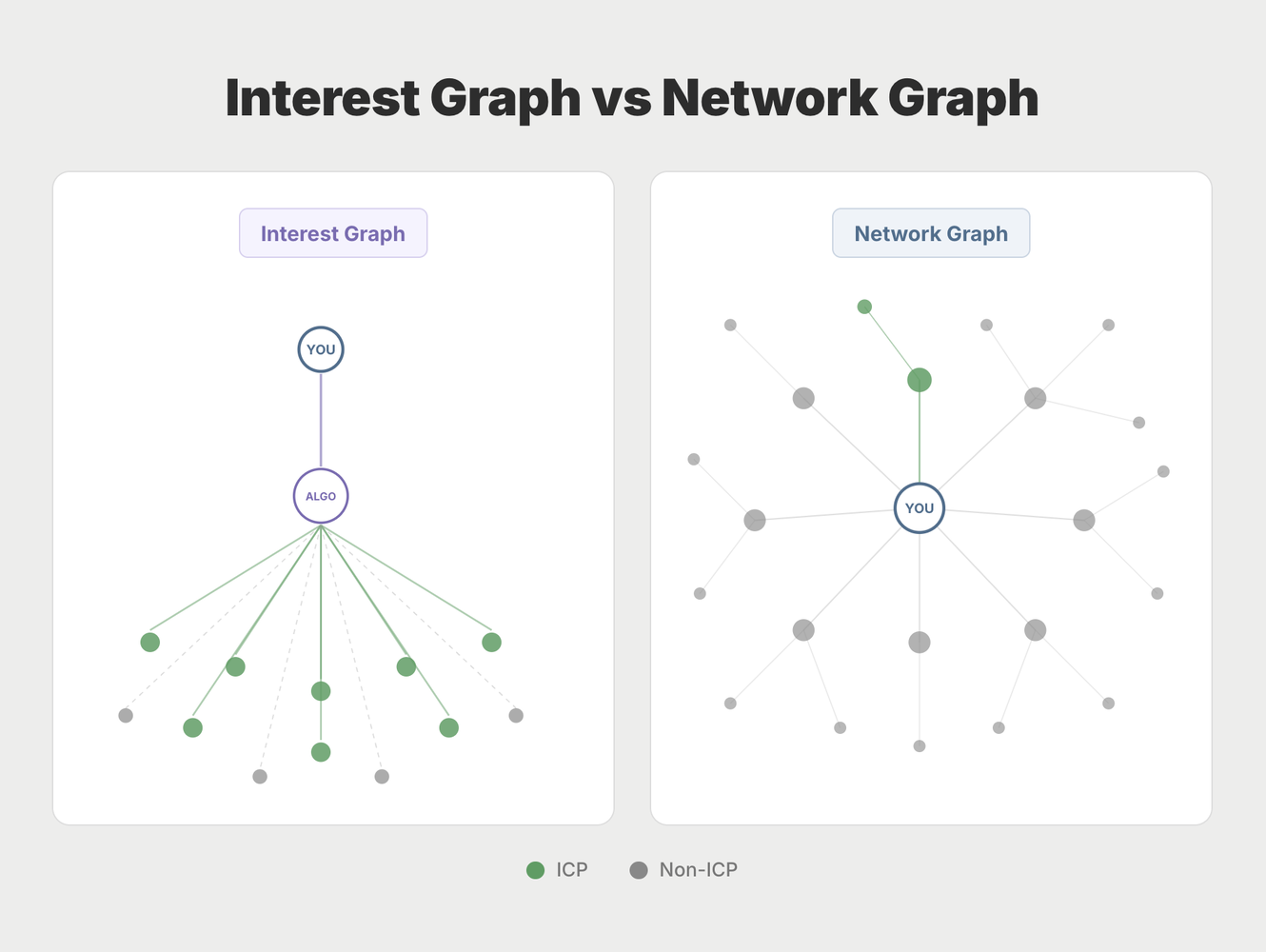
For as long as you continue to assume that LinkedIn functions like every other social platform you use, you will be terribly frustrated at the impact you're able to create here.
(Note: the only exception is a very limited number of "suggested content" placements on the feed as well as LinkedIn's video feed. Even these placements, which represent a very small portion of overall impression share, are only very broadly interest graphed. The vast majority of your content is going to live and die by your network.)
## The answer you don't want to hear
So then, we're all left to wonder: how on Earth can I get in front of my ICP if I don't already have tens of thousands of ICP connections and followers?
That's a great question, and the most straightforward answer is to pay LinkedIn advertising dollars to put that content in front of your ICP using Thought Leader Ads (TLAs) or Boosted Posts. In other words: pay to play.
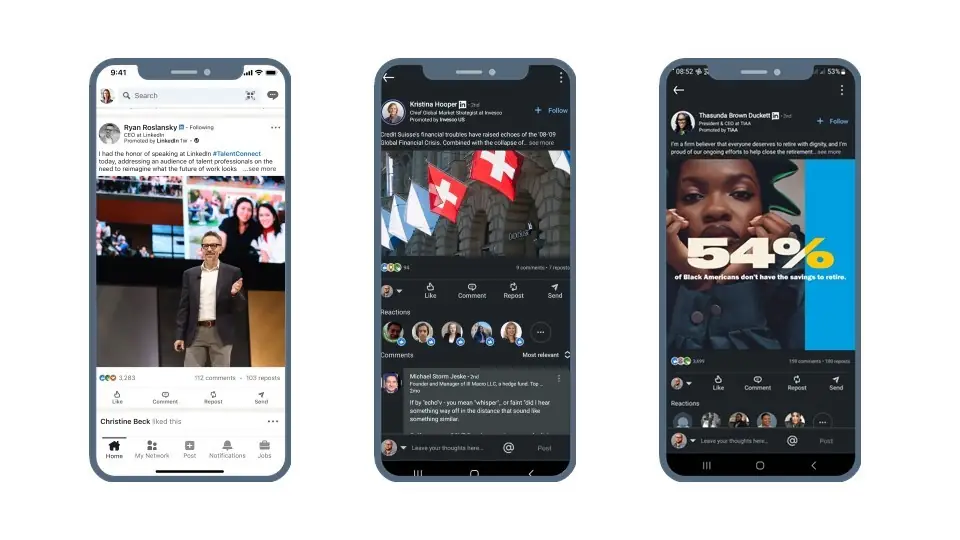
While that's a somewhat uninspiring conclusion, it's also relatively straightforward when you consider all the madness that growth purely through organic requires. A company can (and in my view, should) spend money to circumvent the algorithm and show their content to their ICP directly.
If you want to see the paid plus organic model executed at full scale, read [how Vibe.co took over LinkedIn on the way to a $1.4B acquisition](/blog/vibe-co-linkedin-strategy-case-study).
Unfortunately, not all companies are going to do this, mostly due to an incurable allergy to spending money on any marketing that isn't explicitly lower funnel. This is ironic when you consider that most companies have already spent years and countless dollars attempting to win on LinkedIn, only to produce organic content that is extraordinarily under-leveraged through the organic feed.
I digress. The business world does not always operate as rationally as one would hope.
## So you want to make this work organically
No ad dollars available. Got it. Now what?
In order to build an organic strategy that can effectively attract new ICP engagement and followers, we must first consider how content funnel stages interact with this network-based algorithm. At Influent, we classify content into funnel stages that correspond to the intended audience layer plus the buying-state of the reader. These distinctions matter for what comes next:
- **Upper Funnel (TAM):** Content that addresses broad industry topics, trends, or challenges the total addressable market cares about. The goal is reach and thought leadership by joining relevant conversations. It positions the company or executive as knowledgeable, but doesn't directly address specific customer problems or push toward conversion.
- **Mid Funnel (ICP):** Content focused on the specific problems and pain points the ideal customer profile experiences. The goal is to build urgency and make the reader recognize they have a problem worth solving. It quantifies the cost of inaction and frames the problem as strategic rather than operational. It rarely mentions specific solutions or products.
- **Low Funnel (In-Market ICP):** Content that teaches how to solve the problem through methodologies, implementation approaches, or tactical frameworks. The goal is to educate in-market buyers on what good solutions look like and how to evaluate options. It may present your product as one solution, but primarily de-risks the decision and shapes buying criteria.
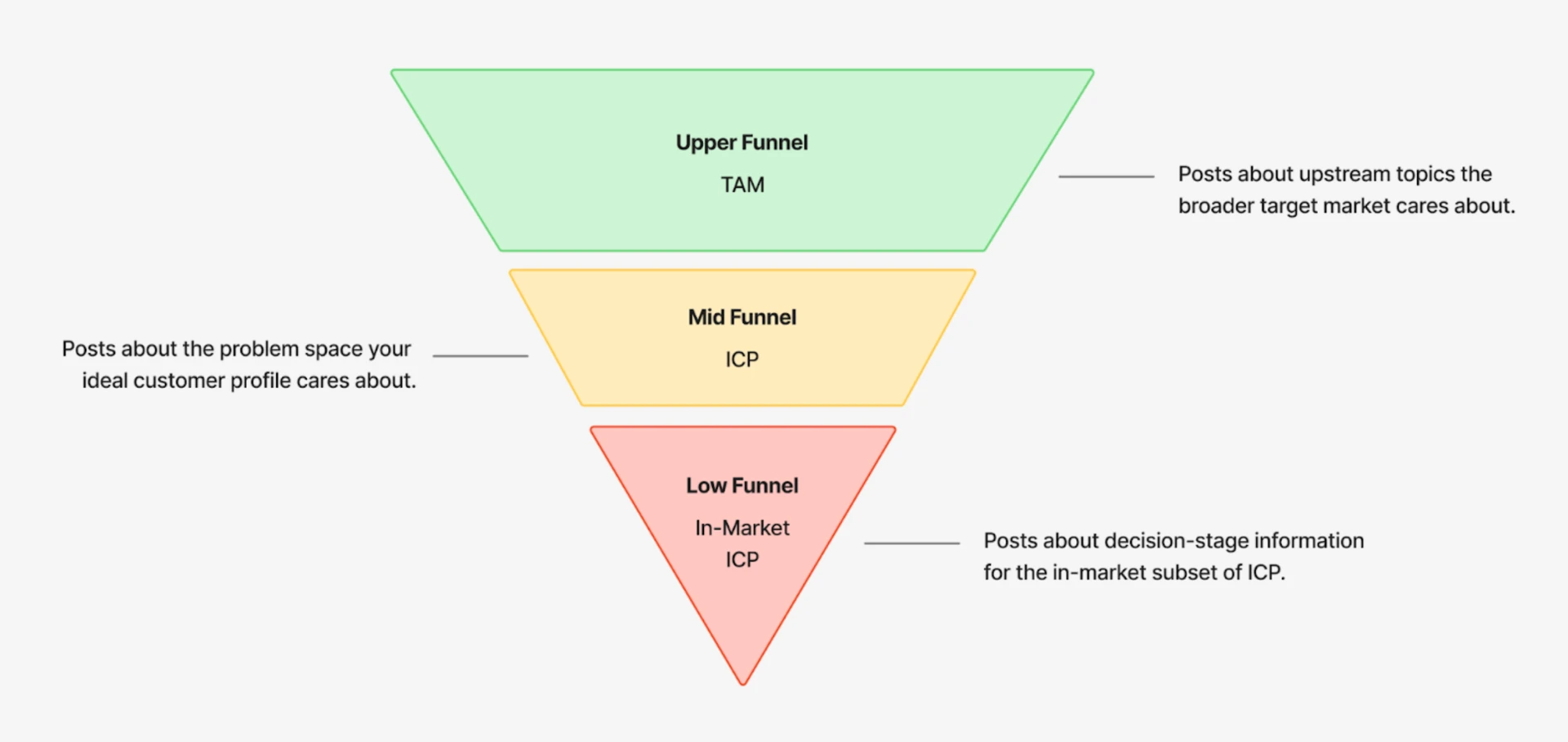
### Where the network graph and the funnel collide
As established, your existing network is a mixed population: former colleagues, industry peers, professional acquaintances, and somewhere in there, a small portion of your actual ICP.
But even among your ICP connections and followers, in-depth research (including research conducted by LinkedIn themselves) consistently shows that only 3 to 5% of any market is actively in buying mode at a given time. In-market buyers are a tiny fraction of your ICP, which is itself a fraction of your total network.
Low funnel content is written exclusively for that final fraction. Which means when you publish it, the vast majority of your network has no reason to engage. Low engagement means low distribution. Low distribution means no new followers. And without new followers, that fraction stays small or shrinks.
Executives who start here often struggle and interpret their lack of results as a content quality problem, not a distribution problem. So they keep rewriting the same low funnel posts until they get mad, claim they are shadow-banned, and quit.
Upper funnel content totally inverts this. When you write about broad industry topics relevant to your entire TAM, engagement comes from a much larger share of your existing network. Those engagements trigger distribution into their networks, populated by their peers, who are also likely in your TAM.
Your follower base grows, and it grows with the right people. Because each new TAM follower expands the network your future content distributes into, this effect compounds. The base accelerates rather than grows linearly.
Mid funnel content then does the filtering. Content that precisely names the problems your ICP is living with will resonate disproportionately with ICP-profile readers. They engage, they follow, and their networks skew similarly. Over time, the concentration of ICP followers within your audience increases.
By the time you deploy low funnel content, the audience it requires actually exists. The in-market buyers are there, because you built the base systematically, from the outside in.
## Beware the upper funnel vanity metric trap
There is some compounding irony built into this model that is worth pointing out. Upper funnel content, by design, reaches the broadest audience, which means it generates the most impressions, the most likes, and the fastest follower growth. Every metric that LinkedIn surfaces prominently will tell you it's working.
This creates a powerful incentive to stay there, one that is entirely rational given the feedback the platform provides, and entirely counterproductive given the actual goal. Executives post upper funnel content, see the numbers climb, and keep posting upper funnel content. Their audience grows. Their impressions grow. And they never understand why none of it produces pipeline.
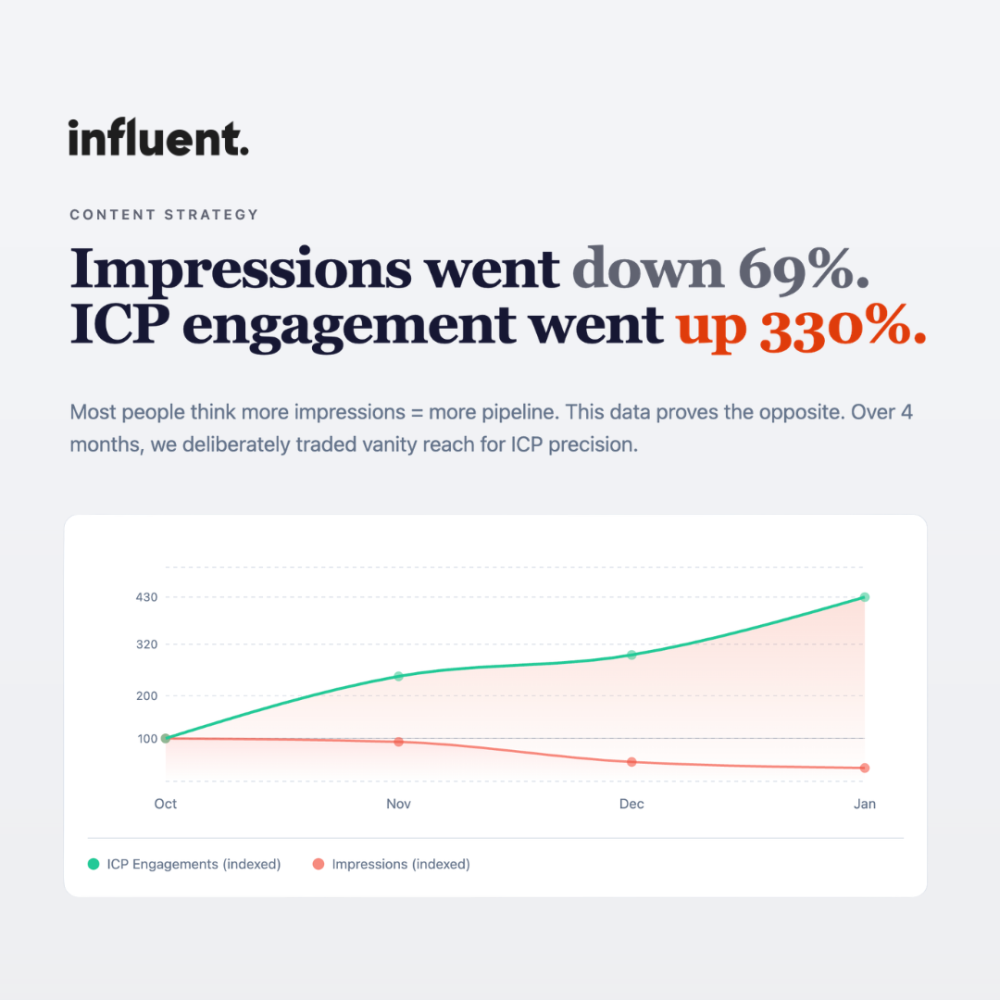
The same trap exists at the extreme end of upper funnel, which I call personal branding content (posts about leadership philosophy, career milestones, and professional identity). These often generate the highest engagement of all. But they're also the furthest removed from any commercial outcome.
Upper funnel content alone can build credibility, social proof, and broad market visibility. But if the goal is pipeline, target account pressure, or measurable ICP engagement (ICPE), upper funnel content alone will not get you there. This is why mid and low funnel content must be layered in deliberately, even when the metrics make it uncomfortable.
Mid and low funnel posts will almost always underperform upper funnel posts on vanity metrics. That is expected and by design. They are reaching a smaller, more qualified subset of your audience. The measure of their success is not impressions. It is ICP engagement rate, which is the strongest directly measurable correlate to lead flow and target account pressure available on the platform.
## Designing the strategy
Given all of this, the first question to ask when designing a content strategy is not "what should we write about?" but "what does our current network look like?" That answer dictates the content distribution.
Marketing leaders who reorganize around this distribution reality tend to share a specific set of habits, which I break down in [The LinkedIn-First CMO](/blog/the-linkedin-first-cmo).
When in-market ICP density is low, the strategy should weight heavily toward upper funnel content to grow the TAM base, layer in a moderate amount of mid funnel content to begin filtering ICP followers out of that growing base, and introduce low funnel content sparingly to serve the in-market buyers who do exist while beginning to shape buying criteria for those who aren't there yet.
As the overall audience grows and ICP density increases, those levers need to adjust. The strategy is not static. It responds to the composition of the network as it develops.
## The end part
You made it to the end. As your reward, here's a single paragraph you could have read instead of everything above:
Every other platform rewards great content with distribution. LinkedIn rewards great networks with reach. Until you internalize that distinction, you will keep producing content that deserves to work and wondering why it doesn't.
**Adjacent reading:** if you are weighing outside help to fix the distribution half of this, start with [the best LinkedIn marketing agencies in 2026](/blog/best-linkedin-marketing-agencies) and [what a program costs](/blog/linkedin-agency-pricing).
Garret Caudle
Founder, Influent
May 12, 2026 · 11 min read
Why LinkedIn has games:
the news strategy behind it
LinkedIn's daily puzzles aren't a quirky engagement experiment. They're a signal that LinkedIn is quietly becoming the newspaper of professional news.
LinkedIn launched six daily puzzle games in 2024: Pinpoint, CrossClimb, Tango, Zip Mini, Sudoku, and Queens (my fave).
"LinkedIn built a news feature that overrides its own algorithm in favor of human editorial judgment. That's pretty wild."
You probably fall into one of two groups. Either you love these games and play them every day, or (more likely) you do not care whatsoever. That is totally fair. Why should you care? It is a bit strange that a professional networking platform would put time and resources into building a poor-man's Wordle. But let's be honest, LinkedIn is a pretty strange place.
Well, I am here to tell you that you SHOULD care. LinkedIn's investment into games signals an incredibly important shift in the future of marketing and public relations, and if you fail to pay attention to these signals, you will get left behind.
Grab my hand. Let's go down the rabbit hole.
## What the hell do I know?
I am not a LinkedIn guru or course-bro. I do not want to sell you my expertise or convince you to download a fake "LinkedIn Algorithm Secrets" whitepaper.
I run a LinkedIn agency. We support 120 of the fastest-growing B2B companies in the world, and we are widely regarded as an industry leader in everything LinkedIn-related, from executive content to advertising to outbound.
What follows is based on my own experience and observations as well as privileged conversations I've had with experts in the space. Some of it may reframe something you thought you already understood.
## Who has games? Newspapers have games.
You might look at LinkedIn's games as a straightforward way to increase engagement on the platform. In a lot of ways you'd be right. But look a little deeper and consider what LinkedIn's real strategy is here.
These are not digital games in the traditional sense, like addictinggames.com or those weird Mafia games your Grandpa got addicted to on Facebook. LinkedIn's games are newspaper games. Crosswords, sudoku, that sort of thing. Quick to play, somewhat addicting, and they reset each day.
Not only that, but LinkedIn's games appear inside the LinkedIn News widget, right below all of the daily headlines. Both decisions (the type of games they built and where they show up) are VERY intentional.
Exactly like the NYT or any other newspaper, LinkedIn wants you to log in first thing each morning with your cup of coffee, read the news headlines, and do your little puzzle. By having these games, LinkedIn is sending a pretty overt signal about how they view themselves and how they want YOU to view them.
As a newspaper.
## Okay, so LinkedIn wants to be a newspaper?
Yes. Well, sort of. The 2026 version of one, at least.
Let me start by stating the obvious: the news industry is contracting. Local newspapers have lost two thirds of their journalists since 2005. The digital media companies that were supposed to replace them have gone through waves of layoffs and closures (RIP Buzzfeed circa-2014). The traditional infrastructure through which professional information reached professional audiences is shrinking, fragmenting, and in some verticals disappearing entirely.
LinkedIn looked at that contraction and basically said, "we're becoming the defacto place where people get their professional and industry news, maybe we should double down on that?"
And so they did. Over the last five-ish years, LinkedIn has quietly signed partnerships with over 400 publishers, built a revenue model to make journalism financially viable on the platform, and grown its editorial team to more than 250 people recruited from Bloomberg, the Wall Street Journal, CNBC, and others.
LinkedIn is trying to become the place where professional news lives, at the exact moment that the traditional places where professional news used to live are becoming unable to sustain themselves. That has HUGE implications for the future of news, earned media, and B2B marketing as a whole.
That shift changes the job description for communications teams, which is the subject of [The LinkedIn-First comms leader](/blog/the-linkedin-first-comms-leader).
## What exists today
Beyond games, let's look at what already exists in LinkedIn's editorial ecosystem. There's a lot, so if you want to skip ahead to the tactical "what to do next" stuff, I will not blame you.
### On the platform
On desktop, the LinkedIn News widget lives on the right side with headlines at the top and daily games below. On mobile it appears beneath the search bar after a scroll. The news section runs about 10 stories at a time.
Each headline shows when it was published along with a real-time reader count across the entire platform. Some stories sit at a few thousand readers, others reach hundreds of thousands, occasionally millions.
Click into a headline and you land on a LinkedIn-hosted page, not an external article. Sometimes it is written entirely by a LinkedIn editor (a summary, an analysis, their take on what matters). Other times it is a few editorial sentences and a link out to the underlying piece.
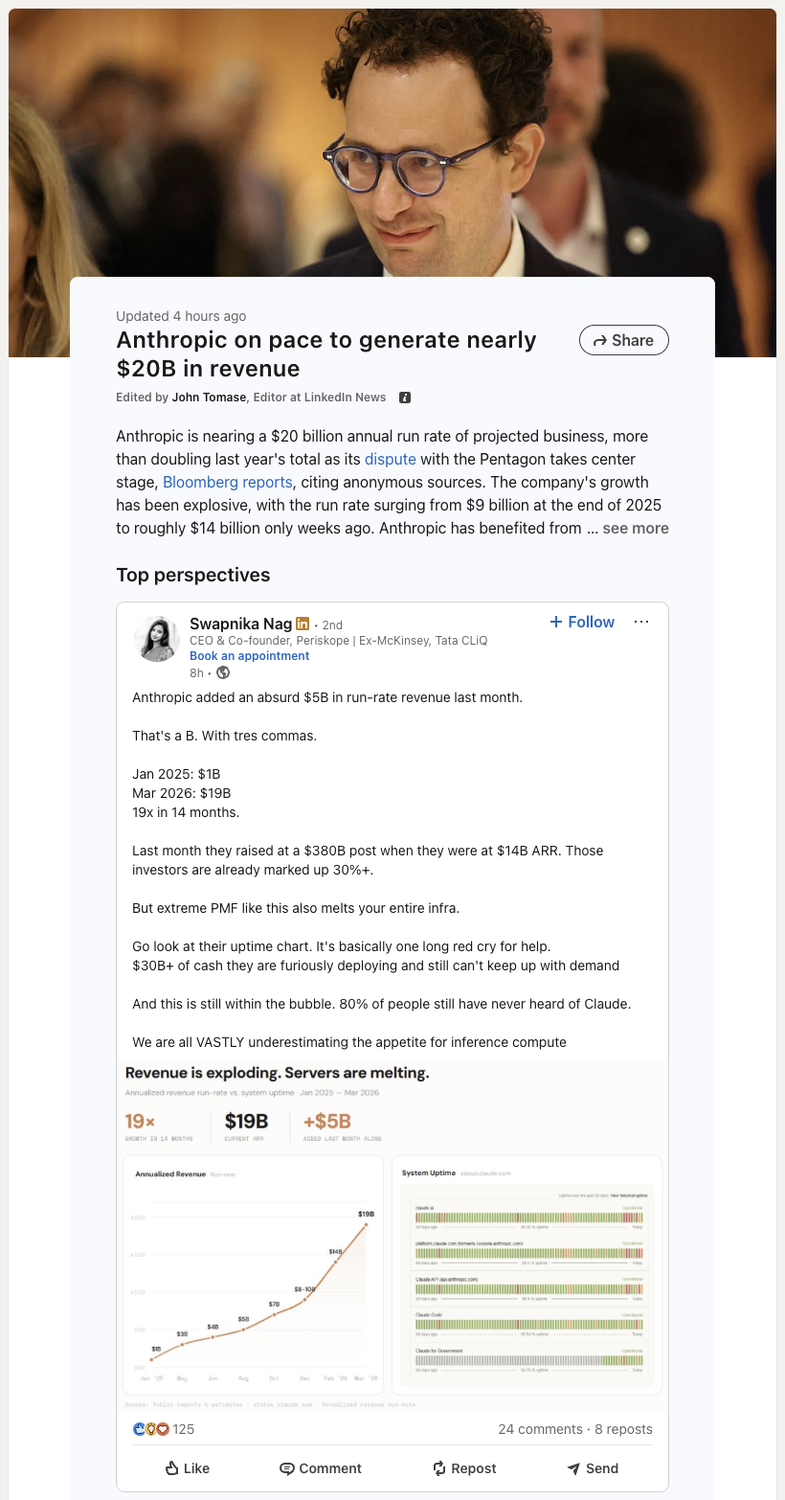
Scroll down on that page and you reach a section called **Top Perspectives**. These are posts from LinkedIn members (execs, journalists, industry experts) that the editorial team has manually selected as relevant to that story. They change throughout the day as editors add and remove posts.
The posts are not selected algorithmically and are not sorted by follower count. LinkedIn describes the selection criteria as "credibility, authenticity, and demonstrated expertise relative to the specific story." If that sounds like an editorial decision, much like a trade publication's editor makes every day, then you're starting to catch on.
There is also a News Banner that LinkedIn has been testing at the very top of the main feed, above the post feed entirely, that surfaces breaking stories curated by the editorial team in real time. It bypasses LinkedIn's own feed algorithm. Human-curated stories appear above everything else, regardless of what your network has been posting.
### The editorial team
LinkedIn's editorial operation started in 2011 with four or five people curating links from third-party publishers. There are now more than 250 of them.
They operate across 190 countries in 8 languages, recruited from Bloomberg, the Wall Street Journal, CNBC, HuffPost, and Wired. There are dedicated vertical editors for finance, technology, careers, and retail, organized into regional newsrooms across North America, Europe, Asia, and Latin America.
For context: the Financial Times has roughly 600 journalists worldwide. The Independent runs about 170 across the UK and US. LinkedIn's editorial team is a legit newsroom.
Their model, which they call "Breaking Views" rather than breaking news, holds that on any significant industry development the most valuable coverage is not a reporter's reconstruction of events, but an aggregation of perspective from practitioners actually operating inside the space. The editorial team's job is to identify who has the relevant expertise, surface their posts, and package them alongside or in place of traditional news articles.
### LinkedIn's own media channels
Beyond the widget and the curation work, LinkedIn runs its own editorial channels. LinkedIn staff, writing and producing content under LinkedIn's brand.
The LinkedIn News main page has 20 million followers, making it one of the most-followed company pages on the platform. Behind it sits a network of regional showcase pages (India, Europe, UK, Australia, Brazil, Germany, France, Japan, Latin America, the Gulf), each operated by a local editorial team. The India page alone reaches 43 million readers across 96 countries in 9 languages.
LinkedIn's editorial team also publishes its own newsletters and podcasts:
- The Finance Files covers finance and fintech
- Tech Stack decodes AI and tech trends for non-technical professionals
- Get Hired has 775,000 subscribers and a companion podcast
- Hello Monday with Jessi Hempel has featured Megan Rapinoe, Daniel Pink, and Barack Obama
- This Is Working with Editor-in-Chief Daniel Roth has hosted Jamie Dimon, Ray Dalio, and Richard Branson
All produced by LinkedIn. And that is just the owned media portfolio. Now look at what third-party publishers have built on top of it.
The Wall Street Journal's careers newsletter has nearly 3 million weekly subscribers on LinkedIn. CNN's PM Plug-In has 600K. Across the platform, LinkedIn has reported over 938 million total newsletter subscriptions. LinkedIn's own editorial team has publicly noted that the subscriber counts publishers accumulate on LinkedIn often dwarf what they get on their own native newsletters.
Publishers are building their most valuable audiences on LinkedIn's platform.
## So what are you supposed to do about it?
This is the part of the article you'll probably want to share or screenshot.
- **Merge your content and PR functions into one team.** LinkedIn has made content marketing and PR the same activity. The content executives publish is what LinkedIn's editorial team evaluates for selection. There is no separate pitching step. If your content and comms teams operate separately, they are fragmenting a single workflow.
- **Reassign budget from legacy earned media infrastructure.** Press release distribution, media database subscriptions, and trade pub sponsorships should be evaluated against the cost of funding an executive publishing program on the platform where editorial selection actually happens.
- **Study what LinkedIn's editorial team covers in your vertical.** Look at Top Perspectives for your industry. Note the topics, the angles, and who gets selected. Use that as the basis for your executive publishing cadence rather than defaulting to your existing content calendar.
- **Build a bench of executives, not just your CEO.** Each executive or subject matter expert publishing credibly is an additional entry point into LinkedIn's editorial layer, journalist sourcing, and audience reach.
- **Send connection requests to journalists, podcast hosts, and LinkedIn's editorial staff.** When those people are connected to your executives, your content appears in their feed organically. Every post functions as a passive pitch without requiring outreach.
- **Have your executives engage in other people's threads.** Commenting on posts from journalists, editors, and industry voices builds name recognition with the people who control editorial selection and press coverage.
- **Invest in video content.** LinkedIn's Editor-in-Chief has said they are placing bigger bets on video, and that leaders are increasingly coming to LinkedIn to break news and share insights on video directly.
- **Use Thought Leader Ads to place key executive posts in front of media professionals.** When an executive publishes something with news value, sponsor it as a TLA targeted to journalists and editors in your vertical. It appears as organic content in their feed rather than a press release in their inbox.
- **Track editorial selection as a KPI, not just engagement.** Measure whether executives are being pulled into Top Perspectives, LinkedIn News features, and editorial roundups. That is the earned media outcome on this platform.
- **Repurpose editorial placements into compounding earned media.** When an executive gets selected for Top Perspectives or quoted by a journalist who found them on LinkedIn, share it, reference it in future content, and use it in sales materials. Each placement makes the next one more likely.
## What it looks like when you get this right
The companies that understand what LinkedIn has become will treat executive content as core infrastructure:
- Your executives have a twelve-month track record of substantive content on the topics that matter in your industry.
- When a major story breaks, LinkedIn's editorial team already knows who your executives are and features them in Top Perspectives alongside the coverage.
- Journalists writing about your industry find your executives on the platform and reach out directly for comment.
- The buyers on your target account list encounter your executives' thinking repeatedly and form a favorable opinion long before a sales conversation happens.
- When you have something to announce, you have a real choice between traditional media and posting directly to an editorial infrastructure that will distribute it at platform scale.
Duolingo shared an all-hands email directly to LinkedIn announcing the company's transition to AI-first, and The Verge, Business Insider, and Tech Times all covered it afterward. Tinder's CEO announced a leadership change on her personal LinkedIn rather than through a press release, and about an hour later Spencer Rascoff responded to her post sharing that he would be taking over leadership of Tinder.
The clearest end-to-end example is when Nasdaq President Tal Cohen announced the exchange's plans to move to 24-hour trading. That is huge global news, and there was no press release, no embargo, and no advance briefing to reporters outside of LinkedIn's editorial team. Nearly 60 media outlets covered the story, and Bloomberg, Fast Company, and Reuters all cited his LinkedIn post as the primary source.
The post was the news, and LinkedIn was essentially the wire service.
**Adjacent reading:** [how the LinkedIn algorithm really works](/blog/everything-you-know-about-linkedin-is-wrong) and, if you are hiring for it, [how to choose a LinkedIn agency](/blog/how-to-choose-a-linkedin-agency).
Garret Caudle
Founder, Influent
April 29, 2026 · 10 min read
The LinkedIn-first comms leader:
a new B2B PR playbook
LinkedIn is now a media company with a social network attached. The comms function at most companies was designed for a very different world.
In case you missed the last 5 years:
- LinkedIn now has 250 news editors recruited from Bloomberg, the Wall Street Journal, and Reuters.
"The post is the pitch, the body of work is the credential, and the editorial placement is the earned media outcome."
- It operates a global editorial infrastructure that selects which practitioners appear alongside major news stories.
- Companies are now using LinkedIn as a breaking news distribution layer instead of issuing press releases.
- Reporters are using LinkedIn to identify thought leaders to feature in their stories.
LinkedIn has become, by any reasonable definition, a media company with a social network attached to it rather than the other way around.
Unfortunately, the comms function at most companies was designed, from top to bottom, for a VERY different world.
Content marketing and public relations have always operated as separate disciplines because they were separate activities. Content was publishing. PR was pitching. The teams were different, the skills were different, and the KPIs were different.
But on LinkedIn those two functions have converged into a single activity, because the content executives publish is what LinkedIn's editorial team evaluates for selection. The post is the pitch, the body of work is the credential, and the editorial placement is the earned media outcome.
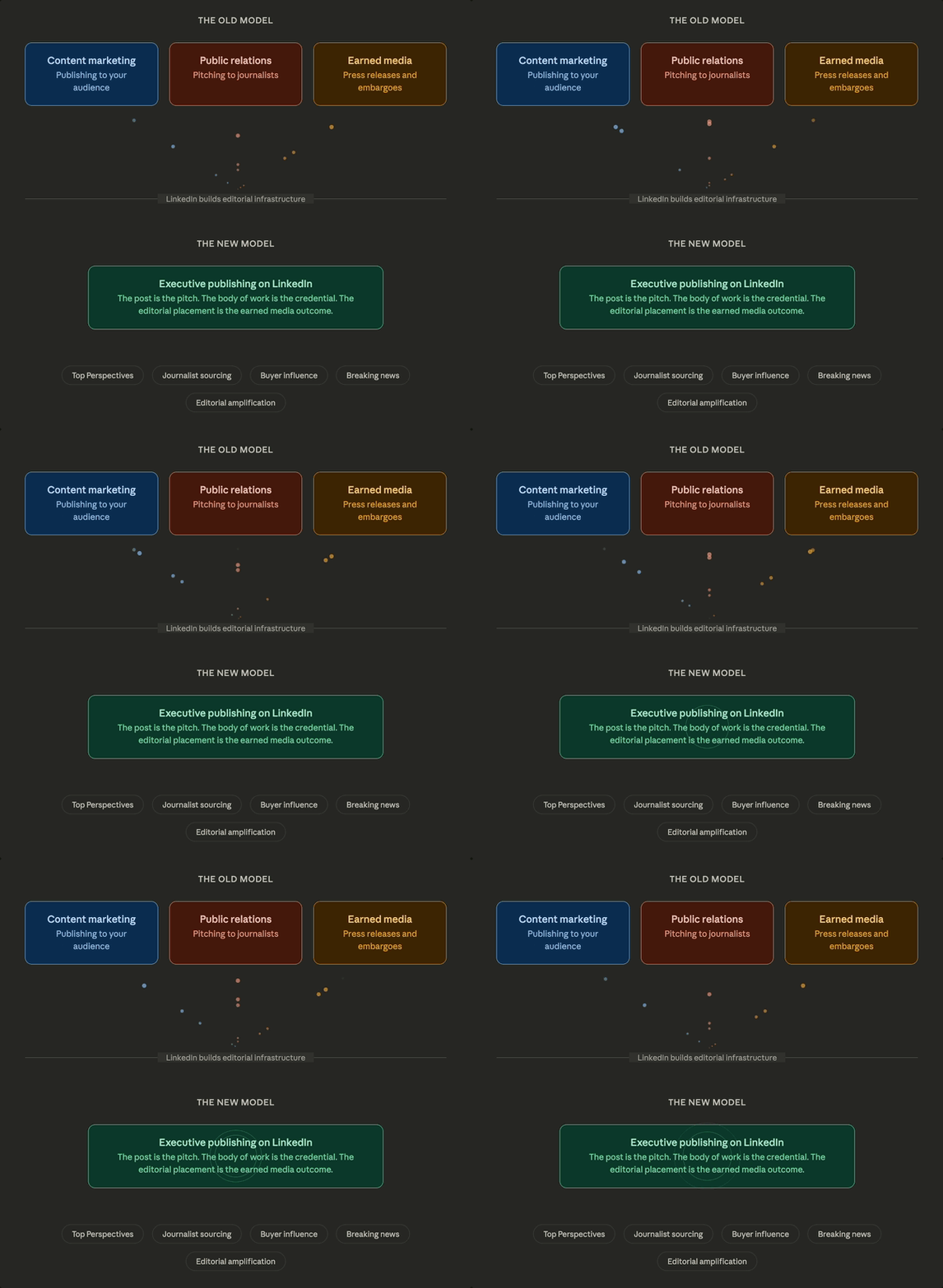
Most comms leaders have not reorganized around this. They are still running infrastructure designed for a media environment that no longer reflects how editorial selection, journalist sourcing, or buyer influence actually work on the platform where all three now happen.
It also helps to understand why executive posts stall in the first place, which comes down to [LinkedIn distributing content through networks rather than interests](/blog/everything-you-know-about-linkedin-is-wrong).
## So what would a LinkedIn-First comms leader look like?
If you run a communications team and you want to operate effectively on the platform where editorial selection, journalist sourcing, and buyer influence actually happen now, here are the seven things that define the role.
### 1. You study LinkedIn's editorial layer like you used to study beat reporters.
Look at Top Perspectives for your industry. Note the topics, the angles, and who gets selected. Pay attention to which formats get picked up, and which points of view get amplified versus ignored. Use that as the basis for your executive publishing cadence rather than defaulting to your existing content calendar. The comms leaders who treat LinkedIn's editorial infrastructure with the same rigor they once applied to media lists will outperform the ones who treat it as a social channel.
### 2. You build a bench of executives, not just your CEO.
Each executive or subject matter expert publishing credibly on the platform is an additional entry point into LinkedIn's editorial layer, journalist sourcing, and audience reach. Your CFO has a perspective on capital allocation that matters to a different audience than your CTO's perspective on infrastructure. Your VP of People has credibility on workforce topics that your CEO does not. Think in terms of a roster, not a single spokesperson.
### 3. You treat executive engagement as relationship building with the media.
Have your executives send connection requests to journalists, podcast hosts, and LinkedIn's editorial staff. When these people are connected to your executives, content appears in their feed organically, and every post functions as a passive pitch without requiring outreach. Commenting on posts from journalists, editors, and industry voices builds name recognition with the people who control editorial selection.
This is not a nice-to-have. It is the LinkedIn equivalent of the coffee meeting, the conference handshake, the "just wanted to put this on your radar" email. It is easier to earn attention from a network that already recognizes you, so build that familiarity continuously rather than scrambling when there is something to promote.
### 4. You use Thought Leader Ads as a precision media placement tool.
When an executive publishes something with news value, sponsor it as a TLA targeted to journalists and editors in your vertical. It appears as organic content in their feed rather than a press release in their inbox. This is one of the most underused capabilities in B2B communications. You can put an executive's point of view directly in front of the people who write about your industry, in a format that looks and feels like something they discovered on their own.
### 5. You merge content and PR into one function.
LinkedIn has made content marketing and PR the same activity. There is no separate pitching step. If your content and comms teams operate separately, they are fragmenting a single workflow. The brief that informs an executive's LinkedIn post is the same brief that should inform your media strategy, because the post is the media strategy.
### 6. You redirect budget toward executive publishing.
Press release distribution, media database subscriptions, and trade pub sponsorships should be evaluated against the cost of funding an executive publishing program on the platform where editorial selection actually happens. This does not mean those legacy channels are worthless. It means the ROI comparison has shifted, and most comms budgets have not shifted with it.
### 7. You measure what actually matters now.
Track editorial selection as a KPI, not just engagement. Measure whether executives are being pulled into Top Perspectives, LinkedIn News features, and editorial roundups. That is the earned media outcome on this platform. Impressions and likes are fine as secondary indicators, but they are not the thing.
And when it happens, repurpose it. When an executive gets selected for Top Perspectives or quoted by a journalist who found them on LinkedIn, share it, reference it in future content, and use it in sales materials. Each placement increases the likelihood of the next one.
## The bottom line
The comms function was built for a world where a small number of gatekeepers decided which perspectives reached professional audiences. Those gatekeepers still exist, but most of them now do their selecting on LinkedIn. The comms leaders who reorganize around that reality first will own the earned media advantage for as long as everyone else keeps treating LinkedIn like a social channel.
For the marketing-side version of this same shift, see [The LinkedIn-First CMO](/blog/the-linkedin-first-cmo). For why LinkedIn is making the move at all, see [the secret reason LinkedIn has games and news](/blog/the-secret-reason-linkedin-has-games).
Garret Caudle
Founder, Influent
June 24, 2026 · 12 min read
The LinkedIn-first CMO:
7 traits of modern B2B marketing leaders
LinkedIn-First CMO sounds like a niche specialization. In a few years, it will simply be called a CMO. Here is what that role looks like.
"LinkedIn-First CMO" sounds like a niche specialization. Like a CMO who just-so-happens to focus on LinkedIn the way that others might specialize in ABM or demand gen or events.
That is not what this article is about. No siree, Bob.
"Investment in any one layer of the LinkedIn flywheel accelerates every other layer. Fund the system, not the tactics."
The LinkedIn-First CMO is not a LinkedIn specialist. In the very near future, they will simply be called a CMO.
My position: LinkedIn has spent two decades accumulating the attention of the entire professional class of the western world, verified, credentialed, and incentivized to keep their information current. What that creates is a marketing substrate with no obvious alternative.
As data quality becomes more premium, as thought leadership becomes more personal because of AI, as traditional media gatekeepers continue to fade away, as traditional search is replaced with AI queries, and as in-person events make way for virtual experiences, every meaningful marketing tactic will pass through LinkedIn whether marketers have planned for it or not.
In the next five years, most B2B marketing will look like this:
- GEO/AEO to LinkedIn
- Content marketing to LinkedIn
- Public relations to LinkedIn
- Paid media to LinkedIn
- Outbound to LinkedIn
- Virtual events to LinkedIn
- Influencer marketing to LinkedIn
Therefore, any CMO who builds their strategy without LinkedIn at the center is ignoring the only path forward that exists for B2B marketing. What follows is a description of the CMO who understands this, and what it practically requires of them.
The mechanics behind that centrality are worth understanding first: [LinkedIn's algorithm is network-based, not interest-based](/blog/everything-you-know-about-linkedin-is-wrong).
### 1. They understand the LinkedIn flywheel, and they feed it deliberately.
Because all of these tactics converge on the same platform, they are subject to compounding. Executive content builds audience. That audience makes paid distribution more efficient. Paid distribution amplifies the content to reporters and analysts. Reporter engagement builds earned media. Earned media reinforces the executive's credibility on the platform. That credibility makes community growth easier. Community drives influencer relationships. Influencer relationships generate new content. And so on.
The CMO who takes this to heart does not fund each tactic in isolation and measure them separately. That would be short-sighted. Instead, they recognize that investment in any one layer accelerates every other layer, and they make resourcing decisions with that compounding logic in mind.
I've seen the alternative over and over again: the CMO who does not understand the above consistently underinvests in LinkedIn because no individual tactic looks like a sufficient standalone return. Don't be that CMO.
### 2. They treat content marketing and PR as a single function.
On LinkedIn, content marketing and PR are the same practice executed toward different goals by people who need to be in constant alignment.
The comms-side playbook for that merger lives in [The LinkedIn-First comms leader](/blog/the-linkedin-first-comms-leader).
Journalists who cover your industry are on LinkedIn. They follow executives in your space, they form opinions based on what those executives post, and they reach out for comment based on what they have already read. The Nasdaq President announced 24-hour trading with no press release and no advance briefing outside of LinkedIn's editorial team. Nearly 60 outlets covered it, and Bloomberg, Fast Company, and Reuters all cited the LinkedIn post as the primary source.
When the content your executives publish for marketing purposes is the same material that reporters encounter before writing about your industry, the teams responsible for those posts and the teams responsible for media relationships cannot operate in separate lanes. PR becomes more of a content practice than a pitching practice, and most marketing orgs are not close to ready for that shift.

### 3. They have a high tolerance for CPMs and they have abandoned the obsession with organic.
LinkedIn CPMs are high because the audience quality is high. Slow down and read that again.
The CMO who is perpetually hunting for cheaper distribution is making a tradeoff that will inevitably bite them. Yet most CMOs continue to be allergic to spending real money on LinkedIn paid because of the relatively high CPMs, and instead double down on organic because it is "free."
Great organic content is not free. It requires significant time from skilled people, is subject to algorithm changes outside of your control, and depends heavily on factors you cannot manufacture, including how interesting and credible your executives are to a given audience. The total cost of a quality organic program, when you account for the people it requires, is often higher than a targeted paid program that delivers comparable results with more precision and less variance.
The more important point is that paid and organic are not in competition. The LinkedIn-First CMO uses paid to push organic content to exact audiences, including the reporters covering their industry, the analysts evaluating their category, and the target accounts their sales team is working. Thought Leader Ads exist specifically for this.
### 4. They become significantly better at managing executive personalities.
CMOs already sit between CFOs demanding attribution and CEOs demanding brand equity. The LinkedIn-First CMO inherits an additional layer of complexity. They are now dependent on those same executives to be the source of content, the face of content, and a consistent presence on the platform.
Get this wrong in public and it looks like [the McDonald's CEO backlash](/blog/mcdonalds-ceo-backlash-thought-leadership-warning).
Personal brands are not like other marketing assets. Most executives are very precious about their voice, skeptical about marketing, and frequently resistant to the strategic direction that would actually serve the company's interests. The same VP who challenges the CMO's budget allocation in Q3 planning is also the person whose LinkedIn content needs to reinforce the ICP messaging the CMO is building the entire program around.
The LinkedIn-First CMO has to manage this without eroding the relationship. They have to keep executives focused on content that moves buyers without making them feel managed, and be the steward of a thought leadership program while giving individuals enough creative latitude to show up authentically. It is one of the harder people-management challenges in the modern CMO role.
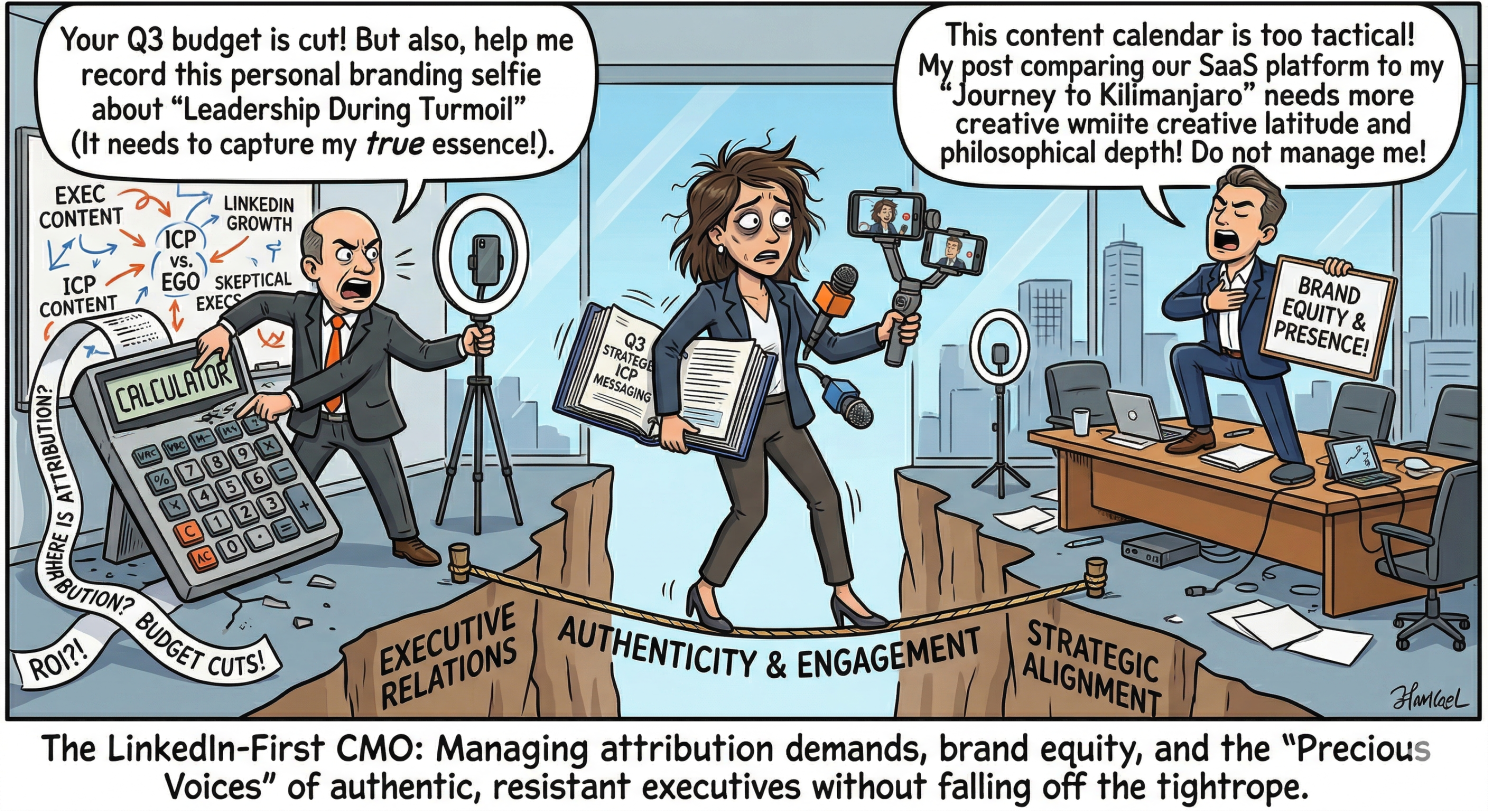
### 5. They build a close working relationship with RevOps.
LinkedIn generates signals. The problem is that LinkedIn also makes those signals difficult to aggregate and harder to push into a CRM in a form a sales team can actually use. The intent data space has been attempting to solve this for years, and the challenge does not get easier when most of your marketing activity lives inside a closed ecosystem that actively restricts scraping and data portability.
The LinkedIn-First CMO who does not have a close operational relationship with their sales and RevOps leaders will generate influence they cannot prove and signals they cannot action. The inverse is also true. When a CMO can identify which target accounts have been engaging with executive content, surface those contacts at the right moment, and pass them to a salesperson who is already warm-reaching them inside the same platform, the ROI case becomes clear and the sales cycle compresses.
### 6. They operate at the speed of the news cycle.
LinkedIn is social media, which means it moves with the news cycle. After running a LinkedIn agency for five years, I can tell you without a doubt that the best content opportunities open and close quickly. A relevant POV posted within hours of a relevant development can reach millions of people. The same post, three days later, performs like any other.
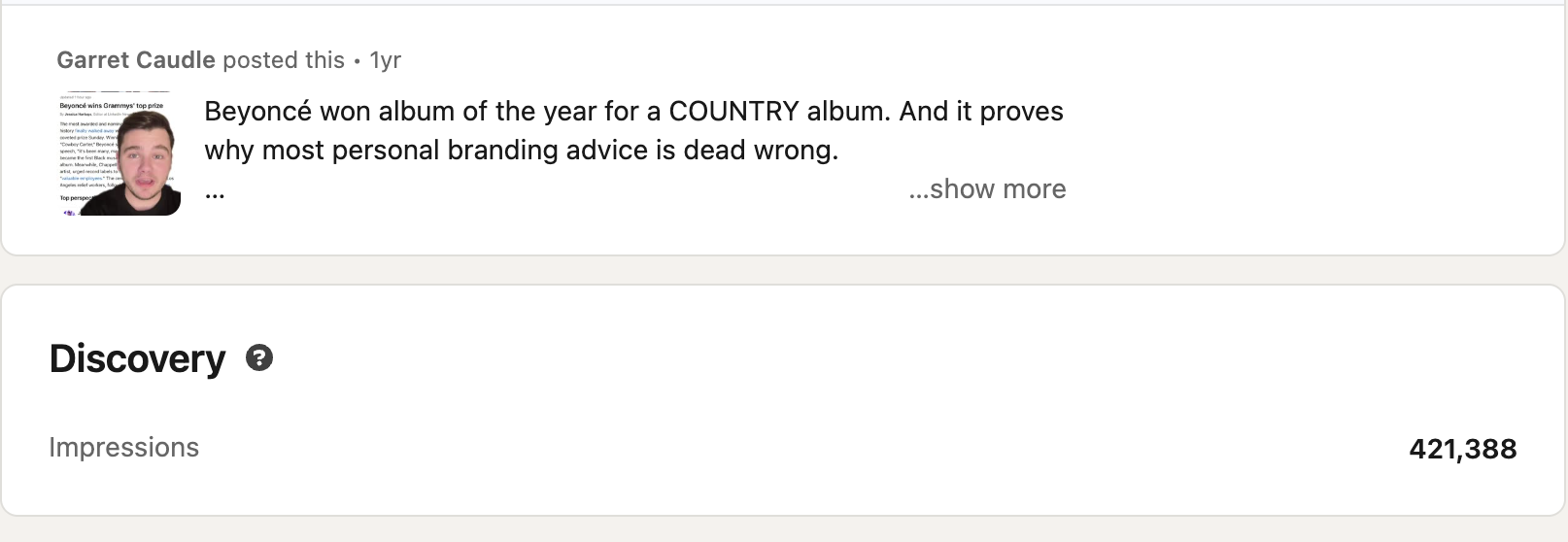
Most marketing organizations, especially at very big companies, were not built to move that fast. Content goes through multiple review rounds. Legal has a standing request to review anything external. The exec who needs to sign off is in back-to-back meetings. By the time the post goes live, the moment is gone.
The LinkedIn-First CMO builds their team for speed: clear approval structures, a defined set of topics where executives can publish without review, and an organization that treats timeliness as a competitive advantage rather than a risk.
### 7. They treat LinkedIn as infrastructure, not a channel.
Channels get a line item, a quarterly review, and a chance to justify themselves. Infrastructure gets funded because everything else depends on it. The LinkedIn-First CMO has made that reclassification internally, and they defend it in front of the board with the compounding logic of the flywheel rather than the last-touch math of a single campaign.
That is the whole shift. Not a specialization. Just what the job is becoming.
Garret Caudle
Founder, Influent
May 28, 2026 · 8 min read
Why CEO thought leadership backfires:
the McDonald's lesson
Picking the CEO as the default thought leader despite an obvious audience-fit problem is the most common reason executive content fails.
The McDonald's CEO video and subsequent backlash is an embarrassingly public version of a mistake I see B2B companies make constantly: picking the CEO (or founder) to be the default thought leader despite an obvious audience-fit problem.
This comes from a fundamental misunderstanding of the executive influencer trend as simply "our CEO posts content." When you get to a massive scale like McDonald's, the repercussions of making this mistake are massive. If you're a B2B exec it won't look this dramatic, but it will mean your content is ineffective at best, and majorly damaging to your brand at worst.
"The CEO posting is not the issue. The lack of audience alignment is."

Here's the mental model you need to avoid the mistake, and a suggestion for a better way forward.
## The framework: content-market fit
There's a concept we use at Influent called **content-market fit**. It sits at the intersection of three things: what the executive can speak to with real depth, what the target audience actually cares about in their day-to-day life, and what connects back to a commercial outcome.
If any one of those three is missing, the content either gets ignored, gets vanity engagement from the wrong people, or gets attention and never converts.
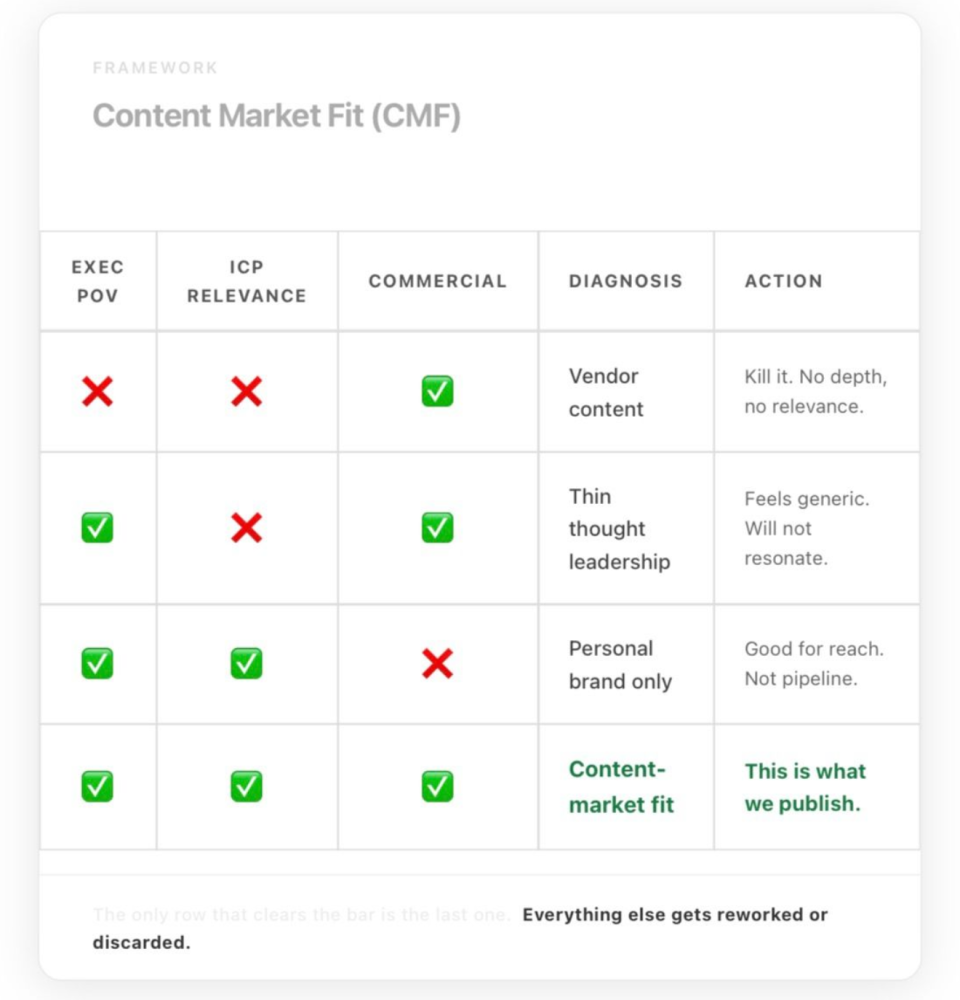
The McDonald's video failed on the first and second checks:
- The CEO does not have an interesting perspective on the burger.
- Consumers do not care what the CEO of McDonald's thinks about the new burger.
That is not information that affects their decision to buy a Big Arch. And the moment he called it a "product" instead of food (which, to be fair, is probably what every executive at that level calls it internally), the distance between his world and the consumer's world was all anyone could see.
## Same CEO, different audience, different outcome
That same CEO, talking about that same sandwich, to a different audience, could honestly have been the right move:
- Kempczinski on LinkedIn talking to franchise owners about what the Big Arch means for average ticket size.
- Speaking to investors about how this is their first permanent global menu addition since Chicken McNuggets in 1983 and what that signals about their product roadmap.
- Addressing supply chain partners about how they scaled a half-pound burger across 13,000+ U.S. locations.
He is deeply credible on all of those topics. He passes all three checks. The CEO posting isn't inherently an issue. It's the lack of audience alignment that makes this go off the rails.
## The B2B version of this mistake
I see this exact mistake constantly with B2B tech companies. A CEO who is a commercial operator gets positioned as the thought leader for a deeply technical product, and the content falls flat with the engineering audience they're trying to reach. Or the reverse: a technical founder gets positioned to speak to the buying committee three levels above the end user, and the content reads like a product spec when it should read like a business case.
The mismatch between the person, the topic, and the audience is the single most common reason executive LinkedIn content doesn't drive pipeline.
The second most common reason is distribution: [LinkedIn reaches your network, not everyone interested in your topic](/blog/everything-you-know-about-linkedin-is-wrong).
This problem has an obvious solution when companies think about it in the context of external influencer partnerships. In B2C, you pair the creator to the audience. A fitness brand doesn't send the CFO to promote protein bars on TikTok. They find someone whose audience equals the buyer. The matching is intuitive and nobody questions it. When companies turn inward and think about their own executives as thought leaders, the matching disappears. CEO equals thought leader. That's the default assumption, and it's almost always wrong at scale.
## The multi-voice model
The better model is a multi-voice approach, and very few companies are doing it well.
The obvious benefit of using multiple thought leaders is more flexibility with audience matching, because different people can speak to different segments. The less obvious benefit (and the more exciting one, in my opinion) is that each voice unlocks content territories that literally do not exist for the other voices:
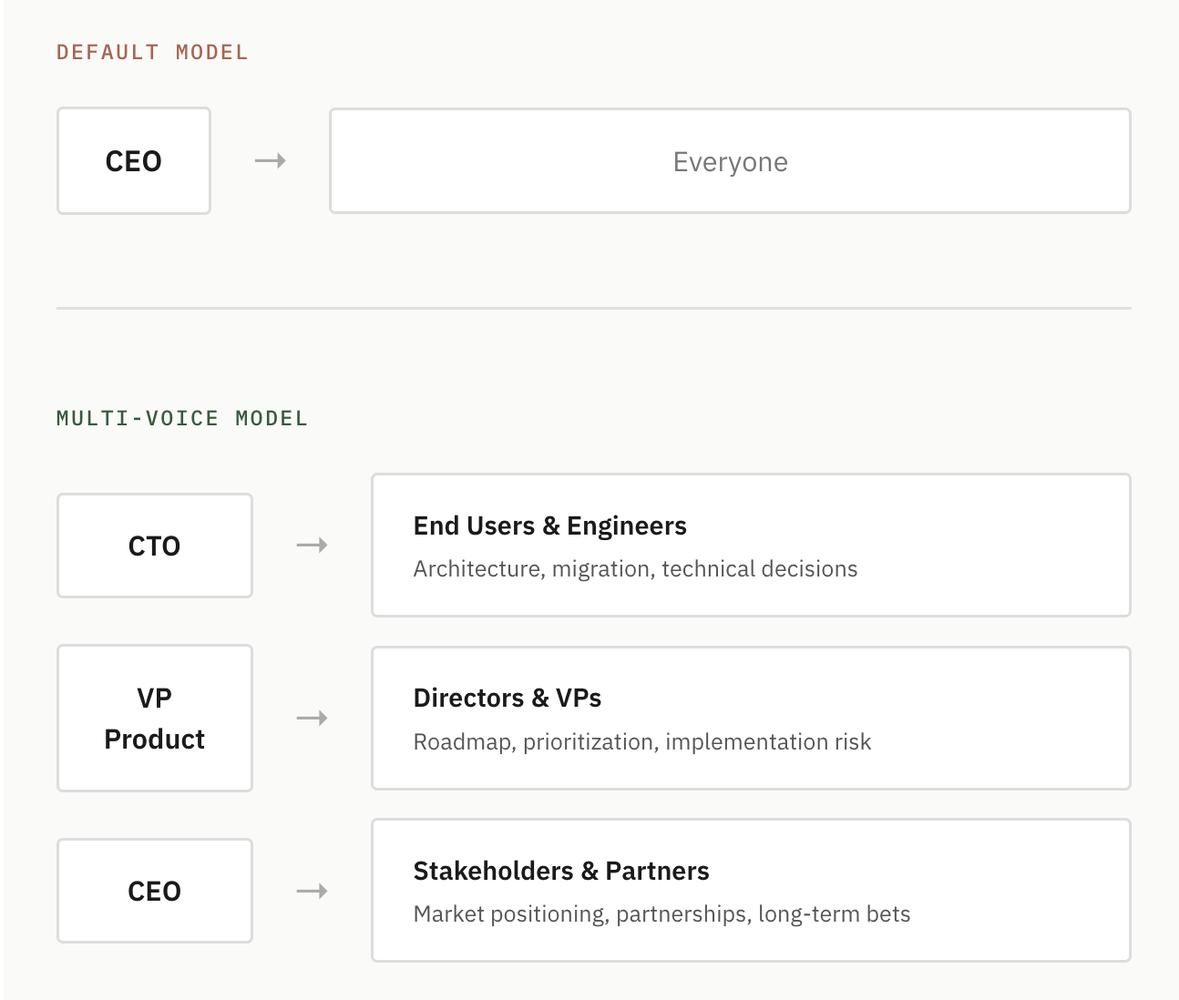
- A CTO can get into architectural tradeoffs, migration complexity, and the real reasons a technical decision was made. That content cannot come from the CEO. The CEO saying it would feel performative, and the audience would know immediately.
- A VP of Product can speak to roadmap philosophy, prioritization frameworks, and how customer feedback actually gets weighted.
- The CEO can speak to market positioning, partnership strategy, and the long-term bet the company is making and why.
These are entirely different bodies of content that only become possible when you put the right person behind them.
This maps directly to how B2B buying actually works. You are not selling to one person. A typical B2B deal involves 4 to 6 stakeholders, and each of them is evaluating the purchase through a completely different lens. The end user cares about whether the product actually works day to day. Their manager cares about implementation risk and team adoption. The VP cares about strategic alignment and ROI. The CFO cares about total cost of ownership and contract terms.
A single executive voice, no matter how good, has content-market fit with maybe one of those people. The rest scroll past.
When you map voices to the buying committee, the content strategy stops being "how do we get our CEO more reach" and becomes "how do we make sure every person involved in this purchase decision encounters a credible voice from our company speaking directly to their concerns."
In the McDonald's case, this could look like a 12-person content operation. Someone from R&D talking about the 50 iterations they tested before landing on the Big Arch sauce (that person would have taken a real bite, by the way). A franchise operator talking about what launch day looks like operationally. A supply chain leader talking about sourcing a new SKU at that scale. And the CEO talking to shareholders, franchise owners, and the press, which are the audiences where his perspective actually carries weight.
We build this for B2B clients. The engineer speaks to the technical end user. A VP of Product speaks to leadership. The CEO speaks to stakeholders and partners. Each voice has content-market fit with their specific audience, and each voice unlocks entire categories of content that would not exist if the company had defaulted to CEO equals thought leader.
For a multi-voice program running at scale, see [how Vibe.co took over LinkedIn](/blog/vibe-co-linkedin-strategy-case-study), and for the leadership model behind it, [The LinkedIn-First CMO](/blog/the-linkedin-first-cmo).
Garret Caudle
Founder, Influent
June 16, 2026 · 11 min read
The best LinkedIn marketing
agencies in 2026
A practical shortlist of the LinkedIn agencies worth a call in 2026, what each one is actually good at, what they publish for pricing, and the five questions that tell you which one fits.
Most companies shopping for a LinkedIn agency are not really shopping for an agency. They want target accounts to know who they are, respect what they think, and eventually buy. The problem is that "LinkedIn marketing" is six different jobs sold by six different kinds of vendor, and picking the wrong one costs you a year.
This guide sorts the market by job, names the agencies worth a call in each, lists the pricing they publish, and gives you the questions that reveal what a vendor actually operates. Full disclosure up front: we run a LinkedIn program ourselves, and we say where we fit at the end.
## Start here: pick the job, then the vendor
| If this is your situation | The job you are buying | Start with |
| --- | --- | --- |
| Nobody in our target accounts has heard of us | Executive content | Stop The Scroll, Demandii, Linkedist |
| We have good content, the right people never see it | LinkedIn Advertising | B2Linked, Impactable, Refine Labs |
| Accounts engage with us but nothing turns into a meeting | LinkedIn Outbound | Cleverly, Belkins |
| We need credibility fast in a market we are new to | Influencer / creator marketing | Creator Authority, CreatorMatch |
| Buyers check our page mid-deal and it looks dead | Company page content | Sculpt, SociallyIn |
| We have a lot of employees and no reach | Employee advocacy | DSMN8 (software, not a program) |
If more than two rows describe you, a single-job vendor will not fix it, and the section on integrated programs at the end is the relevant one.
## Why companies hire the wrong vendor
Almost every buyer knows two things: they need awareness and pipeline, and their buyers are already on LinkedIn. What they do not know is the mechanism. So they go shopping for one, and the market hands them a menu of categories, each presenting itself as the answer and each one a single link in a chain.
The choice ends up being a false one. You think you are picking a tactic. What you came in wanting was an outcome from a platform, and those are two different purchases.
## The six jobs, and what each one cannot do alone
| The job | What it does | What it cannot do alone |
| --- | --- | --- |
| LinkedIn Advertising | Puts budget in front of a defined target account list | Create anything worth putting in front of them |
| LinkedIn Outbound | Turns intent and engagement into direct conversations | Generate the warmth that makes the message land |
| Influencer marketing | Rents reach from creators who already have the audience | Leave you owning anything when the campaign ends |
| Executive content | Builds a point of view in a founder or exec voice | Reach buyers outside that person's network |
| Company page content | Gives the brand a credible, current presence | Build authority with a buying committee on its own |
| Employee advocacy | Multiplies reach through people who already work there | Aim that reach at the accounts you actually want |
Every gap in the right-hand column is filled by another row, because all six answer one underlying problem: [LinkedIn distributes content by network, not by interest](/blog/everything-you-know-about-linkedin-is-wrong). Content creates the asset. The algorithm decides who sees it, and it gets that wrong. Paid overrides the algorithm and forces the asset in front of the accounts you chose. Outbound converts attention that already exists. Creators borrow a community someone else spent years building. The company page catches the buyer who is already looking you up.
Two of the six carry a common misconception worth flagging before you spend money on them. Employee advocacy sold as a tool that prompts 200 people to like a post is counterproductive: when the same employees engage with everything, you teach the algorithm to serve your content to people who will never buy. The useful version is more voices actually creating, mapped to different segments of the buying committee. Company pages work poorly as a distribution lever, because almost nobody follows them and the algorithm is biased against brand posts. Judge the page on credibility for the decision-stage buyer, not on reach.
## LinkedIn Advertising
**Best for:** you already produce content that lands, and you need it in front of a named account list.
### [B2Linked](https://b2linked.com)
LinkedIn Ads specialists and effectively nothing else. Their site states they have audited more than 800 LinkedIn Ads accounts, and they are the most pricing-transparent agency we found: $3,000 per month plus a $1,000 setup fee for budgets under $15,000 per month with a three-month minimum, moving to 6 to 20 percent of spend above that. They also publish a $2,000 audit and a $2,200 per month Thought Leader video offering.
### [Impactable](https://impactable.com)
A B2B demand agency running LinkedIn Ads alongside paid search, Meta, and programmatic. SaaS, cybersecurity, and financial services are their listed focus categories. LinkedIn Marketing Partner. No published pricing.
### [Refine Labs](https://refinelabs.com)
Full-funnel demand generation well upmarket, with LinkedIn paid media as one channel inside a broader program. Their site references B2B tech clients at Series B and beyond, $50MM+ ARR, and more than 300 clients. Published pricing: paid media management from $14,000 per month with a six-month minimum, full service from $26,000 per month, creative-only from $5,000 per month.
**Also worth a call:** [Taktical](https://taktical.co), [Triple Dart](https://tripledart.com), [SociallyIn](https://sociallyin.com), and [Stop The Scroll](https://stopthescroll.io), which sells ads alongside executive content.
**Watch for:** an ads agency that will happily spend your budget on whatever creative you hand them. Ask what they do when the creative is the problem.
## LinkedIn Outbound
**Best for:** converting accounts that have already engaged with you. It is the worst-performing of the six when run cold.
### [Cleverly](https://cleverly.co)
The best-known name in LinkedIn outbound, running connection requests and messaging sequences at volume on behalf of clients. Sold as standalone lead generation, disconnected from any content or advertising program.
**Also in this category:** [Belkins](https://belkins.io) and most SDR-as-a-service shops, which run the same cold, high-volume sequences with no engagement signal behind them. That is why outbound has the worst reputation of the six jobs. Run against accounts that have already engaged with your content, it converts better than any of them.
## Influencer and creator marketing
**Best for:** borrowing credibility in a market where you have none yet, for a defined campaign window.
### [Creator Authority](https://creatorauthority.com)
Focused on LinkedIn creator partnerships, arranging and measuring them on your behalf. Limited public detail and no published pricing.
**Also in this category:** [CreatorMatch](https://creatormatch.com), [Viral Nation](https://viralnation.com) for broader multi-platform campaigns, and [Sculpt](https://wearesculpt.com) inside its social offering.
**Watch for:** the campaign ends and you own nothing. Budget it as rented attention, and have something of your own for that attention to land on.
## Executive content
**Best for:** almost everyone, because this is the only one of the six that produces an asset you keep.
### [Stop The Scroll](https://stopthescroll.io)
Content for B2B founders and executives plus LinkedIn ads, which puts them in the small group doing both. They skew toward startups and scale-ups. Published pricing: individual content from $3,000 per month, teams from $5,000 per month, ads management from $3,000 per month.
### [Demandii](https://demandii.com)
A LinkedIn-focused agency built around executive and founder content, publishing consistently in the leader's own voice. No published pricing.
### [Linkedist](https://linkedist.com)
A broad LinkedIn menu covering content, personal branding, ads, audits, and workshops. They reference IT, SaaS, fintech, and public-sector clients and more than seven years as a LinkedIn agency. No published pricing.
**Also producing executive content:** [Compound](https://compound.so), [Shake Content](https://shakecontent.com), [BAMF](https://bamf.com), [Sonder & Tell](https://sonderandtell.com), [Sculpt](https://wearesculpt.com), and [SociallyIn](https://sociallyin.com).
**Not the same thing:** personal branding shops such as [Klowt](https://klowt.com) and [Qnary](https://qnary.com). Personal branding optimizes how an individual is perceived. Executive content exists to reach a specific buying committee, which is a different objective and a different measurement model.
**Watch for:** ghostwriting priced per post with reach as the only reported metric. Ask what happens to the post after it is published.
## Company page content
**Best for:** the decision-stage buyer who looks you up. Not a growth channel.
### [Sculpt](https://wearesculpt.com)
A B2B social agency covering organic and paid social across platforms, operating since 2012 with SaaS, enterprise, cybersecurity, and manufacturing clients. Company-page and brand social sits at the center of the offering.
**Also in this category:** [SociallyIn](https://sociallyin.com), which handles company-page social alongside broader brand social work.
## Employee advocacy
**Best for:** companies with a large employee base and a real internal owner. This is software, not a program.
### [DSMN8](https://dsmn8.com)
The reference name in the category, with a platform that makes it easy for employees to share approved company content, plus leaderboards and reach reporting. The platform handles distribution mechanics, but strategy and content fall back on your internal team, and the reach is untargeted unless something upstream aims it at your account list.
## Five questions that tell you who you are actually talking to
Every vendor above will say yes to "can you help us grow on LinkedIn." These five separate them.
1. **Which of the six jobs do you operate in-house, and which do you hand back to us?** The honest answer is usually one or two. The answer you want is a clear boundary, not a claim to do everything.
2. **How do you decide what an executive should post about?** Look for a method tied to the buying committee and to commercial outcomes, not "we interview you and find your voice." [Content-market fit](/blog/content-market-fit) is the shape of a good answer.
3. **What happens to a post after it is published?** If nothing happens, you bought a writing service. Amplification, retargeting, and engagement follow-up are what turn a post into pipeline.
4. **What will you report in month three, and what does it tell us about pipeline?** Impressions and follower count are not answers. Ask how engaged accounts get into your CRM. [Here is what that measurement looks like](/blog/measure-category-ownership).
5. **What do you refuse to do?** A vendor with no boundaries is selling whatever you will buy. Any good partner will name tactics they think are a waste of your money.
## What this costs
From published rates across the agencies above, the working ranges look like this. Nearly all of them exclude ad spend, which you pay on top.
| What you are buying | Typical monthly range |
| --- | --- |
| Ads management (sub-$15k spend) | $3,000 or 6 to 20 percent of spend above that |
| Executive content for one leader | $3,000 to $6,000 |
| Executive content across a leadership team | $5,000 to $15,000 |
| Full-funnel demand gen, upmarket | $14,000 to $26,000+ |
| Employee advocacy software | Seat-based, usually four figures |
Minimum terms of three to six months are normal, and they are reasonable: nothing on LinkedIn shows a clean result inside 90 days. [A fuller cost breakdown is here](/blog/executive-linkedin-program-cost).
## When you need an integrated program instead
If you buy one job, you own one link, and nothing compounds. The compounding that makes LinkedIn worth funding shows up when content creates the asset, paid aims it at the account list, engagement is tracked, and outbound converts the accounts that raised their hand.
That is what we do at Influent, and it is the reason this guide exists, so weigh it accordingly. We run all six jobs as one sequenced program with executive content as the spine.
:::system-chain
We are equally specific about what we do not do: no spam outbound, no company page ads, no ego-service ghostwriting, no bulk employee liking. Across the 70+ programs we have seen, roughly 95 percent of executives use about a third of what LinkedIn offers, which is content alone, so they get impressions instead of pipeline because the content was never wired into anything else.
Laid against the vendors above, the coverage looks like this.
| The job | Agencies that sell it | Influent |
| --- | --- | --- |
| LinkedIn Advertising | B2Linked, Impactable, Refine Labs, Taktical, Triple Dart, SociallyIn, Stop The Scroll | Yes |
| LinkedIn Outbound | Cleverly, Belkins | Yes |
| Influencer marketing | Creator Authority, CreatorMatch, Viral Nation, Sculpt | Yes |
| Executive content | Stop The Scroll, Demandii, Linkedist, Compound, Shake Content, BAMF, Sonder & Tell, Sculpt, SociallyIn | Yes |
| Company page content | Sculpt, SociallyIn | Yes |
| Employee advocacy | DSMN8 | Yes |
If one job is genuinely your gap, hire the specialist in that row. They will do it better than a generalist. If three or more rows describe you, buying them separately means paying three vendors to not talk to each other.
## Go deeper on one decision
This guide is the overview. Each of the guides below takes one part of the decision further, and they all lead back here.
| If you still need to work out | Read |
| --- | --- |
| What a program actually costs, model by model | [LinkedIn agency pricing in 2026](/blog/linkedin-agency-pricing) |
| Whether to hire an agency, an employee, or a freelancer | [Agency vs in-house vs freelancer](/blog/linkedin-agency-vs-in-house-vs-freelancer) |
| How to run the evaluation itself | [How to choose a LinkedIn agency](/blog/how-to-choose-a-linkedin-agency) |
| Which content agency type fits your team | [Best LinkedIn content agencies](/blog/best-linkedin-content-agencies) |
| What an ads agency should be reporting to you | [LinkedIn Ads agency KPIs](/blog/linkedin-ads-agency-kpis) |
| Sector fit for B2B SaaS | [Best LinkedIn agencies for B2B SaaS](/blog/best-linkedin-agencies-b2b-saas) |
| Sector fit for CPG and trade | [Best LinkedIn agencies for CPG brands](/blog/best-linkedin-agencies-cpg) |
| Executive content specifically, firm by firm | [Best executive LinkedIn agencies](/blog/best-executive-linkedin-agencies) |
Garret Caudle
Founder, Influent
July 14, 2026 · 11 min read
Vibe.co's LinkedIn strategy:
the $1.4B acquisition playbook
Walmart acquired Vibe.co for a reported $1.4 billion. A breakdown of the three-part LinkedIn motion behind the run, pulled entirely from public data.
Walmart just acquired Vibe.co for a reported $1.4 billion.
Vibe.co sells connected TV advertising to SMBs in a category full of older, bigger, much better-funded competitors, and they still reached $250M ARR and a 10-figure exit in about four years.
**The results, in short:** four executives grew 34,052 followers between them, about 120% of the company page's 28,370. Vibe ran 6,735 ads in the LinkedIn ad library, roughly 5x MNTN and 14x Tatari. Their CEO's version of a funding announcement out-performed the company page's by 3x (1,056 reactions vs 346). Once attribution was fixed, LinkedIn returned more than a dollar for every dollar spent, and the budget grew.
Plenty of people have written about their subway ads, their out-of-home spend, and their CTV campaigns. Almost nobody has written about what they did on LinkedIn, which is where I think the most transferable lessons live.
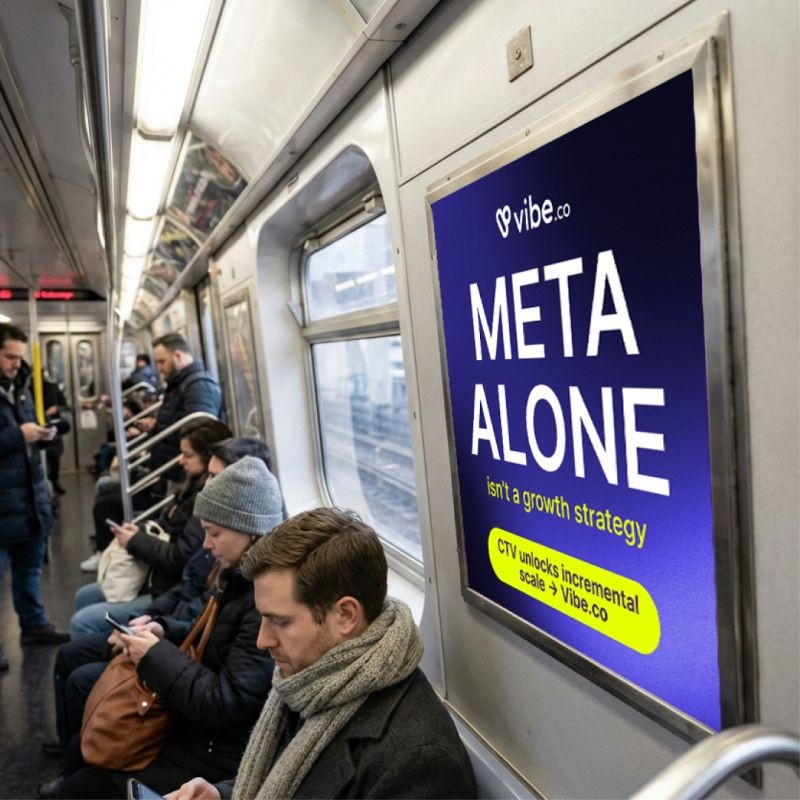
On July 10, 2026, I pulled their entire public LinkedIn footprint: the ad library, every executive's post history, the company page, and the same data for their three closest competitors (MNTN, Tatari, and tvScientific). Everything below comes from those public sources.
## The three parts of the strategy
When a company says it is going all in on LinkedIn, it usually means one of two things: a ghostwriter has been hired to turn the CEO into a philosopher, or a lead gen vendor has been hired to spray InMail across the market. Vibe did neither.
Their program breaks into three motions:
- **Executive thought leadership.** Multiple executives posting, each mapped to a different member of the buying committee, amplified with Thought Leader Ads.
- **LinkedIn-native PR.** Company news announced through executive profiles rather than the company page, then paid into the target account list.
- **LinkedIn-native partnerships.** Integrations and investor relationships turned into media moments rather than one-off announcements.
The common thread: organic proves what is worth amplifying, and paid buys the reach organic can never earn on its own.
## Part 1: Executive thought leadership
Vibe's company page has 28,370 followers. Their four most active executives total 34,052 between them, roughly 120% of the company page.
- Arthur Querou, CEO: 17,167 followers
- Senda Ben Abdallah, Director of Brand and Product Marketing: 7,754 followers
- Romain Marsal, VP Growth and Marketing: 5,154 followers
- Quentin Marchese, CRO: 3,977 followers
Nobody else in the category is close. Measured against their own company pages, executives at Tatari sit at 36%, tvScientific at 32%, and MNTN at 9%.
:::bars Executive followers as a share of the company page | Vibe.co::120::120% | Tatari::120::36% | tvScientific::120::32% | MNTN::120::9%
### Coverage of the buying committee
A decision to spend on CTV advertising typically has to clear four people, and Vibe put an executive in front of each one:
Mapping voices to the buying committee is the same fix for [the mistake behind the McDonald's CEO backlash](/blog/mcdonalds-ceo-backlash-thought-leadership-warning). We use a simple [three-vector framework for multi-executive LinkedIn strategy](/blog/multi-executive-linkedin-strategy) to decide which executives to activate and what each one owns.
- **The CEO or founder**, who wants to know whether the channel works at all. Covered by Arthur, the CEO.
- **The C-suite revenue leader**, who wants evidence that CTV produces sales. Covered by Quentin, the CRO.
- **The marketing VP**, who wants to know how it works day to day. Covered by Romain, VP of Growth.
- **The marketing director**, who wants to see the creative and messaging. Covered by Senda, Director of Brand and Product Marketing.
Each executive posts for their own peer set, which matters for three reasons. They have credibility with those peers. LinkedIn's algorithm is network-based, and each executive is connected to more of their counterparts than anyone else at the company. And LinkedIn weighs whether your profile actually supports the subject you are posting about.
"When someone's profile signals expertise in a specific area and their content reflects that same expertise, credibility matters tremendously in terms of distribution in the feed," LinkedIn's VP of Trust Products, Oscar Rodriguez, has said publicly.
### What each of them actually posts
Arthur, the CEO, posts company results, including revenue and growth rate every quarter. Build in public, essentially. It works because growing revenue implies thousands of marketers keep buying CTV, and because revenue curves are intrinsically interesting to other founders.
Romain, the VP of Growth, posts the marketing department's approach and numbers. He published the full $40M 2026 budget as a spreadsheet, and that post drew 451 reactions and 188 comments, more than any product announcement any Vibe executive has ever published. Marketers almost never get to see a peer's real budget, and a marketing engine that visibly works makes the product look credible by association.
### Thought Leader Ads carry the reach
Organic posts travel through an executive's existing network, and most of Vibe's future customers are not in those networks. So Vibe pays LinkedIn to place the posts in front of the companies it wants.
This is the network-based distribution ceiling in action, explained in full in [everything you know about the LinkedIn algorithm is wrong](/blog/everything-you-know-about-linkedin-is-wrong).
The scale gap is the whole story:
| Company | Ads in LinkedIn ad library |
| --- | --- |
| Vibe.co | 6,735 |
| MNTN | 1,363 |
| Tatari | 481 |
| tvScientific | 364 |
They watch which executive posts perform organically, then put budget behind the ones that have already proven themselves. Untested creative does not get funded.
The ads also run from more than the four core executives. Vibe used 12 or more employees and outside voices, including Jerome Pilz (VP Sales and Partnerships), Alexandre Pham (EVP Enterprise), and outside creators like Nick Shackelford and Martin Galabru. Some of those people barely post organically, which does not matter, because the point is not their followers. The point is that a buyer keeps seeing different faces from the same company.
### Targeting and measurement
In an interview with LinkedIn, Romain described the targeting approach: Vibe keeps roughly 100,000 target companies in its CRM with about 30 facts recorded about each one, such as which marketing tools they use and whether they already run ads elsewhere. Those companies are then sorted into groups, and each group sees the message that fits it rather than one generic ad.
Measurement nearly killed the channel. At first they only counted sales that happened right after an ad click, and by that standard LinkedIn looked like it was not working. After they changed the model, LinkedIn turned out to be producing significant business, particularly through brand campaigns and video Thought Leader Ads that were reaching accounts that later became sales conversations. Romain could then show the CFO that every dollar spent returned more than a dollar, and the budget grew.
### The company page's real job
Vibe's page posts funding news, product announcements, customer results, and jobs. Its best post ever, the $50M raise, drew 346 reactions. Arthur's post about the same news drew 1,056.
:::bars Best-ever post, reactions | Company page, $50M raise::1056::346 | Arthur (CEO), same news::1056::1,056 | Romain (VP Growth), $40M budget post::1056::451
The page is not built for reach. It is built for the buyer who is close to a decision and goes to look the company up, which buyers always do. That person finds the banner, the customer logos, a pinned testimonial, and a record of progress.
## Part 2: LinkedIn-native PR
Vibe announces company news through executive profiles and pays to distribute it.
That is the comms model described in [The LinkedIn-First comms leader](/blog/the-linkedin-first-comms-leader), running at full speed.
When the Walmart acquisition was announced, Arthur posted it on his personal profile and drew 2,653 reactions and 397 comments. His co-founder posted a version. So did the CRO, the VP of Sales, and the EVP of Enterprise. The ad library shows those posts running as paid Thought Leader Ads.
One announcement from a company reads like an announcement. The same news arriving from five different people, repeatedly, reads like the industry talking about it. The buyer cannot miss it, and assumes everyone else is seeing it too, even though every version came from the same company.
They extend the same logic into podcasts, appearing on shows in the space and then layering Thought Leader Ads on top of the clips to squeeze more reach out of each placement.
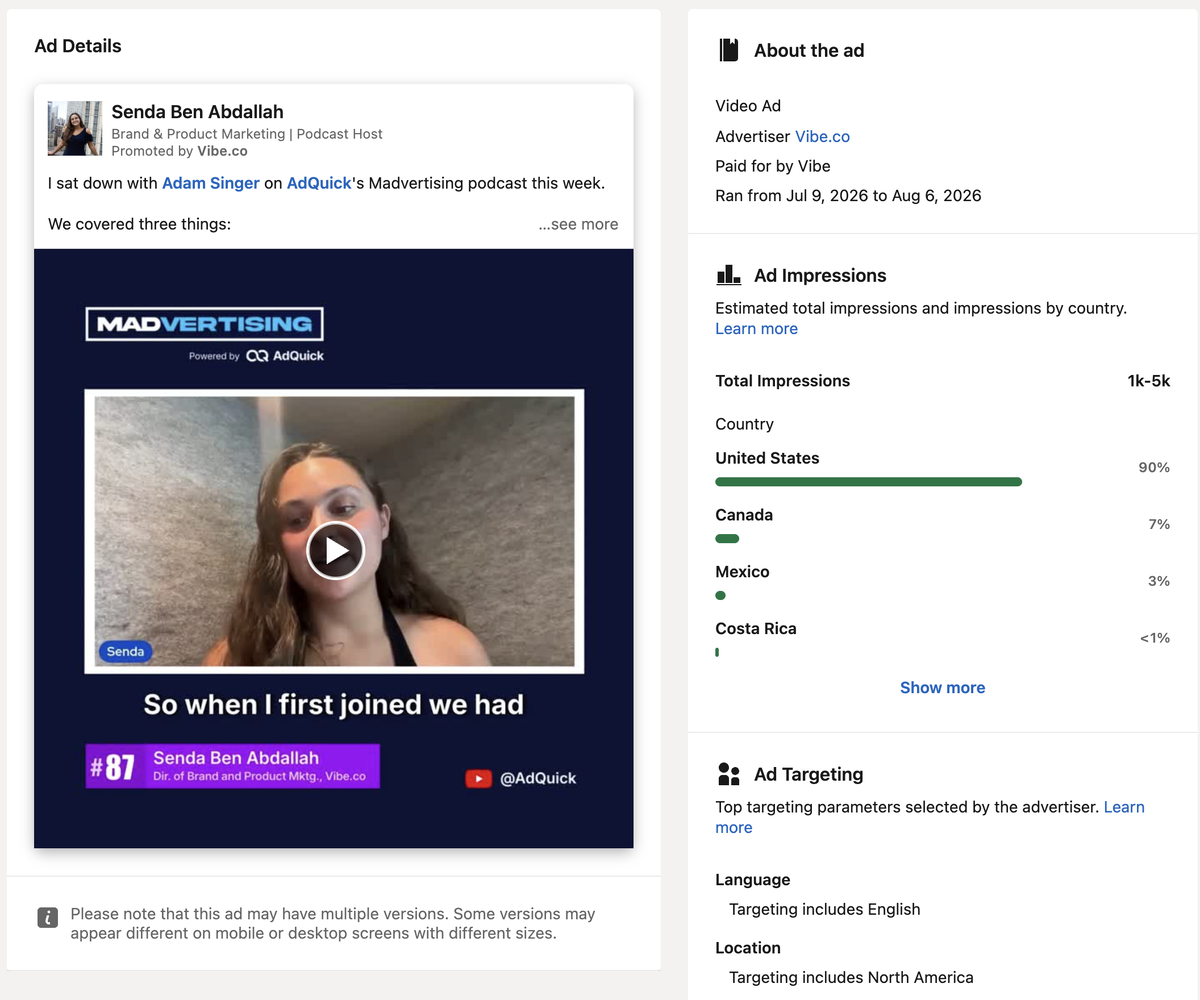
## Part 3: LinkedIn-native partnerships
When Vibe integrates with another software company, they treat it as a campaign rather than a one-time announcement. Their Clay integration was, for at least a month, the most-used ad in their library, running in at least three forms: a company ad about retargeting a Clay audience on streaming TV, a sponsored post from Quentin, and a sponsored post from outside creator Martin Galabru.
Everyone using Clay is a marketer who buys software and runs campaigns, which is exactly Vibe's buyer. The same pattern shows up with HubSpot, with analytics partners like Northbeam, and even with investors such as QuantumLight.
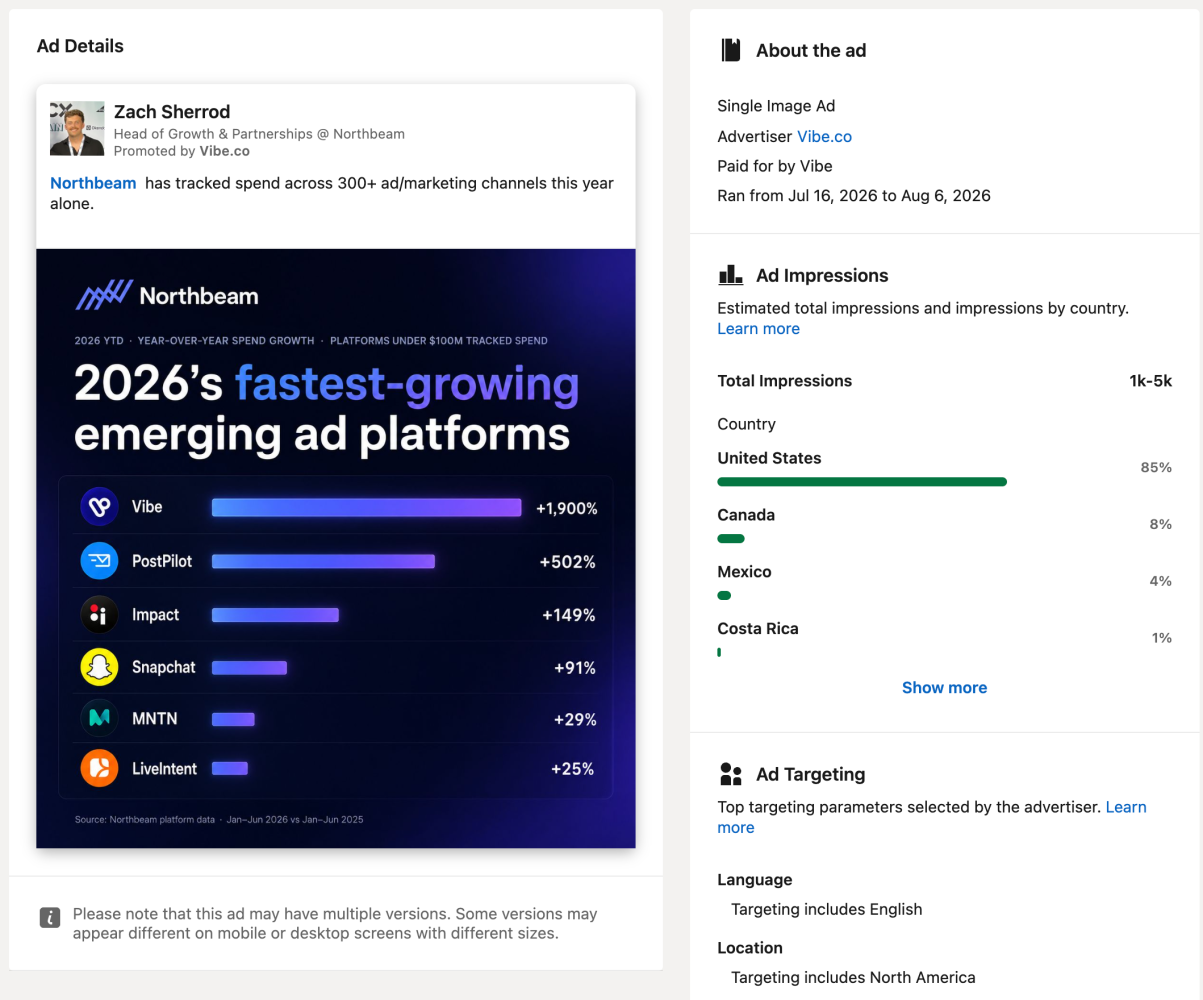
Each partner already has an audience full of the same kind of marketer. An investor endorsement reads as third-party validation rather than a sales pitch. And when vendors start posting about Vibe unprompted, one company's message starts to look like industry consensus.
Part 1 borrows credibility from Vibe's own executives to reach their peers. Part 3 borrows credibility from partners, investors, and vendors to reach the same buyer through someone other than Vibe.
## Why running all three together matters
No competitor in the category runs all three. Their founders post, and that is where it stops. MNTN has the largest company page in the category and Ryan Reynolds as Chief Creative Officer, and runs no Thought Leader Ads at all. Every ad in its library comes from the company page.
Each motion makes the next one work better. Executive posts build an audience. A larger audience makes ads cheaper, because the people seeing them already recognize the person. Ads put the posts in front of target companies and partner audiences the executives could never reach alone. Those new people follow the executives, and the next post travels further.
Fund only one piece and you get none of that. A company that hires a ghostwriter for its CEO has exactly one person posting into whatever audience they already had.
## How to apply this to your own program
- Compare your executives' combined follower count to your company page's. If the page is far ahead, your reach depends on the asset buyers trust least.
- Map your buying committee and assign an executive to each seat, rather than concentrating everything on the CEO.
- Have each executive post for their own peer set, not for a general audience.
- Put paid budget behind organic posts that have already proven they perform. Do not fund untested creative.
- Announce real company news through multiple executive profiles, not only the company page.
- Turn partnerships into campaigns that reach the partner's audience, not just your own.
- Give partners, investors, and vendors a reason to post about you without being asked.
- Identify the people from target accounts who engage, and follow up while it is still fresh.
Everything here came from a public ad library and public profiles. No leaked deck, no inside source. Your competitors can look at your program the same way, so the only question left is whether they will like what they find.
## The one-paragraph version
Most B2B companies treat LinkedIn as a content channel, where good posts are supposed to travel on their own. Vibe treated it as a distribution system, where organic proves what deserves amplification and paid buys the reach organic could never earn by itself. Until you internalize that distinction, you will keep producing content that deserves to work and wondering why it does not.
**Adjacent reading:** [the best LinkedIn marketing agencies in 2026](/blog/best-linkedin-marketing-agencies) if you want this motion run for you, and [agency vs in-house vs freelancer](/blog/linkedin-agency-vs-in-house-vs-freelancer) if you are deciding how to staff it.
Garret Caudle
Founder, Influent
July 28, 2026 · 7 min read
Multi-executive LinkedIn strategy:
the 3-vector framework
Most B2B companies default to one executive voice on LinkedIn. That is a mistake. Here is a three-axis framework for selecting who should post, and why.
The most common mistake I see in executive LinkedIn programs is also the most understandable: the company picks one person, usually the CEO, and asks them to carry the entire channel.
It works for a while. The CEO has the biggest network, the most credibility, and the easiest time getting quoted. But it also creates a ceiling. One voice can only speak to one layer of the market. One profile can only reach one slice of the buying committee. And one person's feed quickly becomes predictable, no matter how good the writing is.
The companies that win on LinkedIn, the ones that make the platform feel inescapable in their category, almost always use multiple executives and outside voices. Not as a stunt. As a system.
This article is the framework I use to design that system. It starts with a simple three-axis chart and ends with a clear operating model for who posts, what they post about, and how the whole thing connects to revenue.
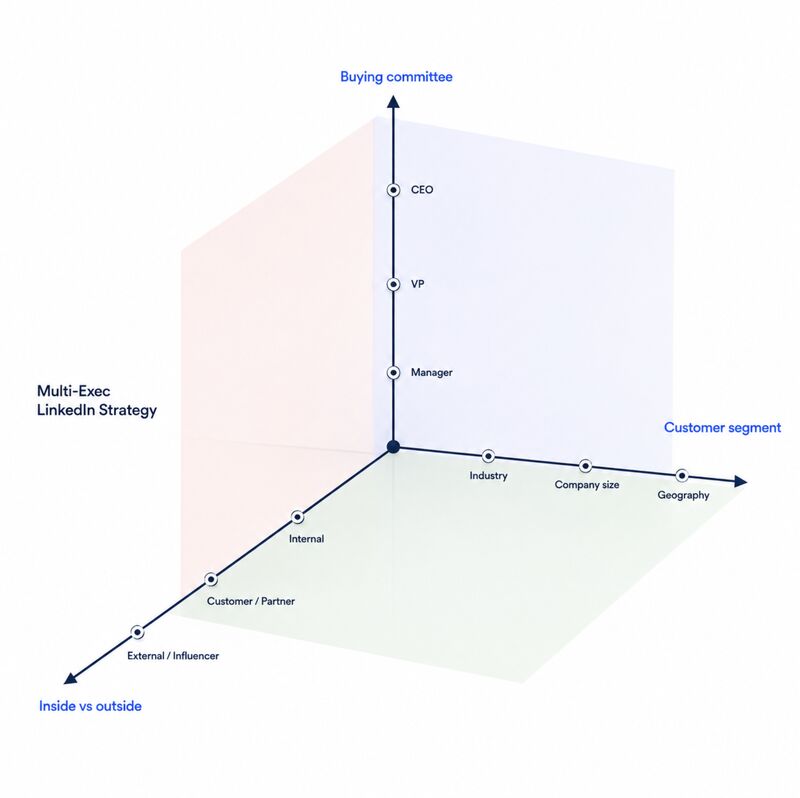
## The three vectors
Think of your executive lineup as a set of coordinates in three-dimensional space. Each axis represents a different way your audience can be segmented, and each executive you add should occupy a distinct position.
The three vectors are:
- **Buying committee.** Which seat on the buying committee does this executive speak to?
- **Customer segment.** Which customer segment, industry, or use case does this executive own?
- **Inside vs outside.** Is the voice coming from inside the company, or from a customer, partner, investor, or industry expert?
When you map these three vectors, gaps become obvious. You might have strong coverage at the C-suite but none at the manager level. You might have three executives all talking to the same industry. Or you might have plenty of internal voices and no third-party credibility. The chart makes the imbalance visible before you waste six months producing content into it.
## Vector 1: Buying committee
Each major role in the buying committee has different priorities, challenges, and levels of responsibility. Your executive lineup should reflect those differences.
Match executives to the audience at roughly the same level:
- CEOs speak to CEOs.
- VPs speak to VPs.
- Managers speak to managers.
Peer alignment matters because people tend to trust and identify with others who operate at a similar altitude. A VP of Marketing is more likely to take advice from another VP of Marketing than from a CEO who has not run campaigns in a decade. A CFO is more likely to engage with financial reasoning from another CFO than from a founder selling a vision.
The content should also reflect whether the audience is tactical or strategic. Managers usually get more value from practical playbooks, execution guidance, and tools they can use Monday morning. Senior executives are more likely to engage with strategic points of view, market shifts, and business implications.
When you cannot cover the entire buying committee, group roles with similar identities and needs. VPs may identify more closely with the C-suite than managers do, while managers may share similar tactical concerns across functions. The goal is not perfect coverage on day one. The goal is intentional coverage that grows over time.
This is the same fix Vibe.co used to map four executives to four distinct buying-committee seats on the way to a $1.4B acquisition. You can read the full breakdown in [how Vibe.co took over LinkedIn](/blog/vibe-co-linkedin-strategy-case-study).
## Vector 2: Customer segment
Different executives can own different customer segments, especially when the product creates distinct value for each one.
This is commonly divided by:
- **Industry.** A fintech buyer and a healthcare buyer often care about completely different risk, compliance, and workflow questions.
- **Company size.** What resonates with a 50-person startup rarely resonates with a 10,000-person enterprise, and vice versa.
- **Geography.** Regional buyers care about local regulations, market maturity, and cultural context.
- **Use case.** One product can serve multiple jobs-to-be-done, and each use case deserves its own expert voice.
- **Customer maturity.** A first-time buyer needs education. A sophisticated buyer needs differentiation and proof.
Segment ownership prevents every executive from sounding like a generic company spokesperson. When an executive consistently posts for one segment, their profile becomes a magnet for that audience. Their network fills with the right peers. Their content gets shared in the right Slack channels. And when you later amplify those posts with paid budget, the targeting becomes obvious.
## Vector 3: Inside vs outside the company
Internal executives provide company expertise, operating experience, and direct credibility. They know the product, the customers, and the market better than anyone.
But internal voices have limits. They are always read as company voices, no matter how personal the post tries to be. And their networks are usually clustered around their own industry and career history, which may not overlap perfectly with your next wave of customers.
External participants can include customers, partners, advisors, investors, industry experts, and other influential voices. These people expand the range and credibility of the program without requiring every point of view to come directly from the company.
A customer talking about results carries more weight than a vendor making the same claim. An investor explaining why they bet on your category borrows credibility from their portfolio. A partner showing how the integration works reaches an audience that already trusts them.
The best programs mix both. Internal executives establish the core point of view. External voices validate it and extend it into networks the company could never reach on its own.
## Assigning roles after the map is built
Once these three vectors are mapped, each participant can be assigned a clear role within the strategy.
Some executives become primary voices. They post regularly, own a specific segment, and represent a consistent point of view. Others become supporting voices. They post around product launches, customer wins, or partner moments. Outside voices become amplifiers, appearing when their credibility matters most.
The role determines the rhythm. A primary voice might post two to four times per week. A supporting voice might post once a week or only around major milestones. An external voice might appear monthly, but each appearance carries disproportionate weight.
The role also determines the content format. A CEO might focus on short strategic essays and company results. A VP might share frameworks and budgets. A customer might share case-study threads. A partner might co-create content about the integration.
## Plugging into a single operating infrastructure
Multiple voices only work if they plug into a single operating infrastructure owned by the marketing team. Without that backbone, a multi-executive program becomes a collection of random personal brands that occasionally mention the company.
The infrastructure includes:
- **Strategy.** The editorial calendar, the message map, and the vector assignments.
- **Content production.** Interviewing, drafting, editing, and design support for each voice.
- **Paid amplification.** Thought Leader Ads and boosted posts that put proven content in front of target accounts.
- **ICP engagement tracking.** Measuring which target accounts and buying-committee roles are engaging, and how often.
- **Sales activation.** Routing warm engagement to the right reps with the right context.
This system should connect into the broader marketing system as well as sales activation workflows if your company has them. The content team should know which accounts are in active opportunities. The sales team should know which executives a prospect has engaged with. The paid team should know which organic posts are worth amplifying.
This is where most programs break down. They invest in the voices but not the plumbing. They hire ghostwriters but no one tracks whether the right people are reading. They run ads but never feed engagement data back to sales. The strategy looks good on paper and produces nothing in practice.
## Common mistakes to avoid
The first mistake is adding executives without a clear vector assignment. If two executives both speak to the same buying committee, the same segment, and both are internal, you do not have a multi-executive strategy. You have redundancy.
The second mistake is treating the CEO as the default answer for every topic. The CEO should own the highest-level strategic narrative, not every product detail, customer story, and partner announcement.
The third mistake is ignoring the network-based reality of LinkedIn. Each executive's content will distribute through their existing network first. If their network does not contain the target audience, even great content will stall. That is why [understanding the LinkedIn algorithm](/blog/everything-you-know-about-linkedin-is-wrong) matters before you design the lineup.
The fourth mistake is under-investing in the operating infrastructure. Voices are visible. Infrastructure is invisible. But infrastructure is what turns a set of posts into a revenue program.
## Start small, then expand
You do not need ten executives on day one. Start with two or three voices that cover distinct coordinates. A CEO for the C-suite and strategic narrative. A VP for the practitioner layer and a specific segment. One external voice for credibility and reach.
Measure whether the right people are engaging, not whether total impressions are climbing. A post with modest reach but high engagement from target accounts is worth more than a viral post that never reaches a buyer.
Once the first few voices are working, add the next coordinate. Fill the gap in the buying committee. Own another segment. Bring in another external partner. The chart becomes a roadmap instead of a one-time exercise.
## The one-paragraph version
A multi-executive LinkedIn strategy works when each voice occupies a distinct coordinate across three vectors: buying committee, customer segment, and inside vs outside the company. Map the voices first, assign roles second, and plug everything into a single operating infrastructure owned by marketing. Without the map, you get redundancy. Without the infrastructure, you get noise.
Garret Caudle
Founder, Influent
June 9, 2026 · 8 min read
Why LinkedIn programs fail:
the $70K lesson in distribution
Six figures of ghostwriting, a year of consistent posting, and no pipeline. The problem is almost never the content. It is the missing distribution and signal layer.
Here is a story I have watched play out dozens of times, at companies with real budgets and genuinely smart marketing teams.
A company decides its executives should be visible on LinkedIn. They hire a ghostwriting agency. They spend somewhere in the range of $70,000 a year. The executives show up for interviews, approve drafts, and post two or three times a week for twelve months. Engagement goes up. Follower counts go up. Someone screenshots a viral post for the board deck.
Then the CFO asks the only question that matters: what did it produce?
And nobody has an answer. Not because the program was lazy, but because it was never built to produce one.
## The three things a LinkedIn program has to do
A LinkedIn program that produces pipeline has to do three jobs in sequence. Most programs buy the first one and skip the other two.
- **Say something the market cares about.** Market-first content, not company-first content.
- **Put it in front of the right accounts.** Paid amplification, because organic reach follows your network, not your ICP.
- **Turn engagement into an action.** Capture who engaged, score it, route it to sales.
Content alone is a publishing habit. Content plus amplification is awareness. Content plus amplification plus signal is a pipeline channel. The $70K program stopped at step one and then measured itself with metrics from step three.
## Job one: market-first content
The default failure mode of ghostwritten executive content is that it is about the company. Product philosophy, hiring announcements, culture posts, milestone celebrations. This content performs fine inside the company's own network, which is exactly the audience that already knows about the company.
Market-first content starts from a tension your buyer already feels and takes a position on it. It is useful to someone who has never heard of you, which is the only kind of content that earns attention from a cold ICP account.
A simple test: remove your company name from the post. If the post no longer makes sense, it was company-first. If it still stands on its own as an argument about the market, it is market-first and it can travel.
## Job two: distribution, because organic will not do it
This is where most programs quietly break. LinkedIn's feed is network-based, not interest-based. A post about CFO priorities does not get shown to CFOs. It gets shown to a slice of the author's own connections, and then to the connections of whoever engaged.
I wrote the full explanation of this in [everything you know about the LinkedIn algorithm is wrong](/blog/everything-you-know-about-linkedin-is-wrong), and it is the single most expensive misunderstanding in B2B marketing. If your executive's network is mostly former colleagues and recruiters, no amount of writing quality will put that content in front of your target accounts.
The fix is paid amplification of organic executive posts, primarily through Thought Leader Ads, targeted at your account list. You keep the credibility of a personal post and you buy the reach that the network graph will never give you for free. That is the whole trick, and it is not a secret. It is just skipped, because the ghostwriting vendor does not run ads and the ads vendor does not write content.
## Job three: the signal layer
Once the right accounts are actually seeing the content, engagement stops being a vanity metric and becomes intent data. Every like, comment, follow, and profile view from someone at a target account is a small, timestamped signal that a real buyer is paying attention.
Most programs let that data evaporate inside LinkedIn's interface. The programs that produce pipeline do three things with it:
- **Capture** engagement at the person and account level, not just the post level.
- **Score** it against ICP fit, so a director at a target account outranks a job seeker.
- **Route** it into the CRM so sales sees warm accounts alongside every other signal they act on.
That is the loop: market-first content, paid amplification to target accounts, engagement captured and routed to revenue. Break any link and the whole chain stops producing.
## What the $70K should have bought
The same budget, split differently, changes the outcome. Roughly speaking, a functional program spends on content, on amplification against a defined account list, and on the tooling and process that turns engagement into CRM records. Content is a component, not the product.
If you want a sense of what the assembled version looks like at scale, [how Vibe.co took over LinkedIn](/blog/vibe-co-linkedin-strategy-case-study) walks through a full-spectrum program, and [the best LinkedIn marketing agencies](/blog/best-linkedin-marketing-agencies) explains why most vendors can only sell you one link in the chain.
## How to audit your own program in ten minutes
- Pull your last twenty executive posts. What percentage would still make sense without your company name in them?
- Open your ads account. Is any budget amplifying organic executive posts to a target account list, or is it all lead gen forms and webinar promos?
- Ask your sales team to name one account they engaged because of a LinkedIn signal in the last quarter. If nobody can, the signal layer does not exist.
- Check what your program reports on. If the top-line metrics are impressions and follower growth, you are measuring step one with the language of step three.
A LinkedIn program is not a content budget. It is a distribution system that happens to use content as its payload. Build it that way and the CFO question has an answer.
Garret Caudle
Founder, Influent
August 5, 2026 · 9 min read
How do I use LinkedIn to drive
AEO/GEO visibility? 7 steps
Seven steps to get your LinkedIn content into AI answers: pick the buyer questions you want to own, publish clear answers, put them in front of the people who repeat ideas, and track whether AI tools name you.
To get AI tools to name your company, use LinkedIn to publish clear answers to your buyers' questions, put those answers in front of the people who repeat ideas, and track whether the tools start citing you.
## The 7 steps
- **Step 1: Pick the questions you want to own.** Write down the exact prompts your buyers type into AI tools.
- **Step 2: Publish one clear answer to each question.** State the answer in one plain sentence, in the first lines of the post.
- **Step 3: Give the answer a structure.** Use named frameworks, numbered criteria, tables and definitions, in the LinkedIn format that fits.
- **Step 4: Say it on your website and on LinkedIn.** Your site holds the definitive version. LinkedIn adds reach, discussion and a credible author.
- **Step 5: Amplify to the people who write.** Put the idea in front of operators, analysts and practitioners who will repeat it.
- **Step 6: Make the author and the pages easy to read.** A clear LinkedIn profile and headline, plus clean pages and structured data on your site.
- **Step 7: Track whether AI tools name you.** Ask the same 10 to 20 questions once a month and record the results in a spreadsheet.
## Overview: what AEO and GEO are, and why LinkedIn matters
A growing share of B2B research never touches a search results page. A buyer asks ChatGPT, Perplexity, Claude or Google's AI results a direct question: who are the best vendors for this, what should I be thinking about, how do companies like mine solve this. The tool answers with a short list. Your company is on it, or it is not.
AEO (answer engine optimization) and GEO (generative engine optimization) are the work of influencing what those tools say about your category. Traditional SEO tries to get one page to rank for a search. AEO and GEO try to make your company the example an AI tool reaches for when it summarizes many sources.
Three differences shape everything that follows:
- **The unit is a claim, not a page.** AI tools combine many sources. A clearly stated idea that other people repeat travels further than a well-formatted page nobody restates.
- **Corroboration beats authority.** An AI tool has more reason to name you when the same idea is tied to your company in many independent places, not just on your own site.
- **Ongoing discussion keeps your language current.** Many AI tools now search the web while they answer, so they can draw on new writing. A steady flow of posts, comments and responses keeps producing fresh pages that describe your category in your words.
LinkedIn matters because it is a large, public body of professional writing. Posts, articles and newsletters can be crawled. Comments and reshares add other people's words to your idea. Author profiles show each writer's role, company and expertise, which helps an AI tool attribute an idea to a credible person.
There is also direct evidence. LinkedIn's [2026 guide to AI search visibility](https://business.linkedin.com/advertise/resources/unlocking-ai-visibility) brings together platform data and research from Profound, Meltwater and Semrush showing that AI tools cite LinkedIn posts and articles. Our [analysis of that guide](/blog/linkedin-ai-search-executive-thought-leadership) covers the findings in detail.
To make each step concrete, we follow one example through all seven. **The example is made up for illustration.** It is not a client, and the company, people and answers are invented: a company that sells scheduling software to hospital nursing teams.
## Step 1: Pick the questions you want to own
Start with the literal prompts your buyers type, not keywords. For example: "What are the best tools for X?" "How do teams like ours handle Y?" "Is Z worth it?"
Ask your sales team which questions come up on first calls, and write them down word for word. Keep the list short. A handful of questions you can answer better than anyone is more useful than fifty you answer the same way as everyone else.
These questions are your targets for every step that follows.
**Example (made up):** the sales team hears the same question on almost every first call: "How do hospitals reduce nurse overtime?" That becomes the first question on the list.
## Step 2: Publish one clear answer to each question
State your answer in one sentence, early, in plain language. AI tools pull out clear claims. Hedged writing that takes three paragraphs to reach the point is much less likely to be quoted.
On LinkedIn, put that sentence in the first two lines of the post. Those lines are what readers see in the feed before "see more", so the answer should not depend on someone expanding the post.
The answer should be a real point of view your company can stand behind, backed by experience your team can substantiate. A distinct way of framing the problem gives other people something specific to repeat. A generic answer gives them nothing.
**Example (made up):** the company's answer opens the post: "Most nurse overtime starts with late schedule changes, so the fastest fix is locking schedules earlier."
## Step 3: Give the answer a structure
Named frameworks, numbered criteria, comparison tables and clear definitions are easy for an AI tool to lift and credit to you. A paragraph of general advice is not.
Choose the LinkedIn format that fits the structure:
- **A post** for a single claim or a short numbered list.
- **An article** for a framework, definitions or a comparison table that needs room.
- **A newsletter** for a recurring series on the same set of questions, so the idea keeps coming back to subscribers.
On your website, build a page around the question, with the answer at the top.
**Example (made up):** a post titled "3 causes of nurse overtime, and how to spot each one", followed by an article with a short table comparing the three causes.
## Step 4: Say it on your website and on LinkedIn
Use both, because they do different jobs:
- **Your website** holds the definitive, structured version of the answer, on a page you control.
- **LinkedIn** adds volume, discussion from other professionals, and a named author with a visible role and company.
Publish the idea from the executive with the most credible experience of it, not automatically the CEO. The author's profile is part of what makes the claim believable. If several leaders speak to different buyers, a [multi-executive LinkedIn strategy](/blog/multi-executive-linkedin-strategy) covers how to split the work.
When the same idea appears on your site, in your executives' posts and in other people's responses, AI tools have more reason to connect it to your company.
**Example (made up):** the website gets a page titled with the buyer's question. On LinkedIn, the posts come from the VP of nursing operations, a former nurse manager, rather than the CEO.
## Step 5: Amplify to the people who write
Organic LinkedIn posts mostly reach people who already know the author. The reasons are in [everything you know about the LinkedIn algorithm is wrong](/blog/everything-you-know-about-linkedin-is-wrong).
Paid amplification fixes the reach problem, and it has a second effect most teams overlook. When you put a distinct idea in front of, say, ten thousand relevant professionals, some of them comment, quote it, write their own version and mention it in newsletters and podcasts. That discussion is public text that ties the idea to your company.
So target the people most likely to write about your category, such as operators, analysts, practitioners and reporters, not only buyers. [Thought Leader Ads](/blog/thought-leader-ads-playbook) let you promote an executive's own post to the exact audience you choose.
**Example (made up):** the VP's post runs as a Thought Leader Ad to nurse managers and hospital operations leaders, plus healthcare workforce analysts and reporters who cover hospital staffing.
## Step 6: Make the author and the pages easy to read
AEO does not replace the basics. It sits on top of them, on LinkedIn and on your site.
On LinkedIn, the author's profile does the work that page structure does on a website:
- Write a headline that states the author's expertise in plain words, not just a job title.
- Use the About section to name the topics they write about, in the same words buyers use.
- Give articles descriptive titles that match the buyer's question, and link to the definitive page on your site.
On your website:
- Use real headings that match the questions buyers ask.
- Put the answer in the first paragraph, then explain it.
- Name the author and show their role and experience.
- Add FAQ and article structured data, so each page's questions, answers, author and dates are clear to machines.
**Example (made up):** the VP's headline changes from "VP, Nursing Operations" to "Former nurse manager. I help hospitals cut overtime with better scheduling." The website page gets FAQ markup for the overtime question.
## Step 7: Track whether AI tools name you
Rankings alone no longer tell you whether you are winning. Ask ChatGPT, Perplexity, Claude and Google's AI results the questions from Step 1, and record three things:
- **Whether you are named** in the answer.
- **How you are described**, and whether it matches how you describe yourself.
- **Which sources are cited**, including LinkedIn posts and articles.
A simple routine to start with:
- **Keep it small.** Use the same 10 to 20 questions every time, so the results are comparable month to month.
- **Run it once a month**, in a new chat each time, so earlier conversations do not shape the answers.
- **Use one spreadsheet.** One row per question per tool, with columns for date, named (yes or no), how you were described and the sources cited.
Over time, the share of answers that name you, and how accurately they describe you, becomes your ranking report. For a full framework, see [how to measure category ownership](/blog/measure-category-ownership).
**Example (made up):** each month, the team asks the four tools "How do hospitals reduce nurse overtime?" and logs whether the company is named, whether the answer mentions late schedule changes, and whether the VP's posts or the website page appear among the sources.
## Conclusion
Using LinkedIn for AEO and GEO comes down to one loop: choose the questions that matter to your buyers, publish clear and credible answers, put them in front of the people who will repeat them, and check whether AI tools start naming you.
The clearest sign it is working is that buyers arrive already using your words. They describe their problem the way you framed it, and when they check with an AI tool, your company comes back as one of the obvious options.
Most B2B companies still treat LinkedIn as a brand awareness channel and AI search as somebody else's problem. They are the same problem.
Garret Caudle
Founder, Influent
July 7, 2026 · 7 min read
How to measure category ownership
in B2B marketing
Everyone wants to own their category. Almost nobody can say whether they do. Here is a three-stage measurement model: share of voice, citation, and association.
"We want to own the category" is one of the most common goals in B2B marketing, and one of the least measured. It usually gets tracked with brand awareness surveys once a year, or not at all.
The problem is that category ownership sounds abstract, so teams either measure nothing or measure the wrong proxy, usually follower count. It is not abstract. It is a chain of three observable states, and each one has metrics you can pull.
## The three stages
- **Share of voice.** Of all the conversation happening in your category, how much of it is yours?
- **Citation.** When other people explain the category, do they reference you?
- **Association.** When someone thinks of the problem, do they think of you unprompted?
They happen in that order, and you cannot skip one. Share of voice without citation means you are talking loudly and nobody is repeating you. Citation without association means people know you exist but you are one option among several. Association is the finish line: the category and your name are stored together in your buyer's head, and in the model your buyer is asking.
## Stage 1: Share of voice
Share of voice is the measurable one, and the one most teams already have partial data for. The question is what fraction of the total category conversation you account for.
What to measure:
- **Impressions in your category on LinkedIn**, yours versus a named set of competitors. Count executive posts, company page posts, and amplified content together.
- **Publishing cadence and consistency**, yours versus theirs. Volume is not the goal, but sustained presence is a prerequisite.
- **Search visibility** for the head terms and questions that define the category.
- **Event and podcast presence.** How many category conversations happen with someone from your company in the room.
The honest version of this metric requires naming your comparison set and keeping it fixed. Share of voice that only ever goes up is usually a sign that the denominator is being redefined.
## Stage 2: Citation
Citation is the first real evidence that your framing has escaped your own marketing. Somebody else is using it, in their words, on their surface.
What to measure:
- **Mentions by non-employees**, especially by people with credibility in the category.
- **Reshares and quote-posts of executive content**, weighted by who is doing it. One reshare from a respected practitioner is worth more than fifty from your own team.
- **Inbound requests to comment.** Journalists, podcasters, and analysts calling you for the category take.
- **AI assistant citations.** Run your buyers' prompts against ChatGPT, Perplexity, and Google's AI results on a fixed schedule and record whether you are named and what sources are cited. This is now one of the cleanest citation metrics available, and I lay out the steps in [how to use LinkedIn to drive AEO and GEO visibility](/blog/aeo-geo-linkedin).
- **Backlinks and reference links** from category content you did not commission.
## Stage 3: Association
Association is when the category question returns your name without a prompt. It is the hardest to measure, but not impossible.
What to measure:
- **Branded search volume**, and more specifically branded search paired with category terms, such as your company name plus the problem you solve.
- **Unprompted mention in sales calls.** Have the team log whether the buyer named your framing or your company before the rep did. This is the single most underused qualitative metric in B2B.
- **Direct and dark-social traffic.** People arriving without a traceable click, because someone told them about you.
- **Inbound from your own vocabulary.** Buyers describing their problem using the exact language you publish.
- **Win rate and cycle length against the comparison set.** Real association shows up commercially, as shorter evaluations and fewer competitive bake-offs.
## Building the scorecard
One metric per stage, reviewed monthly, is enough to start:
| Stage | Primary metric | Cadence | What good looks like |
| Share of voice | Category impressions vs named competitors | Monthly | Sustained share growth against a fixed comparison set |
| Citation | Third-party mentions and AI assistant citations | Monthly | Non-employees restating your framing without being asked |
| Association | Branded plus category search, unprompted mentions on calls | Quarterly | Buyers arrive using your language |
Two rules keep the scorecard honest. Fix your comparison set before you start measuring, and record the qualitative signals as rigorously as the quantitative ones. The sales call log is not a soft metric. It is often the earliest reliable evidence that association is forming.
## Why this framework matters more now
Category ownership used to be a slow, mostly unobservable brand asset. AI assistants changed that. When a buyer asks a model who the serious players are, the model is essentially reporting the state of your citation and association metrics back to you, live.
That makes the chain worth building deliberately: distinct point of view, distributed to the people who define the category, restated by them in public, and measured at each stage. The multi-executive version of that distribution model is in [the 3-vector framework for multi-executive LinkedIn strategy](/blog/multi-executive-linkedin-strategy).
Garret Caudle
Founder, Influent
May 20, 2026 · 7 min read
Should CEOs post on LinkedIn?
The earned-silence myth
The most admired CEOs post almost nothing, and executives love to cite them as proof they can stay quiet too. It is the wrong comparison, and here is why.
Every executive LinkedIn conversation eventually hits the same objection. Someone names a wildly successful CEO who posts nothing, and asks why they should bother.
It is a fair question with a specific answer, and the answer is not "they are wrong." They are right, for themselves. The mistake is assuming the same logic transfers.
## Earned silence
A handful of executives run companies so well known that their brand does the communication for them. Their product launches are covered by every major outlet. Their comments at a conference become headlines within minutes. Their name recognition is effectively total inside their market and well beyond it.
For those people, LinkedIn adds almost nothing, and it adds meaningful risk. They already have distribution. Posting exposes them to scrutiny with no upside they cannot get elsewhere. That is earned silence: the company's existing gravity means the executive does not need to generate attention personally.
It is worth naming what earned silence actually requires:
- A brand that journalists cover unprompted.
- A market that already knows the category and knows your position in it.
- Distribution you own, through press, retail, events, or scale of installed base.
- A buyer who was never going to discover you through a feed.
If your company meets all four, congratulations, stay quiet. Almost none do.
## Borrowed brand
The failure mode is what I would call borrowed brand. An executive at a company with no independent gravity adopts the communication posture of a company that has plenty of it.
They stay quiet like a famous CEO, but nobody is writing about them. They speak only through the company page, which has a fraction of the reach of a personal profile. They wait to be discovered by a market that does not know their category exists.
The outcome is predictable. The company is invisible in exactly the place its buyers form opinions, and the executive concludes that LinkedIn does not work for their industry.
## The real question is not whether to post, it is who has to carry the signal
Reframed properly, this is a resource allocation question. Attention has to come from somewhere. A company either has enough institutional gravity that the market brings attention to it, or someone inside the company has to generate it.
That someone does not have to be the CEO. This is the part most companies get wrong in the other direction, defaulting to the CEO because they have the biggest title. Often the better voices are the executives closest to the specific pain the buyer feels: the head of product for practitioners, the CFO for finance buyers, the head of customer teams for operators. I laid out how to distribute this across a team in [the 3-vector framework for multi-executive LinkedIn strategy](/blog/multi-executive-linkedin-strategy).
A useful test for whether a given executive should be visible:
- **Does your buyer's evaluation include a human trust judgment?** Complex, high-consideration purchases almost always do.
- **Is your category still being defined?** If buyers do not yet agree on what the problem is called, whoever explains it well gets to shape it.
- **Would a journalist cover your launch without a pitch?** If no, you do not have earned silence.
- **Does this executive have a genuine, differentiated point of view?** If not, more posting will not help; find the person who does.
## The quiet-CEO exception has a cost too
Even at companies with real brand gravity, silence is not free. The company's messaging becomes entirely institutional, which is systematically less trusted and less distributed than a person speaking. Personal profiles outperform company pages on LinkedIn by a wide margin, structurally, because the feed is built around people.
There is also a succession problem. When the market only knows the company and never the operators, the company has no bench of credible public voices when it needs them, during a crisis, a category shift, or a leadership change. [What the McDonald's CEO backlash teaches about executive thought leadership](/blog/mcdonalds-ceo-backlash-thought-leadership-warning) is a useful case in the risk direction of the same coin.
## What to do with this
If you are the executive citing the silent CEO, run the four questions above honestly. In almost every case the outcome is the same: your company does not have earned silence, it has obscurity that resembles silence from the inside.
The alternative is not becoming an influencer. It is a small number of people at your company saying something specific and useful about your market, consistently, in the place your buyers already are, with enough distribution behind it to actually reach them.
Garret Caudle
Founder, Influent
September 14, 2026 · 8 min read
LinkedIn algorithm and platform
updates in 2026
A running log of LinkedIn's product and algorithm changes, with the part most coverage skips: whether it changes anything about how you should run your program.
LinkedIn ships changes constantly, and most coverage repeats the same announcement with a screenshot. This page is the other version: what changed, whether it matters, and what to do, if anything.
Entries are grouped by the month they were reported, newest first. Each month links to its full recap.
## Timeline at a glance
| Month | Change | Worth acting on? |
| --- | --- | --- |
| October 2026 | Daily ad spend can reach 2x the daily budget | Yes, update pacing alerts |
| October 2026 | Classic job search retiring for AI search | Yes, for employer brand |
| October 2026 | LinkedIn logo over the top of mobile video | Yes, if you post video |
| September 2026 | Book an Appointment reports booked meetings | Yes, if meetings are your goal |
| September 2026 | AI clips and chapters for Events recordings | Yes, free repurposing |
| September 2026 | Brand safety warnings on starved delivery | Yes, before Q4 spend |
| August 2026 | "For you" feed test | Watch, it is a test |
| August 2026 | "AI slop" report button cuts flagged reach | Yes, audit your posts |
| Earlier in 2026 | Video ranking, Thought Leader Ads, profiles, newsletters, messaging | See below |
## October 2026
**Daily ad spend can reach twice the daily budget.** The maximum daily spend allowance is moving from 1.5x to 2x the daily budget, rolling out through October. A $100 daily budget can spend $200 on a given day, while weekly pacing limits still apply. **What to do:** update pacing alerts and explain the change before anyone sees a daily spike.
**Classic job search is being retired for AI search.** Job seekers will describe the role they want in their own words. To match them, LinkedIn needs context about how a company works, and executive posts supply a lot of it. **What to do:** have leaders write specifically about how the team works and what it is building.
**A LinkedIn logo now covers the top of mobile videos.** It sits across roughly the top 15 percent of the frame, alongside the existing interface overlays. **What to do:** keep faces, captions and on-screen text out of the top, center, right side and bottom caption bar.
Full detail, including Reserved Ads, measurement changes and access-limited betas: [LinkedIn product updates, October 2026](/blog/linkedin-updates-october-2026).
## September 2026
**Book an Appointment reports booked meetings.** Lead Gen Forms can now map to Chili Piper, and booked appointments appear in Campaign Manager as of August 27. **What to do:** connect it if booked meetings are your conversion event.
**Events recordings get AI clips and chapters.** Recordings are automatically broken into key moments. **What to do:** pick the two or three clips that stand on their own and post them as native video.
**Brand safety controls warn when they starve delivery.** Campaign Manager now flags restrictions that cut eligible inventory below a workable level. **What to do:** review the warnings before Q4 budgets run.
Full detail, including the in-testing ad formats: [LinkedIn product updates, September 2026](/blog/linkedin-updates-september-2026).
## August 2026
**The "For you" feed test.** LinkedIn appears to be testing a feed ranked by topic interest, with the network feed moved to its own tab. If it sticks, posts could reach people well beyond your network, which raises the value of a genuine point of view over posting volume. **What to do:** nothing structural yet, because it is a test.
**The "AI slop" report button.** LinkedIn says the button was used one million times in its first two weeks, and flagged posts are getting roughly 40 percent fewer views. **What to do:** check that every post contains a specific claim, number, example or opinion only your company could have written.
Full detail, including how reporting works: [LinkedIn product updates, August 2026](/blog/linkedin-updates-august-2026).
## Earlier in 2026
These entries were logged before this page dated each change.
### Video-first feed ranking
**The change.** Native video, especially short clips under about ninety seconds, is getting meaningfully more reach in the feed than text or image posts, on both personal profiles and company pages.
**Does it matter.** Yes, more than most updates. This is a ranking-level change, not a feature. It shifts the cost structure of the whole content program, because video takes more production effort per post than text.
**What to do.** Repurpose existing long-form assets into sixty to ninety second clips rather than building a new video function. Talking-head video with burned-in captions works, and production polish matters far less than clarity. Keep writing text posts. Reach is not the only variable, and text still converts attention into comments better in most B2B categories.
### Thought Leader Ads expansion
**The change.** Thought Leader Ads now support carousel format and can promote any employee's organic post, not only posts from page admins.
**Does it matter.** This is the most consequential ads change LinkedIn has made for B2B in years, and it is still underused. It removes the bottleneck that made executive amplification an admin-only workflow.
**What to do.** Build a weekly loop: review employee organic posts, identify the ones with above-baseline engagement from your ICP, and amplify those against a target account list. This is the distribution half of the system described in [why executive LinkedIn programs fail to produce pipeline](/blog/linkedin-program-no-pipeline).
### Creator Mode deprecation
**The change.** Creator Mode is being folded into all profiles. Everyone gets the Follow button and the Featured section by default, and "Talks about" hashtags are replaced by a Topics section.
**Does it matter.** Modestly. It removes a small advantage that early adopters had, and it makes the Featured section prime real estate on every profile.
**What to do.** Treat the Featured section as a landing page and put your best-performing content and a clear next step there. Choose Topics based on the language your buyers use rather than industry jargon.
### Newsletter subscriber insights
**The change.** Newsletter publishers get a real analytics dashboard, including subscriber demographics by industry and seniority, read-through rates, and subscription funnels.
**Does it matter.** For anyone running a LinkedIn newsletter, yes. The demographic breakdown is the useful part, because it tells you whether your subscriber base is actually your ICP or an audience of peers and job seekers.
**What to do.** Check subscriber composition before you optimize anything else. A newsletter with excellent read-through among the wrong audience is a hobby, not a channel.
### Collaborative Articles revamp
**The change.** Collaborative Articles support up to five co-authors and use topic matching against contributors' expertise badges, with a rebuilt editor.
**Does it matter.** Marginally. It is low-effort visibility and some topical authority, but it is LinkedIn's content, not yours, and it does not compound the way your own publishing does.
**What to do.** Contribute opportunistically in your badge categories if someone on the team enjoys it. Do not build a strategy on it.
### DM scheduling and templates
**The change.** InMail and connection messages can be scheduled up to thirty days out and saved as reusable templates with dynamic fields.
**Does it matter.** For outbound teams, it is a real workflow improvement. For everyone else it changes nothing.
**What to do.** Build a small library of templates tied to specific engagement signals, so outreach references something the person actually did, rather than blasting a sequence. Templated outreach without a signal is just faster spam.
## How to read any LinkedIn update
A quick filter that saves a lot of time:
- **Is it a ranking change or a feature?** Ranking changes shift where reach comes from and usually deserve a response. Features rarely do.
- **Does it change who sees your content, or only how you make it?** Distribution changes matter far more than authoring conveniences.
- **Does it create a new measurable signal?** New analytics or engagement surfaces can feed your CRM and are worth wiring up.
- **Would ignoring it for six months hurt?** For most announcements, the honest answer is no.
The underlying mechanics rarely change even when the features do. LinkedIn is still a network-based distribution system, which is the constant that determines how any of these updates play out, at least until a "For you" feed changes it. That model is explained in [everything you know about the LinkedIn algorithm is wrong](/blog/everything-you-know-about-linkedin-is-wrong), and the ranking layer behind it in [LinkedIn rebuilt the feed with LLMs, and the 7 changes that matter](/blog/linkedin-feed-rebuild-llm).
**Adjacent reading:** [how to choose a LinkedIn agency](/blog/how-to-choose-a-linkedin-agency) and [what LinkedIn agencies charge in 2026](/blog/linkedin-agency-pricing).
Garret Caudle
Founder, Influent
September 14, 2026 · 6 min read
LinkedIn product updates:
September 2026
Everything LinkedIn shipped or opened for testing heading into September 2026, translated out of release-note language into what it means for a B2B program.
LinkedIn's September product cycle is unusually heavy on two themes: video inventory beyond the feed, and control over where ads run. Most of it is advertising machinery rather than organic reach, so the honest read is that this month changes budgets and campaign setup more than it changes what you post.
Here is what shipped, what is in testing, and which items are worth acting on.
## The research worth quoting
**Trusted voices keep winning.** New LinkedIn research on Gen Z and Millennial buyers found that 86 percent of U.S. marketers agree those buyers trust peer recommendations and expert voices more than branded marketing. As those cohorts take over buying committees, the gap between a brand page and a credible person widens.
**Does it matter.** It is a data point, not a change. But it is the clearest argument yet for putting budget behind people rather than logos, and it is the number to bring to a CFO who wants to know why executive content deserves a line item.
**What to do.** Use it in budget conversations, cited as LinkedIn research on what U.S. marketers report, not as a measured buyer behavior.
**The NFL season is a B2B moment on LinkedIn.** Year over year, LinkedIn saw a 19 percent lift in total engagement around NFL conversation and 25 percent during the event window. Sports and culture commentary is one of the few reliably high-attention windows on a business platform.
**What to do.** Do not force it. If an executive genuinely follows the sport, a timely business angle on it earns more attention in September and October than another industry take.
## Shipped this month
**Sponsored Messaging gets new performance data.** LinkedIn reports that layering Message and Conversation Ads onto a Sponsored Content lead-gen strategy improves cost per lead by about 30 percent on average and produces a 3.6x higher lead-gen form completion rate than Sponsored Content alone.
**Does it matter.** Only if you already run lead-gen forms and have something worth putting in an inbox. Messaging ads are intrusive by design, so they amplify whatever your offer already is, good or bad.
**What to do.** Add messaging only to a lead-gen offer that already converts, and compare cost per qualified lead, not cost per lead alone.
**LinkedIn Events now generates AI clips and chapters.** Event recordings are automatically broken into key moments and navigable chapters.
**Does it matter.** Quietly, yes. This is free repurposing. Webinars and live events are the cheapest source of executive video, and video is still the format the feed favors.
**What to do.** Run the clips through your normal content review, pick the two or three that stand on their own, and post them as native video over the following weeks.
*Recommended clips in LinkedIn's event video editor. Image: LinkedIn, via [Social Media Today](https://www.socialmediatoday.com/news/linkedin-adds-ai-powered-event-highlights/828343/).*
**Book an Appointment adds Chili Piper field mapping and reporting.** Lead Gen Forms with Book an Appointment can now autofill member information into Chili Piper, and booked appointments appear in Campaign Manager as of August 27, with no historical backfill. LinkedIn says forms using Book an Appointment produce a 7x higher click-through rate after submission than forms that link out to an external scheduler.
**Does it matter.** For any team measured on meetings booked, this is the most immediately useful item on the list. It removes the drop-off between form fill and calendar.
**What to do.** If booked meetings are your conversion event, connect Book an Appointment and report on meetings from August 27 onward, since there is no historical backfill.
**Brand safety controls now warn you when they starve delivery.** Campaign Manager flags at campaign and account level when restrictive allowlists, blocklists, or suitability settings cut eligible Audience Network or CTV inventory below a workable threshold.
**Does it matter.** Yes, for anyone with a strict brand safety posture. Over-restriction has been silently throttling campaigns for years. Now you see the tradeoff before launch instead of diagnosing it from bad delivery.
**What to do.** Review any warnings on existing campaigns before Q4 budgets start running, and loosen only the restrictions your brand policy does not require.
## In testing: alphas and betas
These require nomination through a LinkedIn account team, so treat them as a roadmap signal rather than something you can switch on.
- **In-Stream Ads (alpha, US).** Pre-roll ads running against vetted publisher and creator content. LinkedIn is clearly building an inventory business beyond the feed.
- **Sponsored Content in the right rail (alpha).** Single Image Ads extend to desktop right-rail placements, with delivery optimizing across feed and rail automatically. More impressions at lower attention value, so watch cost per qualified action rather than CPM.
- **CTV Conversion Lift Testing (expanded beta).** Incrementality measurement for connected-TV campaigns. The interesting part is not CTV itself, it is that LinkedIn is normalizing lift testing as the measurement standard.
- **Inventory Tiers for the feed (beta).** Finer control over the content sensitivity surrounding your ads in-feed.
- **Creator Discovery (beta, expanding in North America).** New search filters for finding and evaluating creator partners for Thought Leader Ads campaigns. This is the one to watch if you run [Thought Leader Ads](/blog/thought-leader-ads-playbook), because creator sourcing is currently the manual bottleneck.
- **Persona-Based Ads Personalization (alpha).** Tailor messaging to multiple personas inside one campaign, instead of splitting campaigns per persona.
*Creator Discovery filters in Campaign Manager's Creator Marketplace. Image: LinkedIn, via [Social Media Today](https://www.socialmediatoday.com/news/linkedin-tests-advanced-creator-discovery-to-power-brand-campaigns/831555/).*
## What actually changes for a B2B program
Three things are worth doing this month, and the rest is noise:
1. Wire up Book an Appointment if meetings are your conversion event.
2. Turn existing event recordings into short native video using the new auto-clips.
3. Audit your brand safety settings against the new inventory warnings before your Q4 budget starts running.
Everything else on the list is LinkedIn expanding where ads can appear. That is worth tracking, but it does not change the underlying job: publishing credible content from real people, then amplifying the pieces your buyers actually engage with. For the running assessment of the changes that do affect organic distribution, see [LinkedIn algorithm and platform updates in 2026](/blog/linkedin-platform-updates).
Garret Caudle
Founder, Influent
October 5, 2026 · 10 min read
LinkedIn product updates:
October 2026
October brings a higher daily spend allowance, new measurement options, premium video changes and access-limited betas, alongside AI job search and mobile video updates.
Most of October's LinkedIn changes are about advertising: daily spend can now reach twice the daily budget, Reserved Ads accept smaller audiences, and measurement gets new signals. Outside ads, LinkedIn is retiring classic job search in favor of AI search, and a LinkedIn logo now sits over the top of mobile videos.
The most important thing to check for each item is availability. Some are live, some are rolling out, and some need approval from a LinkedIn account team.
## October at a glance
| Update | Status | Who it affects |
| --- | --- | --- |
| Daily spend up to 2x the daily budget | Rolling out through October | All advertisers |
| Reserved Ads minimum audience drops to 100,000 | In effect | Managed accounts with a $50,000+ reservation budget |
| Premiere Video Ads | Public beta | Managed ad accounts |
| New Conversions API signals | Available for eligible categories | Teams using Conversions API |
| Sponsored Messaging impressions and clicks | Expected from mid-October | Sponsored Messaging advertisers |
| Premium Company Page tiers | Rolling out through January 2027 | Company Page admins |
| Sponsored Content on the right rail | Public alpha | Eligible Sponsored Content campaigns |
| Marketing Assistant, MCP Server, Creator Discovery | Beta, approval required | Nominated advertisers and developers |
| AI-powered job search | Gradual rollout since September | Job seekers and hiring teams |
| LinkedIn logo on mobile video | Live | Anyone posting video |
## Daily ad spend can reach twice the daily budget
**The change.** The maximum daily spend allowance is moving from 1.5x to 2x the daily budget. The rollout starts in early October and is expected to finish by the end of the month. Your configured budget does not change.
**Does it matter.** Yes, especially when someone reviews spend one day at a time. A $100 daily budget can now spend $200 on a given day. LinkedIn's [budget documentation](https://www.linkedin.com/help/recruiter/answer/a422101) explains that daily budgets are paced across the applicable schedule: a continuous daily-budget campaign remains capped at seven times that budget per Monday-to-Sunday week.
**What to do.** Update pacing alerts and explain the change before a client sees a daily spike. Check the campaign's budget type and schedule rather than treating the daily number as a hard daily cap.
## Premium video gets a smaller audience threshold
**The change.** Premiere Video Ads entered public beta for managed ad accounts on September 28. Eligible advertisers can select the format when creating a Reserved Ad without a nomination form. Separately, the minimum Reserved Ads audience has fallen from 500,000 to 100,000 members, and the 10,000-member matched-audience minimum for exclusions has been removed.
**Does it matter.** The smaller audience requirement makes reserved inventory relevant to more focused B2B markets. It still has a substantial entry cost: LinkedIn's [Reserved Ads requirements](https://www.linkedin.com/help/lms/answer/a7783216) currently specify a $50,000 minimum reservation budget and a managed account with a dedicated representative.
**What to do.** Consider it for a major launch or brand campaign if the audience and budget fit. [Premiere video](https://www.linkedin.com/help/lms/answer/a9590437) is a mobile-app placement bought through Reserved Ads. Public beta does not mean every advertiser has access.
## More conversion signals, and a Sponsored Messaging reporting change
**The change.** Conversions API now supports hashed IP addresses, hashed first and last names, and a 180-day conversion lookback for eligible conversion categories. Separately, new Sponsored Messaging impression and click metrics are expected to start rolling out around mid-October (an estimate). Sends and opens remain.
The [API schema](https://learn.microsoft.com/en-us/linkedin/marketing/integrations/ads-reporting/conversions-api-schema?view=li-lms-2026-04) lists hashed-name support from version 202609 onward; the [conversion-window documentation](https://www.linkedin.com/help/lms/answer/a426360) limits longer windows to eligible categories such as leads and purchases.
**Does it matter.** Additional match signals can help teams investigate measurement gaps. The messaging change also means a movement in reported CPM, CPC, CTR, reach or frequency may reflect a reporting change, so comparisons across formats need care.
**What to do.** Have the team responsible for Conversions API review the new options against its implementation and approved data practices. For Sponsored Messaging, record when the new metrics appear and check their definitions before comparing them with older reports or Sponsored Content.
## Premium Company Pages add Essentials, Plus and Pro
**The change.** LinkedIn is rolling out three Premium Company Page tiers, with rollout beginning in September and continuing through January 2027. Its [public plan comparison](https://premium.linkedin.com/business/premium-company-page) covers audience insights, executive-leader tracking, follower growth and richer Page presentation, with features and limits varying by tier.
*Competitor comparison, one of the analytics views LinkedIn shows for Premium Company Pages. Image: [LinkedIn](https://premium.linkedin.com/business/company-page/essentials).*
**Does it matter.** Executive-post analytics are worth a look for teams that already run a leadership content program. A paid Page subscription only earns its place if the available features answer a question or replace work your team is doing.
**What to do.** Check the plan and features actually available to your Page. Compare those with your current reporting and publishing needs before upgrading.
## Sponsored Content on the right rail is still an alpha
**The change.** In a public alpha available across ad accounts, eligible Sponsored Content campaigns can opt in or out of right-rail delivery, and some may be selected by default. Right-rail impressions are free during the alpha; in-feed delivery is billed normally.
**Does it matter.** It is an additional placement to test, with creative that may render differently. This is not a promise of free campaigns, and the announcement does not establish eligibility for every ad format or Thought Leader Ad.
**What to do.** Check the placement setting and campaign eligibility, review how the creative renders, and record when you enable it. Ask your LinkedIn account team about alpha requirements before building a plan around it.
## Three betas to watch
These are access-limited tests. LinkedIn says alpha and beta participation should be evaluated with your dedicated account team.
- **Marketing Assistant:** nominations are open for US advertisers to test reporting, campaign management, edits and bulk actions.
- **LinkedIn MCP Server:** approved developers can connect AI agents to select official LinkedIn Marketing APIs. This is a beta integration path, not general access to automate LinkedIn.
- **Creator Discovery:** the beta launched October 1 for approved brands, with nominations open for future waves. Search criteria include expertise, audience makeup, format, industry and professional background.
For B2B teams, Creator Discovery is the one to watch for finding relevant expert voices; the two AI tools are worth evaluating if reporting or campaign operations are a bottleneck. Ask about access before committing a workflow to any of them.
## Smaller operational updates
- **Sponsored Messaging copy:** Campaign Manager can draft or rewrite message copy and subject lines. LinkedIn's [help page](https://www.linkedin.com/help/linkedin/answer/a421723/sponsored-messaging?lang=en) says Draft with AI currently requires English as the ad-set language. Review the result for accuracy and voice.
- **Smartly:** the LinkedIn integration is live for campaign creation, management, automation and reporting, including creative tools. A Smartly account is required. [Smartly's announcement](https://www.linkedin.com/posts/smartly-io_today-smartly-is-announcing-a-new-integration-activity-7508149891211202560-V8SU) describes the creative and campaign integration.
- **CTV controls:** DoubleVerify's DV Authentic Brand Suitability now offers pre-bid genre and maturity-rating controls for supported buying paths, currently Campaign Manager and The Trade Desk. Teams buying CTV should review those settings against their brand-suitability requirements.
## Classic job search is being retired for AI search
**The change.** LinkedIn is showing job seekers a notice: "We're gradually retiring classic job search starting in September. Try AI-powered job search and describe the role you want in your own words." Filter-based search is giving way to natural-language discovery.
*AI-powered job search, from LinkedIn's original 2025 announcement. Image: [LinkedIn](https://news.linkedin.com/2025/navigating-your-career-in-the-ai-era).*
**Does it matter.** Not directly for executives today, but it is a strong signal. To match a candidate who types "a fast-growing fintech where engineers ship weekly", LinkedIn needs context about who a company is, what it does, how it operates and what it is hiring for. Job descriptions alone do not supply much of that. Posts from founders and executives supply a lot of it.
**What to do.** Treat executive content as part of your employer brand. Have leaders write specifically about how the team works, what it is building and what kind of people succeed there. As AI search rolls out, posts like these are likely to shape which candidates find the company, in the same way they already shape which buyers do.
## A new LinkedIn logo on mobile video
**The change.** On the mobile app, LinkedIn has added a small LinkedIn logo across roughly the top 15 percent of every video. Creator Heike Young spotted it and mapped every area where LinkedIn's interface now sits on top of video: the back arrow and new logo at the top, the play button in the center, the like, comment, share and save icons down the right side, and the author name and caption across the bottom.
**Does it matter.** A little. Most videos keep the top of the frame clear already, but any text box or caption placed there is now partly covered. The center matters more than people assume: many members have autoplay turned off, so they see a play button sitting over the middle of the frame.
**What to do.** Keep faces, captions and on-screen text out of those zones. Put captions in the band between the center and the bottom overlay, and keep the speaker's face slightly above or offset from dead center. The likely motive for the logo is branding when people screenshot videos and share them elsewhere, so expect it to stay.
## The through line
For teams running LinkedIn programs, the immediate work is practical: explain daily spend variation, check reporting definitions, and verify account eligibility before promising a new placement or workflow. The content and video updates above still matter, but the advertising changes deserve a place in this month's operating checklist.
For previous months, see the [September 2026](/blog/linkedin-updates-september-2026) and [August 2026](/blog/linkedin-updates-august-2026) recaps, or the running log of [LinkedIn algorithm and platform updates in 2026](/blog/linkedin-platform-updates).
Garret Caudle
Founder, Influent
September 1, 2026 · 4 min read
LinkedIn product updates:
August 2026
Two August changes mattered more than everything else combined: the "For you" feed test, and the first measurable distribution penalty on AI slop.
August was a light month for features and a heavy one for distribution. Two changes landed that affect how far any post travels, which makes them more consequential than a year of release notes.
## The "For you" feed test
**The change.** LinkedIn is testing a "For you" feed, with the traditional network feed split off into its own "Network" tab.
*The two-tab feed as LinkedIn showed it when announcing the Network tab test in September. Image: LinkedIn, via [Social Media Today](https://www.socialmediatoday.com/news/linkedin-tests-network-tab-to-encourage-engagement-among-connections/830853/).*
**Does it matter.** If it sticks, it is the biggest structural change LinkedIn has made in years. LinkedIn has always been a network graph: you post, and distribution starts with the people already connected to you. A real "For you" feed opens the door to an interest graph, where LinkedIn finds people who care about the topic and pushes the post well beyond your existing network. That raises the ceiling on organic distribution substantially.
**What to do.** Nothing structural yet, because it is a test. But the strategic question is worth answering now: if LinkedIn hands you more distribution, what will you fill it with? Volume of generic AI-written posts will not survive an interest-graph feed, because that feed ranks on whether strangers find the content worth reading. Depth of point of view becomes the constraint, not posting cadence.
## The "AI slop" report button
**The change.** LinkedIn says its "AI slop" report button was used one million times in its first two weeks, and posts flagged that way are getting roughly 40 percent fewer views than they were a few weeks earlier. Hari Srinivasan, LinkedIn's chief product officer, shared the numbers. LinkedIn's creator product lead described the target as content that is polished in presentation but lacks substance. An indicator is coming to post analytics that tells you when your own posts have been reported.
*The "Seems like AI slop" option in a post's menu. Image: LinkedIn, via [Social Media Today](https://www.socialmediatoday.com/news/linkedin-says-1m-people-have-reported-ai-slop/828465/).*
**How it works.** Reporting a post mostly affects what the reporter sees from that creator going forward. LinkedIn says no single report determines distribution, and it has built safeguards so members cannot use the button to target each other. Widespread reports across many members can influence platform-wide distribution.
**Does it matter.** Yes. This is the first time LinkedIn has attached a measurable distribution penalty to content that reads as machine-generated filler, and it is a reader-driven signal rather than a detector. Note the description: polished but empty. That is exactly what most outsourced ghostwriting and AI-assisted posting produces.
**What to do.** Audit your output against the standard readers are applying: does the post contain a specific claim, number, example, or opinion that only your company could have written? If it could have been generated from the headline alone, it is at risk. Watch the reported-posts indicator once it rolls out, and treat flags as a content quality signal rather than a technical problem.
*The notice LinkedIn shows in post analytics when members flag a post as seeming like AI. Image: LinkedIn, via [Social Media Today](https://www.socialmediatoday.com/news/linkedin-says-1m-people-have-reported-ai-slop/828465/).*
## The through line
Both changes point the same direction. LinkedIn is trying to rank on whether content is worth reading to someone who does not know you, and it is using its members to help decide. A bigger distribution ceiling and a penalty on filler are the same policy viewed from two ends.
For what shipped on the advertising side, see the [September 2026 product recap](/blog/linkedin-updates-september-2026). For the running log of everything else, see [LinkedIn algorithm and platform updates in 2026](/blog/linkedin-platform-updates).
Garret Caudle
Founder, Influent
August 13, 2026 · 11 min read
How to choose an executive LinkedIn agency:
the 8 capabilities a complete program needs
Most agencies sell one or two pieces of an executive LinkedIn program. Here are the eight capabilities a complete program connects, and the questions that reveal which ones an agency actually operates.
A company evaluating executive LinkedIn agencies should start by defining what it expects the agency to operate.
An executive LinkedIn program can include strategy, content production, advertising, employee participation, influencer partnerships, direct outreach, company-page management, measurement, and sales activation. Many agencies provide one or two of those services.
That is appropriate when the company only needs a writer or a paid-media specialist. It becomes a problem when the company expects LinkedIn to influence a B2B buying process and purchases content production alone.
A complete executive LinkedIn program connects eight capabilities.
## 1. Executive content
The agency should determine which executives participate, which audience each executive addresses, which subjects each person owns, and how those subjects relate to commercial objectives.
Executive interviews are necessary because the content needs the executive's actual expertise. The interview should not be the agency's only source of topic ideas. The agency should also study what the target audience discusses, which problems appear repeatedly in the market, what competing executives publish, and which topics have already attracted the right audience.
The client should receive a written content strategy for every participating executive, a queue of drafts before publication, and regular analysis of which subjects and formats attract target-market engagement.
A strong program gives different executives different responsibilities. A chief executive might address broad strategic changes affecting other senior leaders. A chief technology officer might write for technical leaders. A finance executive might address the financial considerations relevant to the buying committee. The agency should be able to explain the intended audience and purpose of every post it produces.
Weak content programs rely too heavily on the executive interview. The executive describes what they personally want to discuss, the agency turns those ideas into posts, and the result is accurate, well written, and irrelevant to the intended buyer. The division of subjects across several leaders is covered in [the 3-vector framework for multi-executive LinkedIn strategy](/blog/multi-executive-linkedin-strategy).
## 2. Employee advocacy
Employee advocacy should identify employees who have genuine professional credibility with parts of the target audience and help those employees create useful original material.
The agency should decide which employees publish original content, which subjects each person is qualified to discuss, how much production support they need, and how their content contributes to the larger program. The client should receive a defined group of participants, topic guidance for each person, editing and publishing support, and reporting on the audience each employee reaches.
The number of participating employees is a poor measure of success. A small number of credible employees publishing original material can contribute more than hundreds of employees resharing the same company post.
Employee content works particularly well for familiarity, recruiting, and showing how people inside the company think. Influent's own employees generated 8.3 million combined LinkedIn impressions in 2025, which the company associates with $40,000 in signed monthly recurring revenue, three senior hires, and a partnership with LinkedIn.
The program still requires central support. Programs that ask employees to create content independently lose participation, because content production competes with the employee's primary job.
## 3. LinkedIn advertising and paid amplification
The agency should use paid distribution to control which audiences see selected executive content.
LinkedIn Thought Leader Ads promote a post that already exists on an individual's profile, so the advertisement keeps the executive's name, profile, content, and existing engagement instead of appearing as a separate company ad.
The agency should build audiences from named target accounts and relevant roles, identify which organic posts already attract the right people, and allocate paid budget to those posts. That decision should be based on the composition of the organic engagement rather than the total volume. A post with 25 interactions from target buyers can be worth more than a post with 2,000 interactions from people who will never buy.
Influent's program data shows why this matters. Organic distribution typically places roughly 10 to 15 percent of impressions in front of the intended audience. Paid amplification can raise that to roughly 85 to 90 percent.
In one program, a post generated 20 likes and three target-market engagements organically. A $500 Thought Leader Ad budget generated 205 target-market engagements, including senior marketing leaders at Asana, JPMorgan, Salesforce, LEGO, Glassdoor, and Ford.
The client should receive the target-account and audience definitions, a record of which posts received paid distribution, the amount spent on each, and reporting on the target-market engagement produced.
Weak programs either omit paid distribution or run the advertising operation completely separately from the content operation, which prevents each side from improving the other.
## 4. Influencer marketing
Influencer marketing lets the company publish through independent people whose credibility and audience overlap with the target market.
The agency should evaluate creators on audience relevance, subject expertise, credibility, and content quality, with follower count as one factor rather than the main criterion. It should direct the subject of the sponsored content, manage the creator relationship, and use paid amplification to distribute the creator's post to the company's own account list when appropriate.
The client should receive creator recommendations with audience analysis, content briefs, the finished posts, and reporting that separates organic creator distribution from paid distribution.
Large creators are not automatically better. A narrow B2B market is often served better by several smaller creators who are professional peers of the buyer. Influent has seen expensive creator partnerships produce very little measurable activity when the content was poorly matched to the audience.
One Influent campaign used five creators in the sales category across 15 posts, $5,000 in creator fees, and $2,500 in advertising spend. It produced 432 new customers in under 90 days and reduced customer acquisition cost from $200 to $17.36.
## 5. LinkedIn outbound
Outbound activity should focus on people who have already demonstrated interest: individuals who repeatedly engage with executive content, people who view an executive's profile, direct-message respondents, and identifiable website visitors.
The agency should provide a weekly list of people worth contacting, explain the signal that placed each person on the list, draft messages based on the specific interaction, and track the resulting conversations.
One reaction to one post rarely justifies a sales request. Repeated engagement across several posts is a stronger signal, and engagement from several people at the same account is stronger still. Substantive comment questions, direct messages, asset requests, high-intent website visits, and reposts with commentary deserve faster follow-up.
The message should come from the person whose content created the interaction whenever possible. A buyer who has been reading a CTO's posts recognizes that executive. A generic message from an unfamiliar sales development representative discards the context the content created.
Influent's internal benchmark shows that outreach to people who have already engaged converts at roughly two to three times the rate of outreach to people who have not.
High-volume automated messaging is a different activity. Sending large quantities of unsolicited messages to senior buyers creates a reputational problem for companies that depend on long sales cycles and buying committees.
## 6. Company-page management
The company page has a different job from the executive profiles. Its main purpose in this kind of program is to give credible information to a buyer who already has some interest.
The agency should keep the page description, banner, company information, customer evidence, and important content current, and the company should publish significant announcements, research, and data that a prospective buyer may want to verify.
Judge the page by what a visitor learns from it rather than by organic post reach. Company pages get less organic distribution than individual profiles, so treating the page as the primary distribution channel creates an unnecessary constraint. The page matters more when the company runs significant advertising, because buyers exposed to ads visit it as part of their research.
## 7. Buyer-level engagement measurement
This capability determines whether the company can distinguish general social activity from engagement by actual buyers.
The agency should identify public interactions on executive content and associate each one with the person, their role, their employer, and their relationship to the ideal customer profile. That history should accumulate over time, so the company can answer questions like:
- Which people from our target accounts engaged with us this month?
- Which target companies had several employees interacting with our executives?
- Which individual has interacted with 15 posts in the past three months?
- Which topics produce the highest concentration of target-market engagement?
- Which executives are reaching the audience they were assigned?
The client should receive named lists of relevant engagers, counts of distinct target individuals and companies, and historical interaction data across posts and executives.
Some activity cannot be identified at the individual level. LinkedIn does not provide the identities behind every impression or passive view, saves are reported in aggregate, and some profile views stay anonymous. Individual-level engagement data is therefore a directional measure of visible attention rather than a complete record of everyone who consumed the content.
That limitation matters because many senior buyers read without interacting publicly. Companies should combine engagement data with CRM and pipeline analysis rather than assume every influenced buyer leaves a visible signal. The measurement chain is covered further in [how to measure category ownership](/blog/measure-category-ownership).
## 8. Sales activation
Engagement data has limited commercial value while it sits inside a marketing report. The agency should deliver relevant engagement information into the systems and processes sales already uses.
Ideally the interaction is written to the correct CRM contact and account record, and the record identifies which post the person engaged with and which subject that post addressed.
Account-level aggregation matters too. Three people from one target account engaging within a short period can indicate account interest even when no individual has engaged enough to qualify on their own.
The company and agency should agree in advance on the response attached to each signal. A single reaction might lead to nothing or a connection request. Repeated interaction might lead to a personal message from the executive. A high-intent interaction can trigger immediate follow-up. Sales should receive a prioritized recurring list rather than a continuous stream of unfiltered activity.
Influent uses pipeline influence as one measure of whether this is working: the percentage of CRM opportunities that include at least one contact with a recorded LinkedIn interaction. One Influent client, Incrementum, reached 38 percent verified pipeline influence in the first year of its program.
## Which capabilities should you fund first?
A company that cannot fund the complete program should begin with executive content and individual-level measurement. Content provides the material every other capability depends on, and measurement establishes whether that material is reaching the intended audience.
Paid amplification should come next, because it changes audience composition substantially without requiring more content. Sales activation follows once the company is consistently generating identified engagement from target accounts. Outbound messaging, employee advocacy, influencer partnerships, and expanded company-page work can then be added according to the objective.
## Questions to ask an executive LinkedIn agency
- Ask to see a real monthly report with identifying information removed.
- Ask whether the agency can identify the names, titles, and companies of target buyers who engaged with a client's posts.
- Ask how it decides which topics executives should cover, and what information it uses besides the executive interview.
- Ask how it would divide several executives across your buying committee.
- Ask whether it runs Thought Leader Ads and how it decides which posts receive paid budget.
- Ask how engagement information enters your CRM and what action sales is expected to take when it arrives.
- Ask who writes the content and how many clients that person manages.
- Ask what happens when an executive wants to publish a topic the agency believes will not interest the intended audience.
- Ask what results are reasonable at three, six, and twelve months.
- Ask for references from companies with a similar size, contract value, and sales process.
- Ask which previous client programs failed to produce the expected result, and what caused it.
The answers should let you understand exactly which parts of the program the agency operates, which results it measures, and which responsibilities stay with you. Pricing for each of these capabilities is broken out in [how much an executive LinkedIn program costs](/blog/executive-linkedin-program-cost).
**Part of the series:** run this against a shortlist using [how to choose a LinkedIn agency](/blog/how-to-choose-a-linkedin-agency), drawn from [the full agency comparison](/blog/best-linkedin-marketing-agencies).
Garret Caudle
Founder, Influent
August 13, 2026 · 12 min read
How much does an executive
LinkedIn program cost in 2026?
Executive LinkedIn programs run from under $2,000 a month to over $100,000. Here is what each pricing model buys, realistic ranges by capability, and when hiring internally becomes cheaper.
An executive LinkedIn program can cost less than $2,000 per month or more than $100,000 per month. Those prices buy different services.
A freelance writer charging $2,000 per month may produce eight posts for one executive. A larger program may cover several executives, strategy, content production, video, paid distribution, buyer-level measurement, CRM integration, direct outreach, employee advocacy, influencer partnerships, and media spend.
So a buyer comparing prices needs to compare the capabilities in each proposal rather than the monthly totals. This guide covers the common pricing models, realistic ranges, the additional costs people forget, and the point where hiring internally becomes more economical.
## Common pricing models
**Per-post pricing.** Freelancers and small ghostwriting firms often charge per published post, roughly $150 to $600 depending on the writer, research, and format. It is simple, and it creates an incentive to increase volume. The client pays for the amount of content produced rather than for distribution, audience quality, or commercial results.
**Monthly pricing per executive.** Many ghostwriting agencies charge a fixed monthly fee per executive covering a defined number of posts, usually including interviews, writing, editing, and basic reporting.
**Tiered program retainers.** A retainer covers a defined group of executives and a defined set of capabilities, with higher tiers adding paid distribution, more executives, measurement, sales activation, video, employee programs, or influencer work. Influent uses this model, because the company is buying an ongoing operating program rather than a fixed quantity of posts.
**Project or hourly pricing.** Communications consultancies charge this way for audits, executive positioning, content strategy, and launches.
**Percentage of ad spend.** LinkedIn advertising agencies commonly charge 10 to 20 percent of media budget. That works for larger accounts and works poorly for executive Thought Leader Ad programs, where the media budget is small and targeted and the percentage does not cover the management work.
**Performance pricing.** Some lead-generation agencies charge per lead, meeting, or opportunity. It is difficult to apply to a complete executive program, because the agency does not control the whole revenue process. It can create and distribute content and identify engagement signals; the client's sales organization determines what happens next.
## What does one executive cost?
- **Freelance ghostwriter, content only:** roughly **$1,500 to $5,000 per month** for eight to twelve posts.
- **Ghostwriting agency, content only:** roughly **$5,000 to $10,000 per month**.
- **Complete single-executive program** including strategy, content, paid-distribution management, individual-level measurement, and reporting: roughly **$12,000 to $20,000 per month**, before media spend.
The difference between these options is how much of the LinkedIn program the provider operates. A $6,000 ghostwriting engagement can produce excellent content while carrying no responsibility for whether target buyers see it, who engages, or what sales does about it.
## What does a multi-executive program cost?
Costs rise as executives are added, and cost per executive falls, because several components are shared: target-account definition, audience strategy, measurement infrastructure, the advertising account, reporting, and account management. Interview time, content production, voice development, and profile-level campaign management do scale per person.
As a rule, three executives cost about two to two and a half times one executive. Five executives cost about three to three and a half times. Ten executives cost about five to six times.
- A **three-executive program** with broad capability coverage generally falls around **$20,000 to $30,000 per month**.
- A **five to seven executive program** with paid amplification and sales activation across several segments generally falls around **$35,000 to $60,000 per month**.
- Programs with **ten or more executives**, several audience segments, employee advocacy, influencer partnerships, and added production can reach **$75,000 to $150,000 per month**.
Media spend is usually separate. How to split executives across a buying committee is covered in [the 3-vector framework](/blog/multi-executive-linkedin-strategy).
## What does paid distribution cost?
Paid distribution has two costs. The first is management: a separate paid-amplification service generally runs **$2,000 to $6,000 per month** depending on executives, segments, campaigns, and reporting, though some agencies instead charge 10 to 20 percent of managed spend.
The second is the advertising budget. A functional starting point is **$1,500 to $3,000 per month for one executive**. A multi-executive program may spend **$5,000 to $20,000 per month**, and large programs considerably more.
The purpose of that budget is to control audience composition. Influent's program data shows organic distribution puts roughly 10 to 15 percent of impressions in front of the intended audience, and targeted Thought Leader Ads can raise that to roughly 85 to 90 percent.
A useful example: a company already spending $5,000 per month on executive content adds roughly $2,000 in paid distribution. Total spend rises 40 percent, and the share of the audience that matches the target market changes materially.
## What does measurement cost?
Buyer-level engagement measurement and sales activation generally add **$2,000 to $6,000 per month** when priced separately. That work includes identifying engagers, evaluating whether each person matches the ideal customer profile, retaining interaction histories, account-level reporting, and delivering interactions to the CRM. A separate CRM integration can add **$2,500 to $10,000 as a one-time setup cost**.
Influent includes measurement in its core program rather than selling it as an option, because measurement informs topic selection, paid distribution, and sales activation.
Two questions matter when comparing proposals: does the measurement system identify actual people or only report aggregate metrics, and can the historical data be exported and retained after the relationship ends.
## What does LinkedIn outbound cost?
Managed outreach generally costs **$2,000 to $5,000 per active profile per month**, which should include building the list from engagement data, writing messages, sending at an appropriate volume, monitoring responses, and handing conversations to sales.
Software adds to that. Sales Navigator is roughly **$100 to $150 per user per month**, and a website-visitor identification platform can add **$500 to $2,000 per month** depending on traffic and product.
Outbound cost should not rise simply to increase message volume. A program may identify 60 people showing meaningful interest in a period. Those 60 are the useful pool. Getting to 600 means contacting people who showed no such interest.
## What does employee advocacy cost?
A program that mostly coordinates employees around existing material runs roughly **$2,000 to $5,000 per month**. A program producing original content for five to ten employees runs roughly **$5,000 to $15,000 per month**.
Programs with more than about 15 participants usually need a different model, where the agency provides training, process, editorial support, and governance while an internal owner manages daily participation. Budget internal management time either way, because employees need scheduling, topic guidance, and coordination.
## What else should you expect to pay for?
- **Video production:** roughly **$300 to $1,500 per finished piece**, or **$2,000 to $8,000 per month** for a consistent program.
- **Design** for carousels, graphics, and data visualization: **$1,000 to $4,000 per month** when not included in the retainer.
- **Software:** Sales Navigator, LinkedIn Premium, publishing and analytics platforms, competitor analysis, and visitor identification.
- **Onboarding:** **$5,000 to $25,000 as a one-time fee**, covering audience analysis, competitor analysis, topic research, executive interviews, voice development, account-list construction, and measurement setup. Influent's onboarding includes roughly three weeks of research before content production begins.
- **Creator fees** in influencer programs: smaller B2B creators charge roughly **$500 to $3,000 per post**, larger creators substantially more. Keep creator fees separate from both the management fee and the amplification budget.
## A lower-cost version
A company with less budget can build a smaller version internally: hire a freelance ghostwriter, manage $1,000 to $1,500 in Thought Leader Ads in-house, and classify relevant engagers manually in a spreadsheet. It takes more internal work and preserves the three functions that matter, which are content, distribution, and measurement.
For a multi-executive program addressing a buying committee, a practical starting budget is around **$20,000 per month including media**.
## How much executive time does it require?
A participating executive should expect roughly **three to five hours per month**: a 60 to 90 minute interview every two weeks, 30 to 60 minutes of draft review, and periodic strategy discussions.
The internal program owner should expect **five to ten hours per month** for scheduling, approvals, coordination, and reporting. Sales or revenue operations may need another **one to three hours per month** to review engagement data and maintain CRM process.
Cutting interview time reduces content quality, because those conversations supply information that is not available in public sources.
## How should you measure the return?
Evaluate the program over roughly 12 months rather than a quarter when the sales cycle is long. Four measures are useful:
- **Pipeline influence:** the percentage of CRM opportunities containing at least one contact with a recorded LinkedIn interaction. Incrementum reached 38 percent verified pipeline influence in the first year of its Influent program.
- **Cost per target account engaged:** program spend divided by the number of distinct target accounts producing recorded engagement.
- **Customers required to cover the cost:** a company with a $150,000 average contract value spending $30,000 per month has a $360,000 annual program cost, so roughly two to three incremental customers cover it before margin and attribution considerations.
- **The alternative use of the same budget:** conferences, executive events, sponsorships, public relations, and paid media aimed at the same limited group of buyers.
## Is an agency cheaper than hiring internally?
A capable executive-content lead costs roughly **$110,000 to $160,000 in salary**, or **$140,000 to $200,000 annually** after benefits, taxes, equipment, and management overhead. That is $12,000 to $17,000 per month, and one lead can usually support one to three executives well.
The same person is unlikely to deliver advanced content production, paid-media management, buyer-level measurement infrastructure, and CRM integration simultaneously. A more complete internal function needs a content lead, a paid-media specialist, software, and operating support, so fixed cost reaches roughly **$25,000 to $35,000 per month before media**.
Internal teams get more attractive as executive count rises. At roughly eight to ten executives, dedicated headcount can cost less per executive than an agency, and internal teams have easier executive access, more institutional knowledge, and more direct control over approvals.
Agencies have the advantage when a company needs to start quickly, has fewer executives, wants several specialized capabilities without several hires, or values experience gathered across many programs.
## Is a freelance ghostwriter cheaper?
Yes, when the requirement is primarily writing. A freelancer generally costs **$1,500 to $5,000 per month for one executive** compared with $10,000 or more for a commercially oriented program, and often provides more direct access, faster turnaround, and close familiarity with one voice.
A freelancer generally does not provide paid-media management, buyer-level measurement, CRM integration, target-account strategy across several executives, or a sales-activation process. A company with one executive, no advertising budget, and a visibility objective should seriously consider a freelancer. A company trying to reach a defined buying committee and connect content to pipeline needs more.
## What buyers commonly get wrong
Companies frequently spend most of the budget on production and almost nothing on distribution. A company might approve $8,000 per month for content and decline $2,000 in advertising even though the advertising determines whether the content reaches the intended audience.
Companies also underfund measurement. Without buyer-level engagement data, you cannot tell which subjects attract buyers, which posts deserve amplification, or which people deserve follow-up. Some overpay for post volume, which does not solve an audience or topic-selection problem. Others expect organic company-page reach the channel cannot deliver, or fund large influencer partnerships whose audience does not match the buyer.
## What contract terms are reasonable?
A complete program usually requires a longer commitment than a simple ghostwriting service. Influent recommends a **12-month minimum term**, because audience development, paid distribution, buyer engagement, and pipeline influence build over time. Influent's program data indicates the compounding effect of running content, amplification, and outreach together becomes visible around month six.
Onboarding generally takes **three to six weeks** before regular publishing begins, and a **60 to 90 day cancellation notice** is common for larger programs with dedicated staff. The contract should state clearly whether early termination for convenience is permitted, since a notice requirement is not by itself a right to terminate inside the minimum term.
Media spend should be billed separately and transparently. The agreement should also state that the client owns the published content, the underlying source material, and the engagement data, and that historical engagement data can be exported at the end of the engagement.
## The most useful way to compare proposals
Start by listing the capabilities in each proposal: strategy, executive content, paid distribution, buyer-level measurement, CRM integration, sales activation, video, design, employee advocacy, influencer work, and outbound. The full list is in [the eight capabilities a complete program needs](/blog/executive-linkedin-agency-capabilities).
Then separate agency fees, media spend, software, creator fees, and one-time onboarding.
Finally, decide what you expect the program to accomplish. A company that needs eight posts a month should compare writing providers. A company that wants executive visibility should compare personal-brand programs. A company that wants to reach a defined buying committee, identify the buyers engaging with its executives, and connect those signals to pipeline should compare complete programs. Those are different purchases and should be priced as such.
**Part of the series:** for fees across every agency type, not just executive programs, see [LinkedIn agency pricing in 2026](/blog/linkedin-agency-pricing).
Garret Caudle
Founder, Influent
August 13, 2026 · 10 min read
Best LinkedIn agencies for CEOs and leadership teams in 2026:
10 firms compared
LinkedIn agencies for CEOs and executives sell very different services under similar names. Here are ten worth considering in 2026, how we scored them, what each costs your time, and who each one actually fits.
Executive LinkedIn agencies provide very different services under similar names.
Some write posts for executives. Some focus on personal branding and follower growth. Some combine executive content with public relations. Others manage LinkedIn advertising or outbound prospecting. A smaller group treats executive LinkedIn as a complete marketing program, combining content, paid distribution, measurement, and sales activation.
The right agency depends on what the company is trying to accomplish. A chief executive who wants to publish consistently has different requirements from a B2B company that wants to reach a defined buying committee, identify the people engaging with its executives, and connect those signals to sales.
Influent publishes this guide and is included in the list. So the evaluation criteria are stated plainly below, and each entry notes where another type of agency is the better choice.
## The short list: which agency fits which CEO
| If you are... | Look at | Why |
|---|---|---|
| A B2B CEO who needs LinkedIn to influence pipeline | Influent, Moriah | Content plus paid distribution and a path to sales |
| A CEO focused on personal reputation and recognition | SimplyBe., The Executive Brand, Ingrained Digital | Dedicated personal-brand programs |
| A leader who wants LinkedIn, PR, and speaking handled together | Prestidge Group, PAN Communications | LinkedIn inside broader communications |
| An enterprise CEO with investor, legal, or compliance sensitivity | Manhattan Strategies | Built for formal corporate communications |
| A large company running LinkedIn inside multi-channel demand programs | Transmission | Integrated brand and demand work |
| A company that wants a LinkedIn-only content partner | Linkedist | Platform specialization across company and people |
## What CEOs need that other executives do not
Hiring for a CEO is different from hiring for a VP. Four things matter more at the top.
- **Time cost.** A good program should need roughly one 30 to 45 minute interview a month plus quick approvals. If an agency needs hours of your week, it is not doing the thinking for you.
- **Voice accuracy.** Your posts are read by employees, investors, customers, and competitors. Ask to see how the agency captures voice and how many revision rounds are typical before posts sound like you.
- **Risk review.** CEO posts can move deals, hiring, and even valuation conversations. The agency should have a clear process for sensitive topics, approvals, and anything touching financials or customers.
- **Who else speaks.** The CEO should not carry every audience. The strongest programs assign other leaders, such as a CTO or CFO, to the buyers they understand best, so the CEO can focus on senior peers and the market narrative.
## How we evaluated them
Seven capabilities determine whether an executive LinkedIn program can produce measurable business results.
- **Individual-level measurement, 25 percent.** The agency should identify the people from target accounts who engage with executive content and retain that interaction history over time.
- **Paid distribution, 20 percent.** The agency should use Thought Leader Ads to put executive content in front of defined audiences instead of depending on organic reach.
- **Topic selection, 20 percent.** Topics should come from information about the target audience, the market, and the executive's expertise. The executive interview should be one input rather than the whole strategy.
- **Multi-executive program design, 10 percent.** Companies selling to buying committees should be able to assign different executives to different audiences.
- **Content production and voice accuracy, 10 percent.** The content should represent the executive accurately and explain useful ideas clearly.
- **Sales activation, 10 percent.** Engagement information should reach sales in a form salespeople can use.
- **References and reporting, 5 percent.** Buyers should be able to verify the work through comparable references and review the metrics the agency uses.
These criteria suit B2B companies using executive LinkedIn as a commercial marketing channel. A company focused on personal visibility, recruiting, public relations, or company-page advertising should weight them differently.
## 1. Influent
**Best for: B2B companies that want executive content connected to paid distribution, buyer-level measurement, and sales activation.**
[Influent](/) works exclusively on LinkedIn and has operated more than 70 company programs involving more than 200 executives. The model combines executive strategy, content production, Thought Leader Ads, individual-level engagement measurement, and sales activation.
Influent assigns executives to different parts of the buying committee instead of assuming the chief executive should address every audience. A CTO might publish for technical leaders while a CFO publishes for finance leaders and the CEO addresses other senior executives.
Paid distribution is part of the operating model. Influent evaluates which organic posts attract the highest concentration of target-market engagement, then distributes selected posts to named account audiences through Thought Leader Ads. It also built its own measurement software, Fluentcy, to identify engagers, evaluate whether they match the client's target profile, and retain their interaction history.
The strongest fit is a B2B company with a considered sales process, several executives who can participate, a defined target-account list, and a sales team able to act on engagement data. Influent is a poor fit for a single executive who only wants help writing posts, a company whose buyers are not on LinkedIn, or a company with no budget for paid distribution.
## 2. SimplyBe.
**Best for: Companies that view executive LinkedIn primarily as personal-brand development.**
[SimplyBe.](https://www.simplybeagency.com) describes itself as a personal branding agency for corporate teams and individual leaders, covering personal-brand strategy, executive positioning, social media support, content development, and public relations. The company cites work with executives and teams from organizations including Google, Pinterest, Salesforce, Verizon, and Morningstar.
It is a strong option when the objective is a recognizable executive brand across several forms of public visibility. That model differs from a program built around target-account penetration and individual buyer measurement, so buyers should ask how engagement from specific target accounts is measured, how paid LinkedIn distribution is handled, and how those signals reach sales.
## 3. Prestidge Group
**Best for: Executives who want personal branding, social media management, and public relations from one agency.**
[Prestidge Group](https://www.prestidgegroup.com) provides personal branding and communications services for executives and business leaders. Its public offering includes executive positioning, social media management, ghostwritten thought leadership, video, design, public relations, community management, and paid advertising across LinkedIn and other platforms.
It suits executives whose objectives extend beyond LinkedIn, where social content, speaking opportunities, media coverage, and broader brand development are managed together. Companies focused specifically on LinkedIn pipeline influence should determine how deeply the engagement includes LinkedIn-specific buyer measurement and sales activation.
## 4. The Executive Brand
**Best for: Senior leaders who want a dedicated executive-branding program.**
[The Executive Brand](https://theexecutivebrand.com) focuses on executives, board members, and founders, with specialists in brand strategy, content strategy, copywriting, design, video editing, research, social marketing, and thought leadership. The work is positioned around recognition, credibility, authority, and influence for the individual.
That makes it a strong option for leaders who consider their individual reputation the main objective. A B2B company evaluating it for demand generation should separately assess paid distribution, target-account measurement, CRM integration, and coordination across several executives.
## 5. PAN Communications
**Best for: B2B technology and healthcare companies that want executive thought leadership inside a broader communications program.**
[PAN Communications](https://www.pancommunications.com) is an integrated marketing and communications agency focused on B2B technology and healthcare, with public relations, thought leadership, content, demand generation, and creative services. It promotes LinkedIn thought leadership for chief executives and treats executive visibility as part of broader communications work.
It is a logical option for companies that already think of executive LinkedIn as one component of corporate communications and brand development. Companies seeking a specialized LinkedIn operating program should ask which parts of the engagement are handled by dedicated LinkedIn specialists and which buyer-level measurements are available.
## 6. Transmission
**Best for: Large B2B organizations that want executive thought leadership connected to wider brand and demand programs.**
[Transmission](https://transmissionagency.com) provides B2B thought leadership, content strategy, creative production, paid media, and integrated marketing services, and describes its thought leadership work as serving brand, demand, and business-development objectives rather than content production alone.
It is a strong candidate for companies that need research, strategic content, creative production, and campaign activation across multiple channels. A buyer whose main objective is an executive-led LinkedIn program should determine how much of the engagement is built around personal profiles, Thought Leader Ads, named-buyer measurement, and CRM activation.
## 7. Manhattan Strategies
**Best for: Enterprises that need executive LinkedIn support inside formal communications, security, and compliance processes.**
[Manhattan Strategies](https://www.manhattanstrategies.com) offers a dedicated Executive LinkedIn Program covering executive positioning, ghostwriting, design, performance analysis, competitive analysis, and support for complex corporate communications. The service is positioned for enterprises dealing with investor communications, acquisitions, product launches, leadership changes, regulation, and reputation-sensitive situations, and the agency promotes SOC 2 Type 2 controls for enterprise work.
That makes it relevant where executive content must operate inside a formal corporate communications environment. Companies primarily interested in buyer-level sales activation should ask how the program identifies individual target-market engagers and how those signals reach sales systems.
## 8. Moriah
**Best for: B2B companies that want executive content, LinkedIn advertising, and outbound managed together.**
[Moriah](https://www.moriah.ai) positions itself as a LinkedIn marketing agency for established B2B companies, combining executive personal branding, LinkedIn advertising, and targeted outbound rather than selling ghostwriting on its own. That model addresses a real weakness in traditional ghostwriting services, because publication is followed by distribution and direct outreach.
It is especially relevant for companies that want LinkedIn to support direct pipeline creation and are comfortable including outbound prospecting. Buyers should examine the outbound methodology carefully, since volume, timing, and personalization affect the reputation of the participating executives when the product is expensive and the buying committee is large.
## 9. Ingrained Digital
**Best for: Founders and executive teams that want a managed personal-branding program with strong content support.**
[Ingrained Digital](https://ingrained.digital) describes itself as a LinkedIn personal-branding agency for founders and industry leaders, offering strategy, ghostwriting, account management, community engagement, video, outreach, and coordinated programs for founders, executives, managers, and subject-matter experts, with a stated focus on impact-driven founders and climate technology leaders.
It suits companies that want several credible people inside the organization publishing under a coordinated personal-brand strategy. Companies evaluating it for a full revenue program should ask how target-market engagement is identified at the individual level and how paid amplification and CRM integration are handled.
## 10. Linkedist
**Best for: B2B companies that want a LinkedIn-focused content and brand partner.**
[Linkedist](https://www.linkedist.com) operates specifically around LinkedIn and promotes services for B2B brand visibility, executive content, personal branding, creative production, and LinkedIn strategy, with client material emphasizing content quality, strategy, visual production, and preserving individual executive voices.
It is relevant for companies that value platform specialization and want support with both company and individual presence. A buyer seeking a direct link between executive content and pipeline should ask specifically about Thought Leader Ad management and individual-level engagement measurement.
## Questions to ask any agency on this list
- Ask how it decides which topics each executive covers, and what it uses besides the executive interview.
- Ask whether it runs Thought Leader Ads and how it selects the posts that get budget.
- Ask whether it can name the people, titles, and companies from your target accounts that engaged.
- Ask what information reaches the CRM and what salespeople receive when a buyer engages.
- Ask to review a real monthly report with client identifiers removed.
- Ask to speak with clients of similar company size, contract value, and sales process.
- Ask what caused previous client programs to underperform.
The answers show whether the agency primarily produces content or operates a broader marketing program. A longer version of that checklist is in [the eight capabilities a complete program needs](/blog/executive-linkedin-agency-capabilities).
## When an executive LinkedIn agency is the wrong choice
An agency is not always the most efficient option.
A freelance ghostwriter is usually sufficient for one executive whose objective is consistent professional visibility. A specialist LinkedIn advertising agency is better when the requirement is large-scale company-page advertising, lead-generation forms, retargeting, and paid demand capture. A traditional public relations agency is better when the objective is earned coverage in major publications. An internal team becomes more economical at roughly ten or more executives, as covered in [the cost guide](/blog/executive-linkedin-program-cost).
Companies should also avoid an executive LinkedIn program when their buyers are not active on LinkedIn, when they need a material revenue result within 60 to 90 days, or when the sales organization has no capacity to act on buyer engagement data.
Choose the agency according to the business outcome you expect the program to produce, and make that decision before comparing post volume, creative formats, or monthly prices.
**Part of the series:** this guide sits under [the best LinkedIn marketing agencies in 2026](/blog/best-linkedin-marketing-agencies), and pairs with [LinkedIn agency pricing](/blog/linkedin-agency-pricing).
Garret Caudle
Founder, Influent
August 14, 2026 · 9 min read
The Thought Leader Ads playbook:
our full post amplification strategy
This is the strategy deck we walk clients through, written out. What Thought Leader Ads are, why organic alone cannot reach your buyers, and how we target, measure, and activate them.
Most executive LinkedIn programs stop at the post. Someone writes something good, it goes out, it collects a few hundred impressions from colleagues and recruiters, and everyone agrees it was a nice post.
The problem is not the writing. The problem is distribution. This is the amplification half of the system we run, written out the way we present it: why we run paid behind organic posts, what a Thought Leader Ad actually is, how we target and measure them, and what we do with the engagement once it exists.
## Only 2 to 8% of your organic impressions reach your ICP
Just because you post about a topic does not mean LinkedIn will show it to people who care about that topic. Your post goes to your network first, and only if that network engages does it spread outward through degrees of separation.
On average, only **2 to 8% of your impressions** reach your ideal customer profile. That makes it nearly impossible to get in front of new buyers, no matter how good the content is. You are not fighting quality. You are fighting a network graph that was never built to deliver your post to a stranger who happens to be your perfect buyer.
Thought Leader Ads bypass the graph entirely. Instead of hoping content spreads through connections, you serve it directly, so **100% of the paid impressions go to the audience you defined**. The standard LinkedIn audience tools all apply: company-list targeting, job titles, seniority filters. The post is shown to the exact people it was written for.
## So what is a Thought Leader Ad?
A Thought Leader Ad (TLA) is a LinkedIn ad format, launched in 2023, that lets a company sponsor a post published by an individual person and push it into a target audience's feed.
Three things matter about how they work:
- **The creative is a real organic post.** It appears under the person's name and photo, in their voice, in the feed, with a small "promoted by" label. Any format works: text, image, video, document.
- **Engagement is real post engagement.** Likes, comments, and reshares accrue to the actual post on that person's profile and feed the organic algorithm the same way any other engagement does.
- **The person can be anyone who grants permission.** Executives, employees, or people outside the company, as long as they approve the sponsorship. Campaigns run through Campaign Manager on the company's ad account, and you can retroactively promote any post, with no time limit.
## And they outperform standard ads across every metric
Because the creative is a real post from a real person, buyers read it as content rather than as an ad. Compared to standard LinkedIn ad formats, TLAs average:
| Metric | vs. standard ads |
| --- | --- |
| Click-through rate | 6x higher |
| Cost per click | 77% cheaper |
| Engagement rate | 2 to 3x higher |
| Total clicks at equal spend | 4.6x more |
:::stats 6x::Higher click-through rate than standard ads | 77%::Cheaper cost per click | 2 to 8%::Of organic impressions that reach your ICP
## What makes a good Thought Leader Ad
Not every good organic post deserves paid spend. Every post we boost has to do four things. If one is missing, we do not put money behind it.
- **Names the buyer in line one.** The first line calls out who the post is for, so the right person stops scrolling and the wrong person keeps moving.
- **Frames a problem they already feel.** A specific pain the buyer is living with, in their language, not yours.
- **Offers a point of view, not a pitch.** A clear stance or a framework that is useful even if they never talk to you.
- **Earns a save, share, or reply.** Built to be forwarded to a peer or saved for later, which is the engagement signal that actually correlates with buying interest.
### With TLAs, the hook matters even more
You are reaching complete strangers. A strong hook immediately tells your ICP that the post is for them, which means doing two things at once: name the audience directly with an identity signifier (title, company type, role signal) and name a topic they care about.
### Value-additive content beats hot takes
Content that teaches something, hands over a framework, or makes the reader look smart to their team consistently outperforms hot takes and anecdotes, because the engagement bar is lower. A useful post does not require public endorsement, it just needs to be worth passing along.
Only a small share of people will publicly like or endorse a point of view. Private actions like saving and sharing happen far more often, and they signal genuine interest from buyers who are not ready to raise their hand.
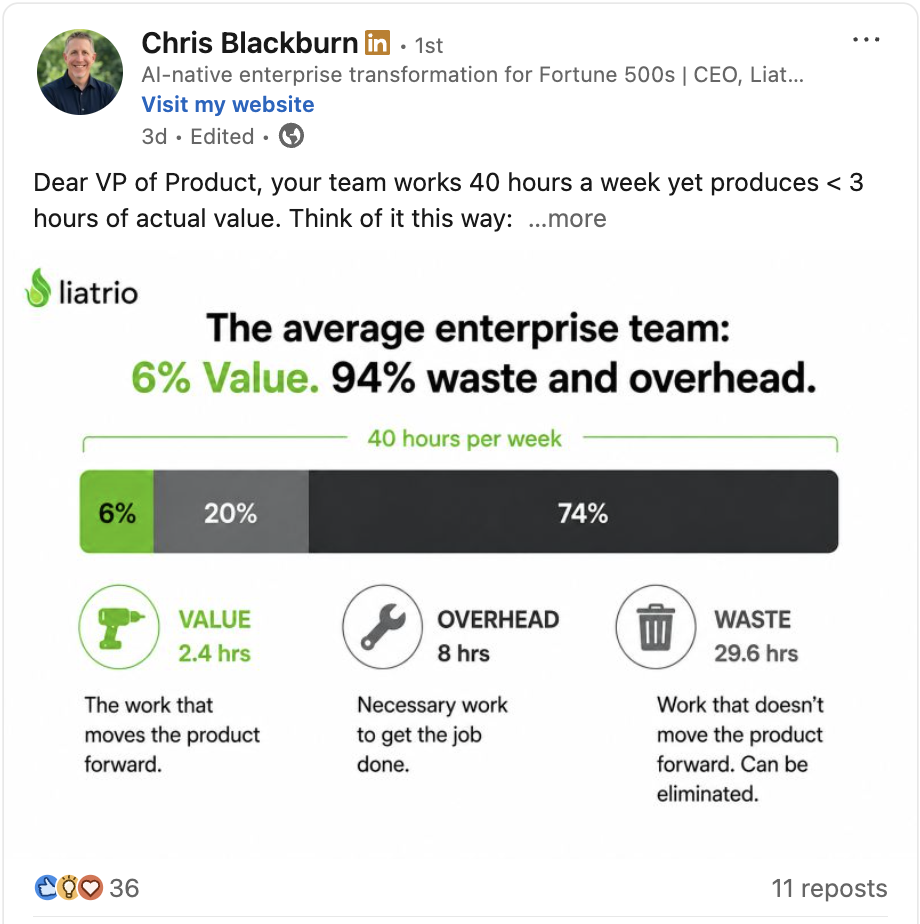
## Two examples
**"If I woke up as a VP of Marketing, I'd go all in on Reddit."** Names the buyer in line one, then gives five specific, semi-controversial moves, numbered. Save-worthy by design.
| Result | Number |
| --- | --- |
| ICP engagements | 204 |
| Website visits | 66 |
| Inbound leads | 12 |
**"If you work in PR, spend 20 minutes on this article."** Names the audience in line one, points to exactly one thing to read, and argues a real position: that LinkedIn is becoming a media platform.
| Result | Number |
| --- | --- |
| Impressions | 120K |
| Reactions | 99 |
| Comments | 43 |
| ICP engagements | 45 |
## Three target audiences
We start with the named accounts you want to reach, then let real engagement compound spend efficiency over time.
- **Approved target account list.** We launch against the named buyers you approve and serve ads directly to them. No broad interest targeting.
- **Lookalikes from real ICP engagement.** As posts collect reactions and comments from real buyers, we build lookalikes off those engagers to find more of the same person, more efficiently.
- **Retargeting previous ICP engagers.** Once there are roughly 300 ICP engagers in the pool, evergreen campaigns resurface your best posts to buyers who already raised their hand.
## How we measure success
Ad reporting pulls everyone toward CTR, clicks, and impressions. We read those as diagnostics, not as the score. The score is whether a qualified buyer inside your target profile engaged with the post: a public reaction, a comment, or a share from someone who matches the profile.
The benchmark we hold ourselves to is **10 to 15 net-new ICP engagements per $500 spent**. We keep it conservative so it stays honest. Paid engagement also triggers the organic algorithm, so the real number is usually higher, but we leave that second wave out of the benchmark rather than take credit for it.
## Turning engagement into pipeline
None of this matters if the engagement sits in Campaign Manager. We built Fluentcy to capture, qualify, and activate it in one place:
- **Capture.** Every engagement on the post, collected as it happens.
- **Enrich.** Title and company details added for each engager.
- **Filter.** Our scoring model rates person fit and company fit.
- **Activate.** ICP profiles get queued into a messaging workflow in one click.
- **Inform.** The data tells us which posts deserve paid spend next.
That last step is the loop that makes the whole thing compound. Paid distribution tells you which posts your buyers actually respond to, which improves the next round of content, which makes the next round of spend more efficient.
If you want this run for your executives, [book a call](/) or read how we [connect LinkedIn activity to pipeline](/blog/linkedin-program-no-pipeline).
Garret Caudle
Founder, Influent
August 14, 2026 · 8 min read
How to write scroll-stopping
post hooks on LinkedIn
The hook is the text before the See more cut. This is the internal system we use to write them: how to signal relevance, the three hook types, and the subtypes under each.
A hook is the opening of a LinkedIn post, specifically the text that shows before the "See more" cut. Its only job is to earn attention. In a crowded feed it decides whether someone stops or keeps scrolling, and no amount of quality further down the post can rescue a hook that failed.
This is the system our writers use internally. It exists so that hooks get chosen on purpose instead of written by feel.
## First job: signal relevance to your ICP
Before anything clever, a hook has to tell the right person that the post is for them. The reliable way to do that is to combine two elements in the opening line.
- **Name the audience directly.** By title (CTO, VP of Comms), by company type (beauty brands, accounting firms), or by role signal (hiring 100+ people a year).
- **Name a topic they care about.** A platform or tool, a goal like growing ACV or reducing churn, a problem like losing clients or absorbing a price increase, or a subject specific to the job such as P&L, screening calls, or ROAS.
With both in place, the remaining game is calibration. Too broad ("leaders and AI") and nobody feels addressed. Too narrow ("CMOs of automotive brands who were just promoted") and the addressable audience disappears. The hook also has to promise something specific: no broad generalizations, no recycled hot takes, no AI tells, no manufactured drama.
## What makes a hook work
Relevance is the floor. These practices are what get your ICP to actually read the hook, understand it, and care enough to expand the post.
- **Dollar figures.** Specific numbers make the cost or the opportunity concrete.
- **First-person language.** Brings a real voice forward, which matters more every quarter as generated content fills the feed.
- **ALL CAPS for emphasis.** Sparingly, on the single most important word or phrase.
- **Conciseness.** Every word earns its place. Shorter hooks demand less from the reader.
- **Plain language.** Words that land instantly. Cognitive lift kills a scroll-stopper.
### One hard rule
**Never open a hook with "Most."** Our internal data shows hooks that start that way consistently underperform. It is a constraint, not a preference.
### Secondary considerations
Lower priority than the above, but worth applying when they fit.
- **Lead with the core idea.** Skip the clever buildup and let the point land first.
- **Use privileged information.** Insight earned through unique access beats a generic take every time.
**A note on tone.** Funny, sarcastic, or ironic can improve a hook, but tone is not a hook type. It never substitutes for relevance, best practices, or an intentional type choice.
## The three hook types
Hook type is about earning attention. Post type is about what you deliver once you have it: awareness, consideration, or conversion. The hook decides whether someone reads. The post type decides what that reading accomplishes.
Three questions settle the classification:
- Trying to make someone feel seen? **Validation.**
- Trying to assert a belief? **POV.**
- Grounding the post in lived exposure? **Experience.**
If you debate the label for more than ten seconds, you are missing the point. The value is in choosing an intent before writing, not in perfect taxonomy.
### Validation hooks
Designed to make the audience feel seen. Classified as VALID - [Subtype].
| Subtype | Example |
| --- | --- |
| Standard | B2B demand gen managers are blamed for pipeline shortfalls they don't control. |
| Dialogue | CEO: "Why aren't leads converting?" Marketing: "We don't own pricing." |
| Confession | I used to think the burnout meant I wasn't cut out to be an entrepreneur. |
| Direct Address | If you've ever been held accountable by someone without authority, this will feel familiar. |
| Headline | MARKETERS ARE BEING SET UP TO FAIL |
| Setup | The part of marketing no one prepares you for: |
### POV hooks
Designed to assert a belief or perspective. Classified as POV - [Subtype].
| Subtype | Example |
| --- | --- |
| Standard | Marketing teams focus on the wrong metrics. |
| Hot Take | The vast majority of CMOs are not worth their salaries. |
| Reversal | More leads isn't the answer. Fewer, better ones are. |
| Tease | There's one reason your content isn't converting. And it's not what you think. |
| Direct Address | If you're still reporting MQLs, you're missing the point. |
| Headline | MARKETING IS BEING MEASURED INCORRECTLY |
| Setup | Here's what everyone gets wrong about attribution: |
| Hypothetical | If I were a first-time founder, here are the 5 things I'd do to hit $1M ARR: |
### Experience hooks
Grounded in lived exposure or privileged information. Classified as EXP - [Subtype].
| Subtype | Example |
| --- | --- |
| Standard | I scaled demand gen at three companies and saw the same issue every time. |
| Reversal | We spent six months doing everything the "right" way. And that's exactly why it failed. |
| Tease | I grew my business to $5M ARR. That's when one big mistake I made unraveled the whole thing. |
| Setup | In 2022, I completely rebuilt our go-to-market. Here are 3 things I learned: |
## Combining hook types
Hooks can be combined, as long as every element is intentional. There should be one primary intent carrying the pull, with supporting lines reinforcing it. Classify a combo by that primary intent, which is usually the first type used.
For example: "CTOs are criminally underpaid" (POV - Hot Take) followed by "I spent 3 years as CTO of a F500 company. Here are the 3 ways I learned to negotiate higher pay" (EXP - Setup). The classification is POV - Hot Take.
## Why this matters more when you run paid
Organic distribution gives you a warm audience that already knows the author. Paid distribution does not. When a post runs as a [Thought Leader Ad](/blog/thought-leader-ads-playbook), the hook is doing the entire job of qualifying a stranger, which is why our paid creative is held to a stricter standard: the audience has to be named in line one, no exceptions.
A hook system also makes content reviewable. Instead of arguing about whether an opening "feels strong," you can ask which type it is, whether that intent was the right one for the post, and whether the audience and topic are both named. That is a conversation a team can actually resolve.
Garret Caudle
Founder, Influent
August 14, 2026 · 9 min read
Top 24 LinkedIn post types
(and when to use them)
Post types are the structural vehicles that carry your point of view. Here are the 12 proven types, the 12 experimental ones, and the situation each is built for.
A post type is the structural vehicle that carries your content. It defines how a post delivers its message, not what the message is about, not the tone, and not the format it is packaged in.
Almost every marketing post has a point of view baked into it. That is what makes content worth reading. But a POV on its own is just an opinion. The post type is the vehicle you choose to deliver that opinion.
Take one POV: most B2B companies target too broad an audience. You can deliver it as an Anecdote (a client narrowed their ICP and doubled pipeline), an In the Wild (a company that did it well), a Coin Post (naming the problem "spray and pray marketing"), a Playbook (steps to narrow your ICP), or a THIS/THAT (old way versus new way, line by line). Same opinion. Five completely different posts.
## How to tell a post type from a technique
Ask one question: does the post collapse if you remove the structure?
- If yes, it is a post type. A Letter stops being a Letter without the direct address. A THIS/THAT stops working if you strip the paired contrasts. A Meme is nothing without the cultural reference. The structure is load-bearing.
- If the post still works without it, it is a technique or a formatting choice. Reversals, co-creation, timelines, and lists can be applied across post types without changing the underlying structure.
Post types apply to marketing content only. Personal branding posts (founder stories, vulnerability moments) and company branding posts (event promos, team photos, funding news) are defined by what you are sharing, not how. There is no repeatable structure worth naming.
## The 12 proven post types
These are tried and true. They should make up the majority of your post type decisions. If a post does not seem to map onto a type, it is very likely a standard POV post with an interesting hook or visual, not a new type.
### 1. POV
The default. The author shares a take and backs it up with reasoning. **Use it when** the idea is strong enough to stand on its own and does not need a story, proof, or a gimmick to carry it.
**Example:** Your brand doesn't need more content. It needs better content. Most B2B companies publish 3-5x per week and none of it resonates with their ICP. Volume isn't a strategy. Relevance is.
### 2. Anecdote
A first-hand story is the main vehicle for a lesson, POV, or question. **Use it when** the insight lands harder as a scene than as a claim, and when you want the reader to feel the moment before they hear the point.
**Example:** Last year I sat across from a CMO whose team produced 40 pieces of content a month. I asked how many drove pipeline. She went quiet. The problem was never output. It was alignment.
### 3. Playbook
Executable, step-by-step instructions the audience can go do. **Use it when** you want to be saved and shared, and when your credibility comes from showing the mechanics rather than describing the outcome.
### 4. Case study
Your own customer's success, used to signal effectiveness or demonstrate a recommended approach. **Use it when** the post needs proof, especially further down the funnel where the reader is evaluating whether you can actually do it.
**Example:** Our client was spending $180K a year on parts they already had in stock at other plants. We cleaned the master data, found 4,200 duplicates, and connected inventory across 6 sites. Result: $320K saved in year one.
### 5. In the Wild
A real-world example, made by someone else, that proves your POV. **Use it when** you want third-party evidence without pitching, and when praising a good example is more persuasive than arguing for it.
### 6. Mental Model
A structured way of thinking about something. Not tactical steps, but a reusable lens. **Use it when** the audience keeps making the same mistake because they lack a framework to sort the decision.
### 7. Timely News
Your POV inserted into a headline that is currently dominating attention. **Use it when** you can add the angle nobody else is taking, and only while the news is still hot.
### 8. Debrief
A report back from a firsthand conversation with an external person. **Use it when** privileged access is the value: you heard something the audience cannot hear anywhere else.
**Example:** Had coffee with a Head of Procurement at a Fortune 500 manufacturer. He said: "We don't have a spare parts problem. We have a trust problem." One sentence explains billions in wasted spend.
### 9. Conversation
A scripted dialogue between roles that illustrates a point. **Use it when** the tension lives between two functions, and hearing both sides is funnier and clearer than narrating it.
### 10. Curation
A collected list of tools, resources, articles, or people worth knowing. **Use it when** you want to build goodwill and reach by pointing attention at others rather than yourself.
### 11. Lead Magnet
The entire post exists to deliver or tease a downloadable resource. **Use it when** you have something genuinely valuable to give away and want to convert attention into a list or a conversation.
### 12. Meme
A borrowed cultural reference redirected at your audience. Technically experimental, functionally common. **Use it when** the shared frustration is so recognizable that a caption would ruin it.
## The 12 experimental post types
These are less proven. Test them, watch the results, and handle them with care.
### 13. Coin Post
You name a phenomenon that is relatable, validating, or novel. **Use it when** the audience already feels the thing but has no words for it. Naming it makes you the owner of the idea.
**Example:** I keep seeing the same thing across B2B marketing teams. I'm calling it "content debt." Every low-effort post borrows against your future credibility. Eventually the bill comes due.
### 14. THIS/THAT
Paired contrasts, line by line: old versus new, before versus after, wrong versus right. **Use it when** you are arguing that the standard approach is outdated and the delta is easy to see.
### 15. Letter
Written directly TO a specific person or persona, not about a topic. **Use it when** one archetype is causing the problem and addressing them by name gives the post its charge.
### 16. Scorecard
You evaluate or grade real things against criteria, playing judge publicly. **Use it when** you have done the work at volume and the aggregate finding is the story.
### 17. Pop Quiz
You test the audience's knowledge with a question they have to answer. **Use it when** the answer is counterintuitive and being wrong is the lesson.
### 18. Open Mic
An open-ended question to spark discussion, with the value living in the comments. **Use it when** you genuinely want the answers, not when you are fishing for engagement.
### 19. AMA
You invite the audience to ask you anything, flipping the dynamic from push to pull. **Use it when** you have enough audience and enough earned authority for questions to actually arrive.
### 20. Remix
You build on, challenge, or extend someone else's content publicly. **Use it when** you agree with a popular take but can add the layer it is missing.
### 21. Demo
You show something working in real time instead of explaining it. **Use it when** the claim strains belief and watching it removes the doubt.
### 22. Assignment
You give the audience a specific task to go do and report back on. **Use it when** the realization only lands if they check their own numbers.
**Example:** Go look at your last 10 posts. For each one ask: would my ICP screenshot this and send it to a colleague? If the answer is no for more than 7, your content is built for the algorithm, not your buyer.
### 23. Reversal-led types
Not a type on its own, but worth calling out: flipping a Playbook into "what not to do" or an Experience post into "why doing it right failed" changes how the same material reads. Layer it onto any type above.
### 24. Co-created posts
Same caveat: bringing another person in via video, quote, or screenshot is a technique, not a structure. It works on top of Case Study, Debrief, Remix, and In the Wild, and it borrows the other person's credibility and audience.
## How to choose
When building a content calendar, start with the POV you want to communicate: the insight, the argument, the lesson. Then choose the type that will deliver it most effectively.
Some POVs are best served by a story (Anecdote). Some need proof (Case Study, In the Wild). Some are best delivered through structure (Mental Model, THIS/THAT). Some are about sparking participation (Open Mic, Assignment, Pop Quiz).
Post type is a creative decision, not a formula. The goal is variety, intentionality, and making sure each post earns attention through a vehicle that fits the message. The type decides what the post accomplishes once someone reads it. Whether they read it at all is the job of the [hook](/blog/linkedin-post-hooks), and whether the topic is worth writing about at all is a question of [content-market fit](/blog/content-market-fit).
Garret Caudle
Founder, Influent
August 14, 2026 · 7 min read
Content-market fit: the framework
behind every post worth publishing
Content-market fit is the overlap between what an executive can speak to with depth, what the ICP actually cares about, and what points back to a commercial problem. Here is how we validate it.
Content-market fit is the overlap between three things: what an executive can discuss with real depth, what their ICP actually cares about, and what eventually points back to a commercial problem the company solves.
If any one of the three is missing, the content either gets ignored, gets vanity engagement from the wrong people, or gets attention that never turns into pipeline.
The core principle is easy to miss: content-market fit is not about what the exec knows. It is about where the exec's knowledge overlaps with what the ICP already cares about. The expertise is real. It is just often sitting in the wrong arena.
## The three ingredients
- **Exec POV density.** Specific stories, mistakes, tradeoffs, unpopular opinions, and patterns from an actual career. Not opinions collected from other people's posts.
- **ICP emotional relevance.** Something the buyer thinks about unprompted during a normal week. Does it touch their money, power, status, stress, or time?
- **Commercial relevance.** A connective thread back to the problem the company solves. It does not need to be a pitch. It needs to exist.
## The most common mistake
Most executives anchor their content in their service or their industry instead of in the buyer's real concerns.
- Accounting CEOs talk about accounting.
- Restoration CEOs talk about water damage.
- IT founders talk about servers and security stacks.
In the ICP's head, those topics are background noise. Vendor stuff. Not core to how they think about their own job. The expertise is genuine, but it lives in an arena the buyer never walks into.
This is the failure a good program is hired to fix. If a company could reliably identify its own content territory, it would not need help publishing in it.
## How to validate a content pillar
Before approving any pillar or topic for an executive, run three checks.
### Check 1: exec POV density
Can this executive tell specific stories, name real mistakes, describe tradeoffs they lived through, and hold an unpopular opinion on this topic? If they can only speak in generalities, the content will read thin no matter how well it is written.
### Check 2: ICP emotional relevance
Does the ICP think about this unprompted during a normal week? Does it affect their money, power, status, stress, or time? This is the check that kills the most topics. An exec can be a world-class expert on something their buyer simply does not care about.
### Check 3: commercial relevance
Can this topic, even loosely, be linked back to the problem the company solves? It does not need to be a direct pitch. It needs a connective thread.
**The hard rule.** If Check 2 is a no, the topic is out of bounds, even if the executive is the most qualified person alive on the subject. ICP emotional relevance is the gatekeeper. Everything else is negotiable.
## The decision matrix
| Exec POV | ICP relevance | Commercial | Diagnosis | Action |
| --- | --- | --- | --- | --- |
| No | No | Yes | Vendor content | Kill it. No depth, no relevance. |
| Yes | No | Yes | Thin thought leadership | Feels generic. Will not resonate. |
| Yes | Yes | No | Personal brand only | Good for reach. Not pipeline. |
| Yes | Yes | Yes | Content-market fit | This is what we publish. |
Only the last row clears the bar. Everything else gets reworked or discarded.
## Three executives, three arenas
The pattern below is always the same: move out of the exec's service language and into the ICP's emotional language. These executives are invented, but the topics are the ones we see every week.
:::exec-cards
Notice what did not change in any of those examples. The expertise is identical on both sides of each card. The accountant still knows accounting, the restoration CEO still knows drying equipment, the founder still knows zero trust. What changed is the arena the knowledge is spoken into.
## Turning fit into posts
Once a pillar clears all three checks, the topic is only half the work. The opening line still has to name the audience and name something they care about, which is the job of the [hook](/blog/linkedin-post-hooks). Content-market fit decides what to write about. The hook decides whether the right person reads it.
Service-linked posts are the easiest way to keep commercial relevance alive without pitching. Two examples from the accounting arena:
- "We just helped a client clean up 18 months of bad bookkeeping so they could close a round. Here is what was actually broken."
- "A founder thought they had 12 months of runway. The real number was 6. Here is how we surfaced it."
Both are stories about the buyer's stakes, told from inside the work. That is what content-market fit sounds like in practice.
## Where programs lose it
Content-market fit is not a one-time decision. Programs drift back toward vendor language over time, usually because service topics are easier to produce and get polite engagement from peers and competitors. The [McDonald's example](/blog/mcdonalds-ceo-backlash-thought-leadership-warning) shows the other failure mode: content with reach and no fit between the executive's authority and what the audience was ready to hear from them.
Re-run the three checks quarterly, and re-run them per executive when [multiple leaders post](/blog/multi-executive-linkedin-strategy). Different executives sit in different arenas even inside the same company, and a pillar that fits the CEO can be completely out of bounds for the CTO.
Garret Caudle
Founder, Influent
August 14, 2026 · 6 min read
LinkedIn rebuilt the feed with LLMs:
7 changes and what they mean for you
LinkedIn's engineering team published how it rebuilt the feed around large language models. Here are the seven changes that matter, and what each one means for how you write and distribute.
If your reach on LinkedIn has felt inconsistent lately, there is now a technical explanation for it. LinkedIn's engineering team published a detailed write-up of how it rebuilt the feed around large language models and learned embeddings rather than the older stack of hand-tuned features and keyword matching.
The engineering detail is interesting on its own, but the part that matters to anyone running a content program is what the new architecture rewards. Below are the seven changes with the largest practical impact, and the honest read on what each one changes about how you should write and distribute.
## 1. The feed understands what your content is actually about
Ranking no longer leans on keywords and surface features. Posts are represented as semantic embeddings, so the system models the meaning of a post rather than the words in it.
**What it means.** Keyword stuffing, buzzword padding, and "writing for the algorithm" stopped being a lever. Specificity is now the lever. A post that clearly makes one argument about one problem is easier for the system to place than a post that gestures at five themes so it can catch more terms.
## 2. It connects adjacent topics, even in different language
Because topics live in an embedding space, the feed can relate your post to nearby subject matter that uses none of the same vocabulary. A post about onboarding friction can surface to people who engage with churn and retention content.
**What it means.** You get credit for consistency of subject, not repetition of phrasing. Publishing repeatedly inside a coherent territory compounds, which is exactly the argument behind [content market fit](/blog/content-market-fit). It also means you no longer have to force your category's jargon into every post to be found by the right readers.
## 3. Out-of-network distribution got much better
Relevance now beats connection distance more often than it used to. Genuinely relevant content reaches people well outside your first and second degree.
**What it means.** This is the biggest upside in the whole rebuild. The ceiling on a strong post is higher than it was, and follower count matters slightly less than it did. It does not make organic reach reliable enough to plan against, which is why paid amplification is still what puts content in front of a named account list. See [the Thought Leader Ads playbook](/blog/thought-leader-ads-playbook).
## 4. Engagement is read as patterns over time
Individual likes and comments are weighed inside a longer behavioral history rather than as isolated events. The system is modeling a member's sustained interests, not their last tap.
**What it means.** A single spike is worth less, and a steady record of relevant engagement from the right audience is worth more. Programs that publish in bursts and then go quiet get penalized by this quietly, without any visible signal.
## 5. Deliberate engagement outweighs passive scrolling
The model learns most from what people actively choose to engage with, and treats passive impressions as much weaker evidence.
**What it means.** Impressions were always a vanity metric. Now they are also a weak ranking input. Optimize for the response you want from a small number of the right people rather than for volume of eyeballs, which is also how you should be [measuring the program](/blog/measure-category-ownership).
## 6. The feed updates within minutes
Interest signals propagate almost immediately. What someone engages with this morning shapes what they are shown shortly after.
**What it means.** The first stretch after publishing carries more weight, so having a small set of relevant people who reliably see and respond to a post matters more than a scheduled comment pod. It also means recovery is faster: a weak week does not sit on your account the way it used to.
## 7. Engagement bait, automation, and generic content are actively suppressed
The rebuild came with stronger classification of low-quality patterns: bait formats, automated engagement, and templated content that could have been written by anyone.
**What it means.** The old growth-hack toolkit is now a liability. Comment pods and engagement rings produce activity that does not match a real interest pattern, which is precisely what the new model is good at spotting.
## What this actually changes
The overall effect is that the gap between genuine expertise and content produced for engagement is widening. A system that models meaning and sustained interest is very hard to trick and comparatively easy to satisfy: publish specific, opinionated content about a coherent subject, consistently, for a clearly defined audience.
That is the same conclusion we reached from client data before this write-up existed, and it does not change the underlying mechanics of the platform. LinkedIn is still a network-based distribution system, and the ceiling on organic reach is still set by who follows and engages with you. The rebuild makes the ranking smarter inside that system, not a replacement for it. That model is explained in [everything you know about the LinkedIn algorithm is wrong](/blog/everything-you-know-about-linkedin-is-wrong).
For the running list of other platform changes and whether they matter, see [LinkedIn algorithm and platform updates in 2026](/blog/linkedin-platform-updates).
Garret Caudle
Founder, Influent