%20(3000%20x%20800%20px).avif)
"This new Claude workflow is about to change LinkedIn forever! 🤯"
Every few months, a new AI tool arrives, and a certain kind of person announces that everything is about to change on LinkedIn.
Right now, that tool is Claude CoWork... before that, it was Nano Banana 2... before that, it was ChatGPT Deep Research... and so on.
With the way that people talk about these AI tools, you'd think that we'd all be LinkedIn celebrities by now... getting millions of impressions... becoming the darlings of our respective industries... signing dozens of clients...
Most importantly, we'd all be, as the kids like to say, "stacking these bands"
My guess is that you are not reading this article while swimming in pool full of cash.
So what gives?
That's basically what we'll be covering over the next ten minutes... why Claude (or any other AI tool) is unfortunately not going to change much about how much success you're getting out of LinkedIn... and in fact might actually make things ever more difficult.
If you read this article and take it seriously, I promise that you will finish it with a clear understanding of why AI has not solved your LinkedIn problem, where the actual leverage points are in 2026, and what it would take to build a presence on this platform that compounds into something real.
The first thing you need to understand and REALLY take to heart is perhaps the toughest pill to swallow inside this medicine cabinet of an article.
The total amount of attention available on LinkedIn at any given time is roughly fixed.
Meaning... there are a finite number of professionals scrolling, a finite number of minutes they spend doing it, and a finite number of posts that can register in any meaningful way.
This is not unique to LinkedIn. It's fundamental to virtually every platform that reaches ubiquity inside a larger attention economy.
A new content tool DOES NOT expand the overall supply of attention.
(It does, however, expand the supply of content competing for it, which is more of a headwind than a tailwind... but we'll get to that later).
If 9% of people who post on LinkedIn were generating real ROI before AI... 9% of people who post on LinkedIn will generate real ROI after AI.
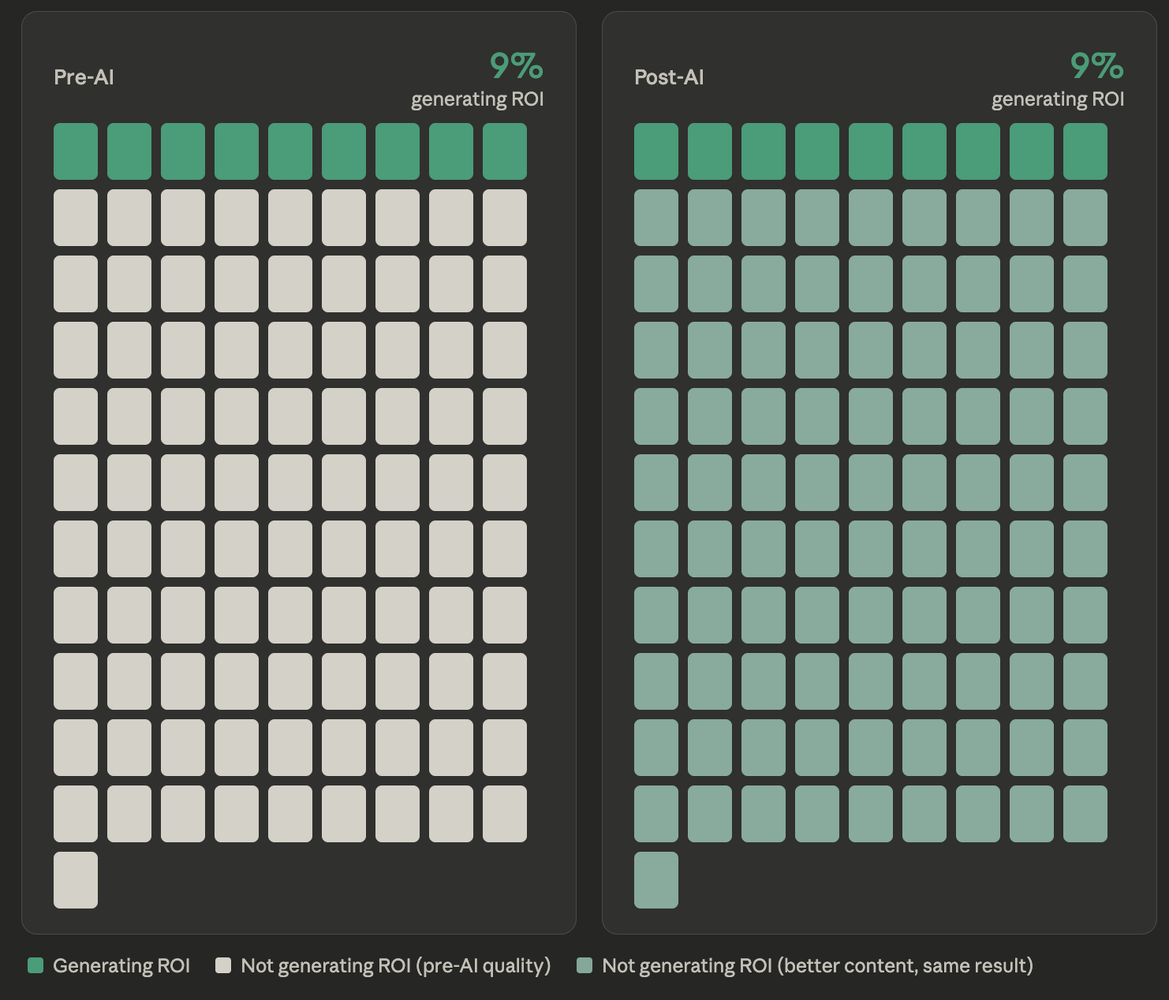
Yes, the floor for baseline content quality rises dramatically. But the percentage of people above that floor does not.
What's that thing people say? If everyone has something than no one has it?
Yeah, well that applies to cool AI tools too.
My business partner had a great analogy for this when I told him that I was going to write this article...
When factories first got access to electricity, a certain kind of factory owner probably got very excited about electricity. It was going to fundamentally change his or her business overnight!
And he was right. The problem was, of course, that every other factory also got access to electricity at the same time. Thus electricity became the floor, not the differentiator, and the question of how to beat his or her competitors remained exactly as difficult as it had been before, if not more so because more people could afford to enter the playing field.
AI is electricity for content.
Now, before I get yelled out by the AI bros of the world, I should acknowledge that there is some short term leverage to be had if you can stay on that razor thing edge of AI innovation. That will always be there. But, what most of those bros are not admitting, is that you will end up spending just as much energy and time chasing that edge as you are reporting to save by using said tools.
In other words, you are not a durable competitive position.
Before AI, the primary leverage point on LinkedIn was the content asset itself.
If you were on LinkedIn in 2018, you remember the days when just posting a really long article earned attention...
"You spent time writing ALL OF THAT? Damn... well must be worth my time to read!"
As content creation tools got better, leverage moved to video production, carousel creation, sharper hooks, etc.
Honing your content and exploring how AI allows you to increase the quality of your insight and storytelling will continue to be an INCREDIBLY important useful endeavor.
But it is no longer where the largest gap exists between those who generate meaningful business outcomes from LinkedIn and those who do not.
The leverage has shifted. In my humble opinion, it now mostly sits in five places.
Most teams running LinkedIn are optimizing for impressions because impressions are visible and easy to report on. But they are a poor proxy for whether LinkedIn is actually moving your business forward in any meaningful sense.
The teams generating real pipeline from LinkedIn, on the other han d, are measuring how many ideal customers are engaging with their content, which specific posts are attracting that engagement, and how those signals accumulate over time into something a sales team can act on.
When a prospect has engaged with 40 posts over three months and your AE finally gets them on a call, that is a structurally different conversation than a cold outreach, and most teams have no visibility into the fact that the engagement happened at all.
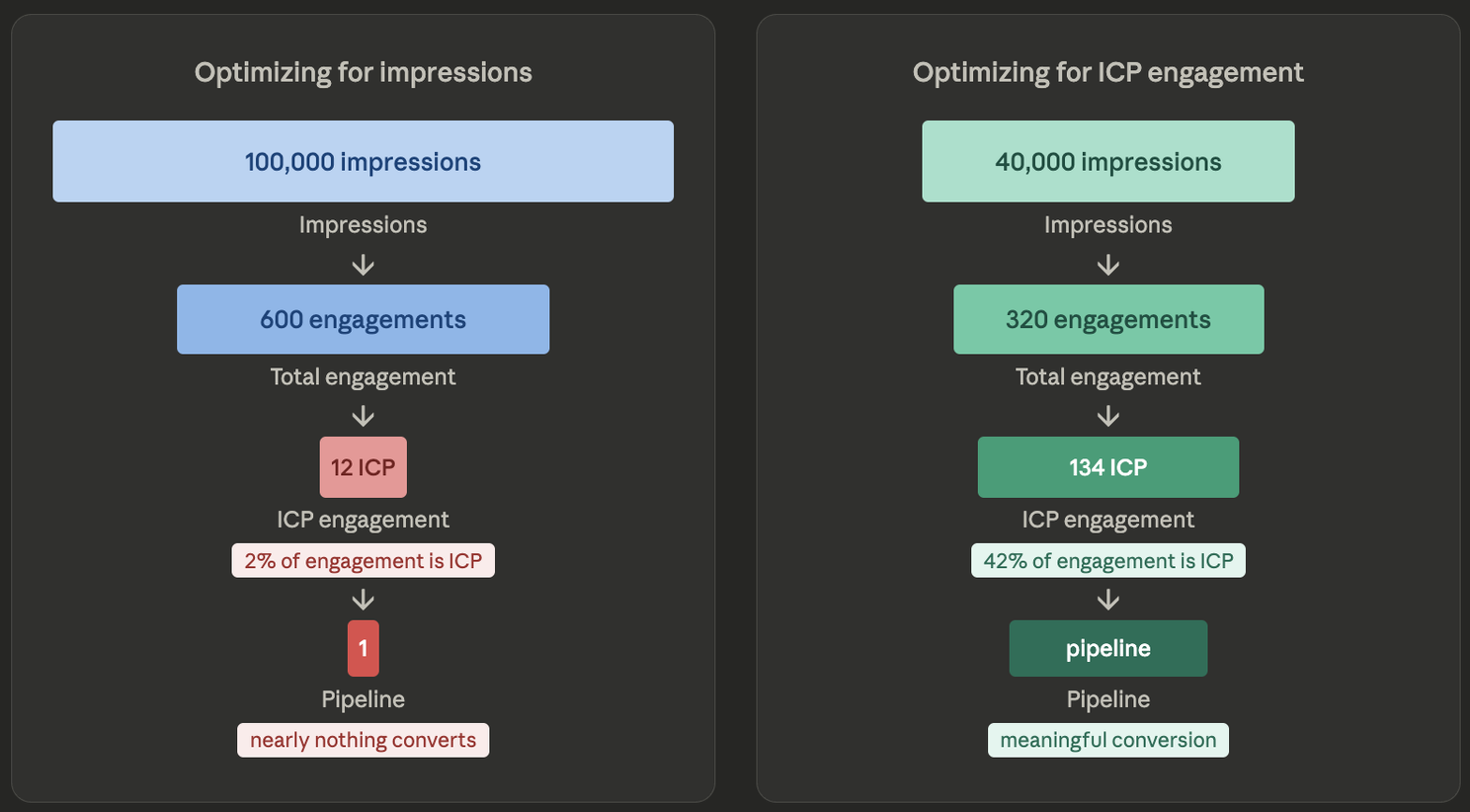
A program where impressions drop over four months while ICP engagement rises looks like a failure to a team optimizing for the wrong metric and looks like a success to a team that has built the measurement infrastructure to tell the difference.
(We have a really cool case study that I will send you if you're interested that shows how ICP engagement and pipeline are negatively correlated with impressions... pretty sick stuff.)
Getting those engagement signals into a CRM so they are visible to sales is what converts a content program into a pipeline program.
LinkedIn's algorithm distributes content according to engagement signals that do not always correlate with reaching your actual buyers. A post can perform well algorithmically and still generate practically zero engagement from anyone in your ICP (let alone the in-market segment of that ICP).
Thought Leader Ads are by far the most effective tool available to override that dynamic.
When you identify organic content that is already generating ICP engagement and amplify it directly to a defined audience (down to the individual company!), you are routing distribution deliberately rather than waiting for the algorithm to find your buyers.
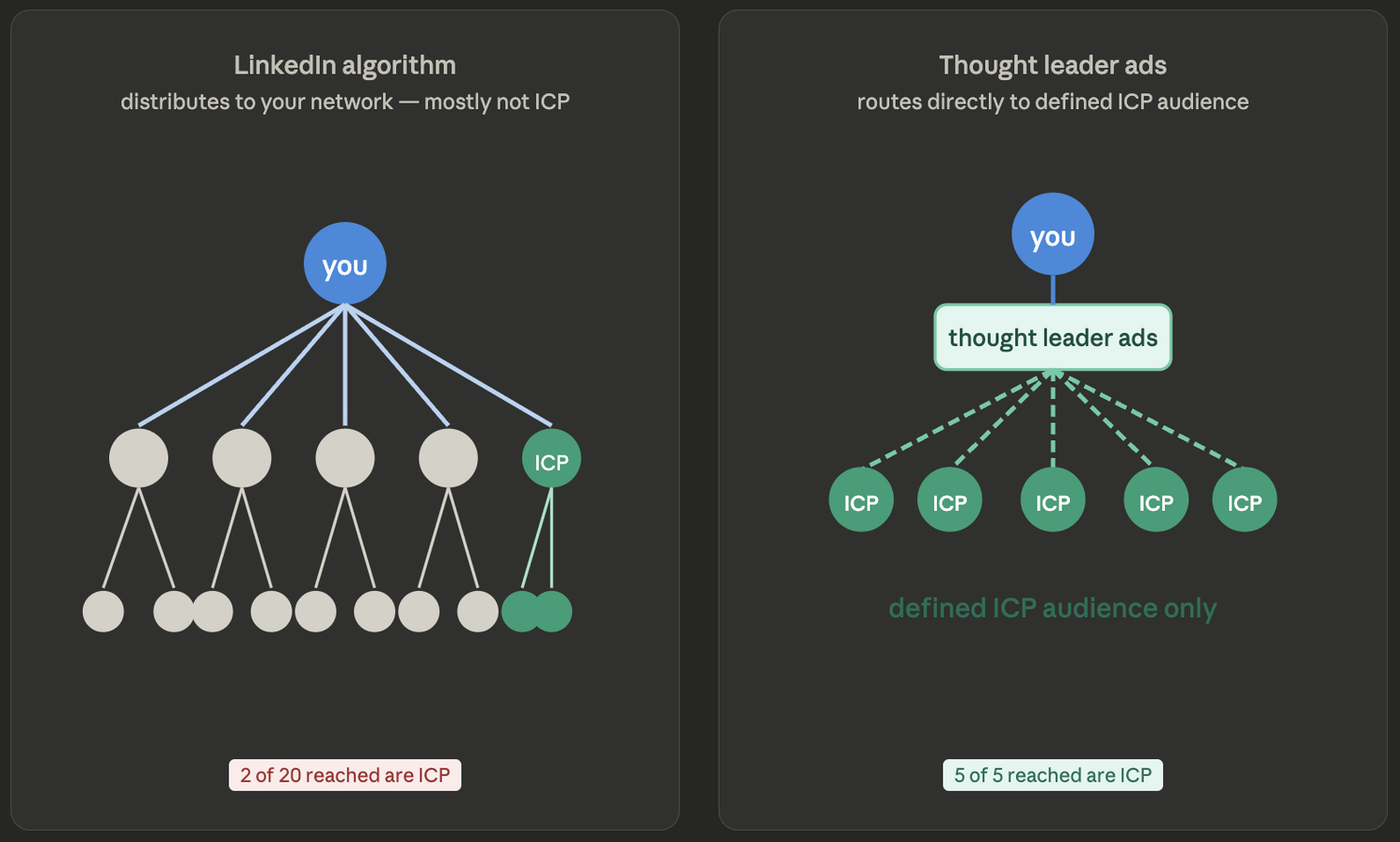
The distinction between running ads on weak content and amplifying a post that has already demonstrated ICP resonance is the difference between paying to show something to the wrong people and multiplying the reach of something that is already working.
The teams who have figured this (many being clients of ours) out are running a single coordinated system where organic content surfaces signal and paid amplification scales the signal that proves itself, rather than running ads and content as separate programs with separate objectives.
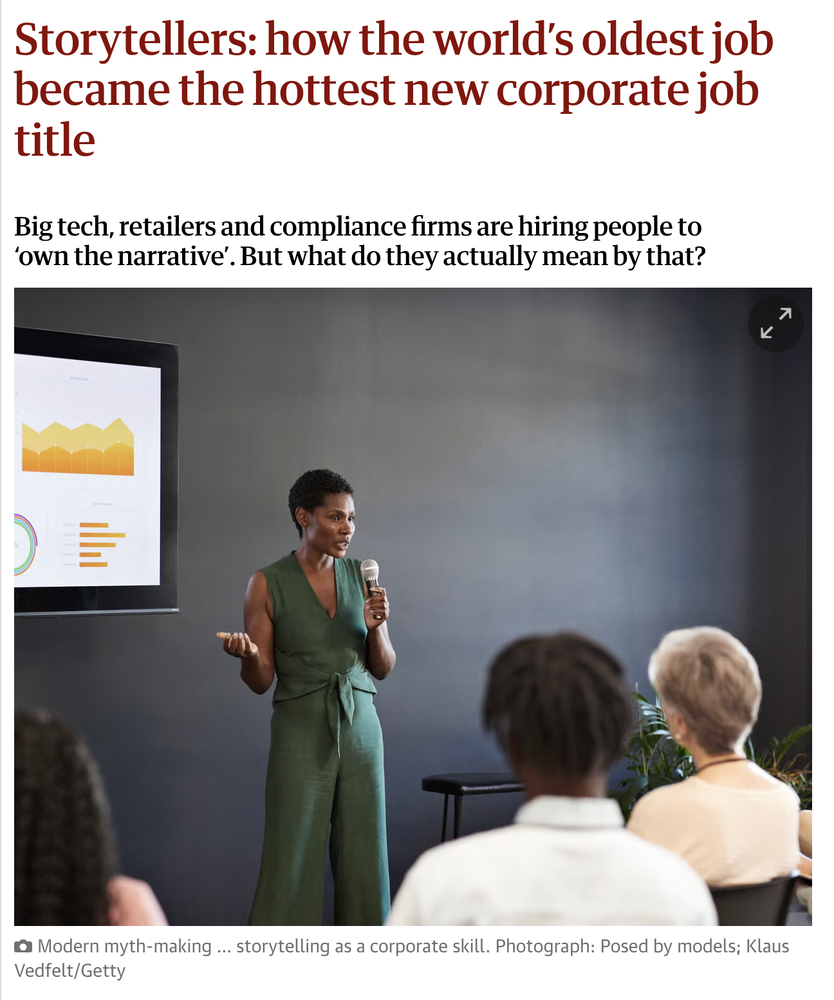
Storytelling has become the content buzzword of 2026 for a reason. It points at the one category of content production that AI handles poorly.
AI can retrieve and summarize any body of knowledge that already exists in public. What it cannot do (very well at least) is show you how that knowledge arrived in a specific person's life, how it changed their actual decisions, how it looks in practice rather than in abstraction.
That kind of demonstration creates a form of recognition in the reader that informational content does not.
It's widely agreed upon that good content does any combination of three things: it educates, it validates, and it entertains.
The executives who are willing to be imperfect and idiosyncratic on a platform that rewards polish have access to a quality of audience attention that AI-generated content cannot produce regardless of how well it is prompted.
The volume of content on LinkedIn is increasing faster than the attention available to consume it, and the practical consequence of that dynamic is that the bar for earning a genuine stop-and-read from your ICP has risen substantially.
What earns that stop-and-read (and dwell time!) right now is raw commentary on something that happened this week, or a post that names and reframes an experience your customers are living in real time that nobody else has yet articulated.
Getting there first, with a framing that brings people along rather than putting them on the defensive, requires the kind of taste and contextual awareness that cannot be automated. It requires being genuinely inside the conversations your buyers are having as a practitioner, not as someone monitoring those conversations from a content strategy perspective.
Not all followers are created equal, and the gap between a large undifferentiated following and a smaller community of people who are genuinely invested in your point of view is, in my very humble opinion. one of the most underappreciated variables in B2B LinkedIn strategy.
Point blank. Period.
The B2C influencer world arrived at this understanding WAY before B2B did.
Even macro influencers with very large followings consistently talk about the primacy of their core communities, the people with whom they have built enough of a parasocial relationship that those people function as a center of gravity for everything else, amplifying content, recruiting new followers, and maintaining presence through periods of lower activity.
In B2B, that core community is the buyer who has been reading your content for two years before they have budget, the person who forwards your posts to their team, the former colleague who thinks of you when a relevant conversation comes up at their new company.
Those relationships are built through consistent presence, genuine engagement in comments and DMs, and the construction of ongoing touchpoints like events, newsletters, and groups that give people a structural reason to stay close over time.
Some of these leverage points are accessible to any individual willing to put in the work. Others require infrastructure that is difficult to build as a single account. When evaluating outside help, the questions worth asking go beyond content quality. They are
Spoiler: we do these things at Influent!
B2B execs, entrepreneurs, and really anyone who is serious about LinkedIn in 2026 should absolutely be using AI for content production... operating without these tools is simply leaving efficiency on the table. What remains unsolved, and what will continue to separate the 9% from everyone else, is everything above it.
Someone has to decide who the content needs to reach. Someone has to know when a prospect has been warm for three months before the AE ever reaches out. Someone has to recognize when a conversation is happening in your market that is worth weighing in on, and have the taste to do it well. Someone has to turn a comment thread into a relationship that is still alive two years from now.
Those are human problems. AI just made it easier to confuse the solved version of the content problem for the whole problem.
The factory that gets excited about electricity and stops there is the factory that loses to the one that figured out what to build and how to get it to their customers.

Copyright 2025 © Influent Social LLC & Vanta Five, Inc.